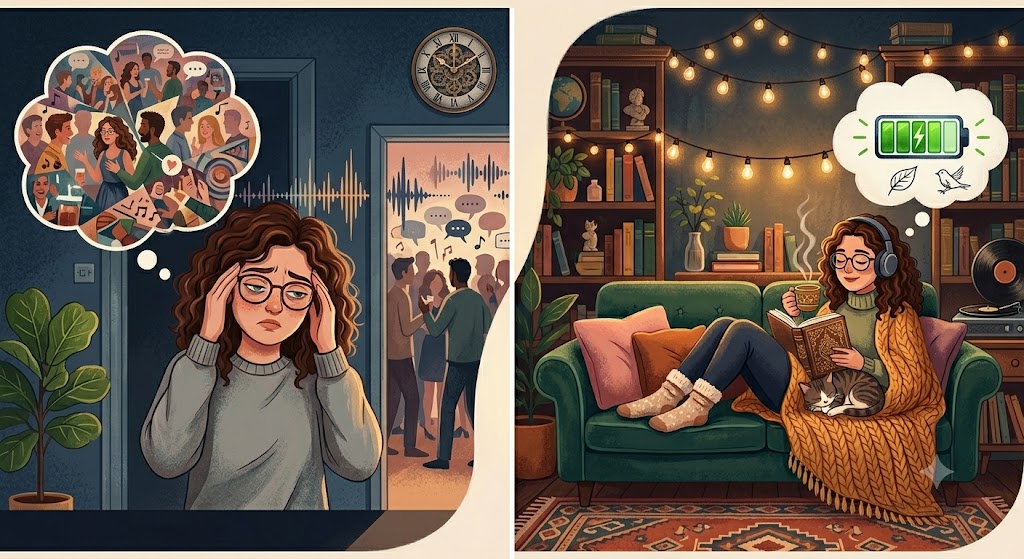
What happens to introverts after social events is not laziness or antisocial behaviour — it is a neurological process that leaves you genuinely depleted. Even a pleasant evening with people you like can leave you flat, foggy, or quietly overwhelmed. Understanding why this happens makes it easier to stop fighting your own wiring and start working with it instead.
Why Introverts After Social Events Feel So Drained
The most widely accepted neurological explanation involves how introverts and extroverts process dopamine. Research suggests introverts tend to have a more sensitive dopamine response, meaning social stimulation that energises an extrovert can tip an introvert into overload relatively quickly. The introvert nervous system is not broken — it is simply calibrated differently, more reactive to external input.
Carl Jung, who first popularised the introvert-extrovert distinction, described it as a matter of where you direct your psychic energy. For introverts, that energy flows inward. Social interaction requires redirecting it outward, which works fine for a while — but it runs a cost. The more complex or emotionally demanding the event, the higher that cost tends to be.
There is also the matter of cognitive load. Introverts often process conversations more deeply than they appear to from the outside. They track subtext, tone, and social dynamics continuously. That kind of sustained attention burns through mental resources in a way that shows up clearly once the event ends and the adrenaline fades.
What Introvert Social Exhaustion Actually Looks Like
For introverts after social events, it often shows up as a kind of heaviness that descends within an hour of getting home. Your body feels heavier than it should. Thinking clearly takes effort. Small decisions — what to eat, what to watch, whether to respond to a text — feel disproportionately tiring. This is introvert social exhaustion presenting itself, and it is real, not dramatic.
You might notice a strong pull toward silence and stillness. Noise that would normally be fine — a TV in the background, a phone notification — suddenly feels abrasive. Some introverts describe a kind of emotional flatness after social events, not sadness exactly, more like the screen has dimmed. Others experience mild irritability that has nothing to do with the people they were just with.
There is also what people sometimes call the social hangover: replaying conversations in your head, second-guessing things you said, noticing awkward moments that probably went unnoticed by everyone else. This is not unique to introverts, but it is especially common. The mind keeps processing the event long after the body has left the room.
What Actually Helps You Recharge
The most effective introvert recharge strategy is one most people resist: do nothing immediately after you get home. Resist the urge to scroll, to decompress with noise, or to immediately engage with anyone who lives with you. Give yourself fifteen to thirty minutes of actual quiet. Not productive quiet — just quiet. It resets the nervous system faster than most things.
Physical stillness helps too. Lying down, taking a slow walk alone, or sitting somewhere without screens gives your brain permission to stop performing. The shift from outward-focused awareness to inward rest is what you are actually after. Screens often delay that shift rather than assist it.
If you share a home with others, name what you need clearly and without apology. Not “sorry, I just need a bit of space” — just “I need an hour to decompress.” The apology signals that your need is unreasonable. It is not.
Building in buffer time before and after social events makes a measurable difference. Scheduling something demanding the morning after a heavy social evening consistently makes the exhaustion worse. When you have space on either side, the recovery is faster and the event itself feels less costly.
Finally, notice which kinds of social events drain you most and which drain you least. One-on-one conversation with someone you trust is often far less costly than a large group. Unstructured mingling tends to be harder than events with a clear purpose or activity. Knowing your personal pattern helps you plan more honestly.
When to Get Support
Introvert social exhaustion is normal. But if you are regularly unable to recover within a day or two, if you are dreading social events weeks in advance, or if the aftermath consistently includes anxiety, low mood, or physical symptoms, it is worth talking to someone. A therapist who understands introversion — not one who treats it as a problem to fix — can help you distinguish between personality and something that needs attention.
A Few Questions Worth Answering
Why is an introvert after social events so flat?
An introvert after social events is depleted rather than unhappy. The flatness is the cost of sustained processing, and it arrives regardless of how good the evening was.
Why am i drained after socialising when I enjoyed it?
Why am i drained after socialising has nothing to do with enjoyment. Pleasure and energy cost are separate accounts.
How long does post social exhaustion introvert recovery take?
Post social exhaustion introvert recovery usually runs from a few hours to two days, scaling with the number of separate interactions rather than total time.
Is being an introvert after social events a sign of poor social skills?
An introvert after social events can be excellent company and still need a day afterwards. Skill and cost are unrelated.
- Why do I feel depressed after social events even when I had a good time?
-
This is one of the more confusing parts of introvert social exhaustion. Enjoying yourself and feeling drained afterward are not contradictory. Your nervous system was working hard the whole time. The drop afterward reflects depletion, not dissatisfaction. It tends to ease with rest rather than reassurance.
- How long does it take introverts to recharge after social events?
-
It depends on the length and intensity of the event, your baseline stress levels, and how much buffer time you have. A short social gathering might need an evening. A multi-day event — a wedding, a work conference — can take two or three days to fully process. Pushing through without rest extends the recovery time.
- Is social hangover the same thing as social anxiety?
-
Not exactly. A social hangover is primarily about energy depletion and post-event mental replay. Social anxiety tends to involve dread beforehand, fear of judgement, and often physical symptoms like a racing heart. They can overlap, but introvert social exhaustion can happen without any anxiety at all.
- Can introverts get better at handling social events over time?
-
You can get more skilled at managing them — knowing your limits, building in recovery time, choosing events selectively. But the underlying need to recharge after social interaction does not disappear with practice. Introvert recharge is not a habit to break. It is a need to accommodate.
The crash after a social event is not a character flaw or a sign you did something wrong. It is your nervous system completing a process that started the moment you walked in the door. Rest is not indulgence here — it is the actual work of recovery.