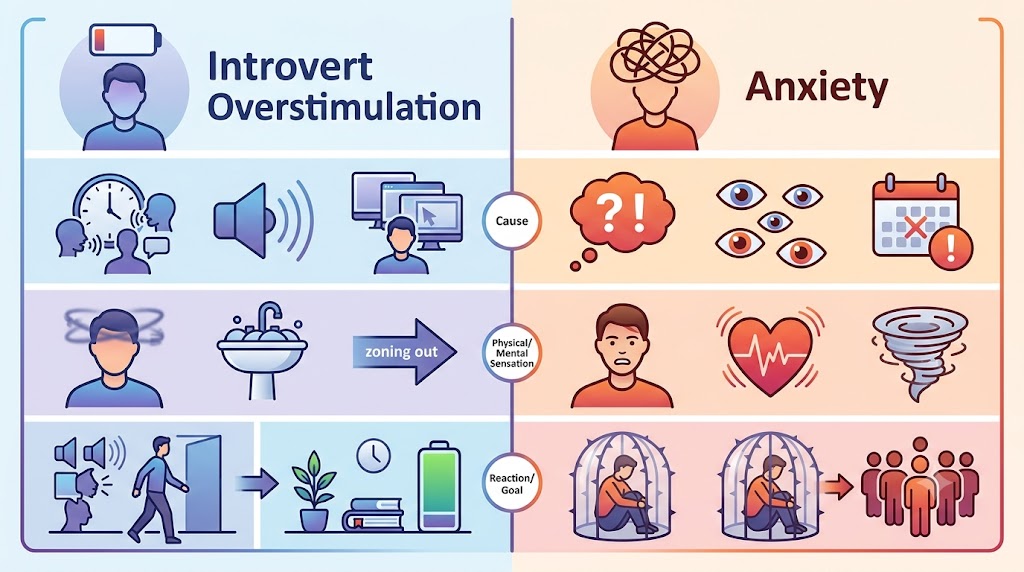
Introvert overstimulation and anxiety can feel almost identical in the moment — racing thoughts, a need to escape, the body sending urgent signals to stop. But they are not the same thing, and treating one as though it were the other tends to make both worse. If you have spent time wondering whether you are wired differently or struggling with something clinical, this is worth thinking through carefully.
What Introvert Overstimulation Actually Is
The difference between introverts and extroverts is not about shyness or social preference alone. It is rooted in how the brain responds to stimulation. Research into neurotransmitter sensitivity suggests that introverts tend to have a lower threshold for dopamine arousal. This means external stimulation — noise, crowds, rapid conversation, sensory input — reaches a saturation point faster than it does for extroverts.
Introvert overstimulation is the result of that threshold being crossed. Your nervous system has taken in more than it can comfortably process. The signals it sends — irritability, mental fog, a strong pull toward silence and solitude — are not signs of dysfunction. They are the system doing exactly what it is designed to do: asking for less input so it can recover.
This matters because overstimulation is primarily about the volume of external input, not about fear. It has a clear cause and a predictable remedy: reduced stimulation and rest. Anxiety, while it can share some physical symptoms, works differently at its root.
How to Recognise Which One You Are Experiencing
Introvert overstimulation tends to arrive after sustained exposure to busy environments. You might notice it as a kind of flatness — not panic, but a drained, almost mechanical feeling where even small decisions feel like too much. Your patience shortens. Sounds that would normally be fine start to feel abrasive. You become unusually aware of how many people are in a room.
Anxiety, by contrast, often involves forward-looking dread. The discomfort is less about what is happening right now and more about what might happen, what you said, what others thought, or what is coming next. It can arrive without a clear external trigger. It tends to persist even after you have had time alone, and it often comes with a loop of thoughts that quiet and rest do not easily break.
Sensory overload in introverts lifts with recovery. True anxiety does not reliably do this. That distinction is not a diagnosis, but it is a useful starting point for understanding your own patterns.
What Actually Helps Each One
For introvert overstimulation, the most direct thing you can do is reduce input without guilt. Leave the gathering when your body tells you to, not when social convention says it is acceptable. You do not owe anyone an explanation for needing quiet. Spend at least twenty minutes in genuine silence afterward — not scrolling, not listening to anything, just letting the nervous system settle.
Build transition time into your schedule after high-stimulation events. A buffer of even thirty minutes between a busy meeting and your next obligation changes how you feel by the end of the day. Physical space matters too — if your home environment is visually or acoustically cluttered, that low-level input drains you even at rest.
For introvert anxiety, the approach needs to be different. Avoidance tends to feed anxiety rather than relieve it. Gradual, deliberate exposure to whatever triggers the anxious response — rather than retreating from it entirely — is what tends to reduce its grip over time. Writing out the specific thought that is looping, then examining whether it is based on something real or imagined, interrupts the cycle more effectively than simply waiting for it to pass. Rest helps the body, but it does not resolve the underlying pattern the way it resolves overstimulation.
Where the two overlap is real: chronic introvert energy drain can lower your resilience and make you more susceptible to anxious responses. Managing your stimulation levels is not a cure for anxiety, but it removes one layer of pressure that makes everything harder.
When to Get Support
If quiet time consistently restores you and the discomfort is tied to specific high-input situations, you are likely managing overstimulation — and lifestyle adjustments are usually enough. But if the dread or unease follows you into solitude, disrupts your sleep regularly, or has been affecting your daily functioning for several weeks, that is worth discussing with a therapist or your doctor. Anxiety responds well to structured support, and there is no reason to manage it alone.
A Few Questions Worth Answering
How do you tell overstimulation vs anxiety apart?
Overstimulation vs anxiety separates on what relief looks like. Overstimulation eases when the input stops; anxiety often does not, because the threat is internal.
Is it anxiety or overstimulation if my heart races?
Is it anxiety or overstimulation is best answered by testing the quiet room. Overstimulation vs anxiety differ in how fast leaving helps.
What about introvert anxiety or overstimulation together?
Introvert anxiety or overstimulation frequently occur together, one triggering the other. Treating only the sensory side leaves the anxious loop running.
Does the distinction change what you do?
Overstimulation vs anxiety matters because the responses differ: one calls for less input, the other for addressing the thought underneath it.
- Can introverts have both overstimulation and anxiety at the same time?
-
Yes, and it is common. Chronic introvert energy drain lowers your baseline resilience, which can make anxiety symptoms more frequent or intense. Addressing both means managing your stimulation levels as a separate concern from working through anxious thought patterns — they overlap but need different responses.
- Is sensory overload in introverts the same as a sensory processing disorder?
-
Not necessarily. Introvert overstimulation is a normal variation in how the nervous system responds to input. Sensory processing disorder involves a more pronounced and consistent disruption across many areas of life. If sensory sensitivity is significantly affecting your ability to function, a clinical evaluation gives you clearer information than self-diagnosis.
- Why does social anxiety and introversion get confused so often?
-
Because both can result in avoiding social situations. The difference is the driver. Introverts often enjoy social contact but find it tiring. Social anxiety involves fear of judgment or embarrassment, and the avoidance is driven by that fear rather than by a preference for solitude. Many people are both introverted and socially anxious — these are not mutually exclusive.
- How long should it take to recover from introvert overstimulation?
-
It varies by person and by how intense the exposure was. A busy afternoon might need an hour of quiet. A multi-day conference might need a full day or two of low-input recovery. If you are consistently needing much longer than expected to recover, that is a signal worth paying attention to — it may indicate accumulated burnout rather than single-event overstimulation.
The most useful thing you can take from this is simply the habit of asking which one it is before deciding how to respond. Overstimulation asks for rest and reduced input. Anxiety asks for something more active. Getting that distinction right saves a lot of time spent on the wrong solution.