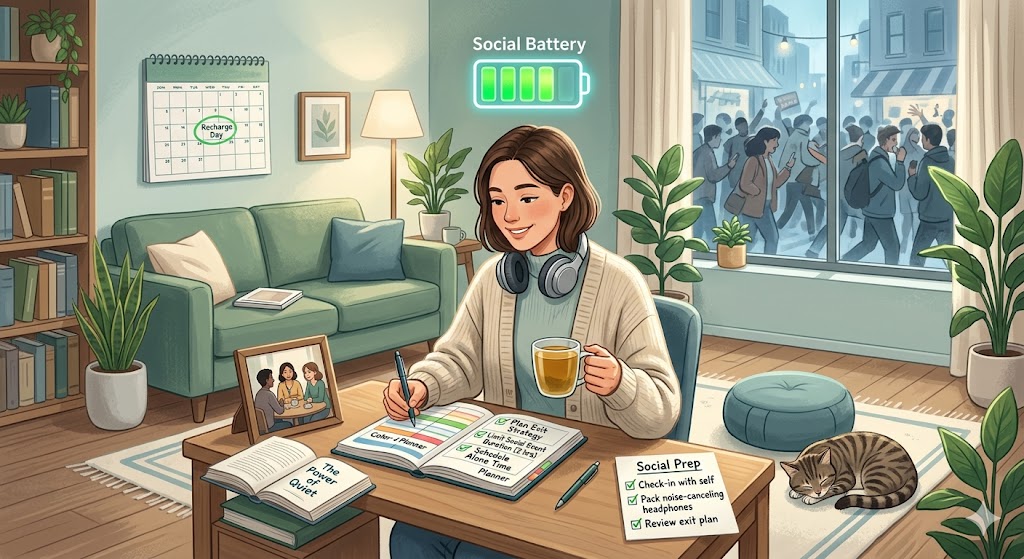
You made it through the thing. The party, the work event, the family dinner that was supposed to end at eight and somehow lasted until eleven. You smiled, you talked, you were present. And now you’re home, staring at the ceiling, feeling like someone wrung you out and hung you up to dry â the unmistakable feeling of an introvert hangover.
That specific kind of tired — the kind where even texting back feels like too much, where your own thoughts feel loud, where you need the world to just stop for a while — has a name: the introvert hangover. And more than naming it, there are actual ways to keep it from swallowing the whole next day.
What’s Actually Going On With an Introvert Hangover
Introversion isn’t shyness and it isn’t antisocial behavior. Psychologist Carl Jung described it as a preference for turning inward — introverts restore energy through solitude rather than social interaction. On a neurological level, introverts tend to have higher baseline arousal and are more sensitive to dopamine stimulation, meaning social environments flood the system faster.
When you spend hours reading the room, tracking conversations, managing expressions, and being switched-on for other people, your nervous system is doing a tremendous amount of work. It’s not emotional weakness. It’s closer to running a background program that never gets to close.
The introvert hangover happens when you’ve exceeded what your system can process without a break. The resulting fog, irritability, and emotional flatness isn’t a character flaw. It’s your brain asking — firmly — for quiet.
The Signs You Might Be Experiencing This
You might notice it starts before the event is even over. A subtle pulling sensation, like part of you has already left the room. Conversation starts to feel like manual labor. You’re nodding, but you’ve stopped actually listening.
It often looks like needing to sit in your car for ten minutes before going inside your own home. Or lying down the moment you get back and finding that sleep won’t actually come — just a restless, overstimulated half-awake state that helps nothing.
The next day carries a specific texture. Not sick, exactly. Not sad. Just hollow. Low-grade irritation at small things. A resistance to plans you’d normally be fine with. A quiet wish that everyone — even the people you love — would leave you alone for a while.
If that Tuesday-after feeling sounds familiar, you already know what this is.
What This Actually Looks Like
Jordan had a work conference on Friday. Two days of panels, networking lunches, small talk with colleagues from other offices. Not terrible. Even kind of good, actually — there were moments.
By Saturday morning, though, Jordan couldn’t make a decision about breakfast. Stood in the kitchen for four minutes staring at the cereal. Cancelled plans with a friend via text and then felt guilty, then resentful about the guilt. Spent most of the afternoon on the couch watching something without really watching it.
Sunday was mostly lost too. Monday required effort that felt disproportionate to the task of just showing up.
Two days of being on had cost Jordan a whole weekend. That’s the math the introvert hangover does.
What Tends to Help
The most effective thing — and the hardest to actually do — is building recovery into the plan before the event, not after. If you know Saturday is a full-day family gathering, protect Sunday morning before Saturday even arrives. Block it. Tell no one you’re free.
During a long social event, find one legitimate reason to step away every ninety minutes or so. A bathroom break that takes a little longer. A walk to get a drink you don’t need. Even three minutes alone in a hallway resets something.
When you leave, don’t apologize. Don’t over-explain. Just leave. The performance of leaving — the long goodbye, the reassurance that you had a wonderful time, the lingering at the door — costs more than people realize.
In the hours after, resist the urge to decompress by scrolling. Screens keep the stimulation going. Silence, a walk without headphones, or something low-input with your hands — cooking, folding laundry, a jigsaw puzzle — lets the nervous system actually downshift.
Finally, give yourself a genuine buffer day whenever you can. Not a productive recovery day. A nothing day. Those exist for a reason.
When to Get Some Support
If the hangover feeling is showing up even after small interactions — a twenty-minute phone call, a quick errand — that’s worth paying attention to. Chronic social exhaustion that doesn’t lift with rest can sometimes point to anxiety, burnout, or depression sitting underneath the introversion.
A therapist who understands introversion (they exist, and the difference is noticeable) can help you figure out what’s wiring and what’s something else. You don’t have to be in crisis to make that call.
A Few Questions Worth Answering
What is the reliable way to learn how to prevent an introvert hangover?
How to prevent an introvert hangover is mostly about the front half of the event. Arriving early, eating first and setting a leaving time do more than anything you do afterwards.
Can you avoid social hangover entirely at a big event?
You can rarely avoid social hangover completely, but you can halve it. How to prevent an introvert hangover means reducing duration and unpredictability, not enjoyment.
What does introvert hangover prevention look like the day before?
Introvert hangover prevention starts the day before with a deliberately quiet evening. Going into a demanding event already depleted doubles the cost.
Is leaving early part of how to prevent an introvert hangover?
Leaving at ninety minutes is the single most effective element of how to prevent an introvert hangover, and the one people skip most often.
How long does an introvert hangover last?
Usually one to two days, depending on how overstimulated you got and how much real rest you manage to get after. The faster you give yourself quiet and low-stimulation time, the shorter it tends to run. Pushing through without recovery usually extends it.
Is the introvert hangover the same as social anxiety?
Not exactly. Social anxiety is about fear before and during social situations. The introvert hangover is about depletion after. You can have both, or just one. The exhaustion piece is about energy, not fear — though anxiety absolutely makes the hangover worse.
Can extroverts get an introvert hangover too?
They can get socially drained, especially from the wrong kind of socializing — high-conflict, draining, or emotionally demanding situations. But the regular introvert hangover from normal social activity? That’s pretty specific to how introverted nervous systems process stimulation.
Why do I feel guilty for needing so much recovery time?
Because the world tends to treat social ease as the default, and needing to recover from it as something to fix. It’s not. Your nervous system is built differently, not broken. The guilt is borrowed from people who don’t have to manage what you manage.
You’re not asking for too much when you protect your quiet time. You’re asking for exactly what your brain needs to work. There’s nothing to fix here — only something to finally stop fighting.