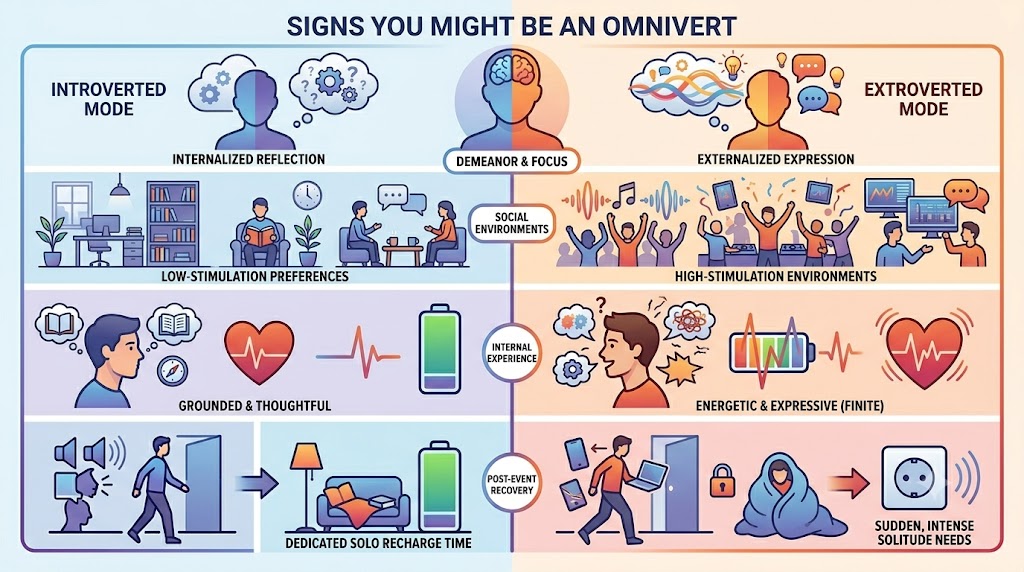
Most personality labels feel like they were written for someone else. If you’ve read the introvert checklist and nodded at half of it, then read the extrovert one and nodded at the other half, you might not be sitting somewhere in the middle — you might be an omnivert. That’s a different thing entirely, and understanding it can save you a lot of confusion about why you seem to contradict yourself.
What Being an Omnivert Actually Means
The omnivert personality describes someone who shifts between genuine introversion and genuine extroversion depending on context, mood, or circumstance — not someone who is mildly both at once. This is the key distinction from the ambivert, who tends to sit in a stable middle ground. An omnivert swings. Some days you want to be around people intensely and feel alive in conversation. Other days the thought of small talk feels like a physical weight.
Psychologically, this maps loosely onto research around neurological sensitivity and arousal thresholds. Hans Eysenck’s work on introversion and extroversion suggested these traits relate to how stimulated the brain becomes in social situations. For most people, that threshold is relatively fixed. For some, it fluctuates — influenced by sleep, stress, hormonal shifts, environment, and emotional state. The brain’s reward response to social interaction isn’t constant. It varies.
This isn’t a disorder or a flaw in your personality. It’s a real and recognisable pattern. The problem is that most personality frameworks don’t account for it well, which leaves omniverts feeling like they can’t be trusted to know themselves.
Signs You Are an Omnivert, Not an Ambivert
It often shows up as a genuine craving for solitude one week and a restlessness with it the next. You might cancel plans because being home alone sounds restorative — then three days later feel genuinely lonely and wish you’d gone. Both feelings were honest. Neither was performance.
You might notice that your social energy depends heavily on what’s happening in the rest of your life. After a period of high stress or emotional drain, you pull inward sharply. After rest and stability, you open back up and actively seek connection. People who know you across different seasons of your life may have conflicting impressions of you — some see you as reserved, others as warm and outgoing. Both are accurate.
Another recognisable sign is that you sometimes surprise yourself. You dread an event, arrive, and find you’re genuinely enjoying it. Or you look forward to a gathering and hit a wall halfway through that no amount of willpower can push past. The shift isn’t chosen — it arrives on its own terms. That unpredictability is one of the most telling signs that you’re an omnivert rather than simply an introvert who occasionally socialises.
What Actually Helps When You’re an Omnivert
Stop committing to a fixed identity. Telling yourself you’re an introvert and then feeling guilty when you crave company helps no one. Telling yourself you’re an extrovert and then being bewildered by your need for days of quiet does the same damage. Hold the label lightly. Your needs shift. That’s the truth you need to work with.
Track your patterns across a few weeks, not just a single day. A simple note — energy level, social desire, what you did — will start to show you when your extroverted phases tend to arrive and what tends to trigger your introverted ones. Sleep deprivation, high-stakes work, and emotional conflict reliably push most omniverts inward. Rest, physical movement, and low-stakes routine tend to open them back up.
When you leave a social gathering early because you’ve hit your limit, leave without the apology spiral. You don’t need to explain your personality in real time. You needed to go. You went. That’s enough.
Give the people close to you a simple, honest framework: your availability fluctuates, it isn’t personal, and the best way to reach you is to ask rather than assume. That one conversation prevents a lot of misread signals over months and years.
Finally, stop scheduling your social life like an extrovert during your introverted phases. If you’re in a quiet period, one meaningful connection is more sustainable than three obligations. Quality over quantity isn’t just a preference — during those phases, it’s the only thing that actually works.
When to Get Support
If the swings feel extreme — weeks of near-total social withdrawal followed by bursts of intensity that you can’t explain — it’s worth speaking to a therapist or psychologist. Significant mood-linked shifts in social need can sometimes overlap with patterns worth exploring in a clinical context, including mood dysregulation or anxiety. A professional can help you separate personality variation from something that deserves more attention. There’s no drama in checking.
A Few Questions Worth Answering
Are the signs you are an omnivert stable over time?
The signs you are an omnivert tend to persist across decades, even as the swings get easier to predict. If the signs you are an omnivert fit at twenty, they usually still fit at fifty.
- Am I an omnivert or just moody?
-
Mood shifts how you feel about people. The omnivert pattern shifts how much company actually costs you. If a busy weekend leaves you energised in March and flattened in April, that is capacity changing, not mood.
- Which omnivert traits show up most often?
-
The omnivert traits people report most are abrupt switching, a strong dislike of being held to plans made in a different mode, and friends who describe you in contradictory terms.
- Which omnivert signs are easiest to spot in yourself?
-
The clearest omnivert signs are retrospective: look at your last three months of cancelled and eagerly-kept plans, and see whether they cluster into stretches rather than scattering evenly.
- What is the difference between an ambivert and an omnivert?
-
An ambivert sits in a consistent middle ground — moderately social, moderately private, relatively stable. An omnivert experiences the full range of both introversion and extroversion at different times. The difference is stability versus fluctuation. Ambiverts are balanced. Omniverts swing between genuine poles depending on circumstance and internal state.
- Is the omnivert personality type recognised in psychology?
-
Not as a formal clinical category. The introvert vs extrovert spectrum comes primarily from Big Five research and Eysenck’s earlier work. The omnivert concept is a descriptive term, not a diagnostic label. That said, the underlying phenomenon — fluctuating social energy linked to context and mood — is a real and documented pattern in personality research.
- Can you be an omnivert and also highly sensitive?
-
Yes, and it’s fairly common. High sensitivity affects how intensely you process stimulation, which can amplify both the desire for social connection and the need to retreat from it. A highly sensitive omnivert may experience the swings more sharply than someone with lower baseline sensitivity. The two traits operate independently but interact meaningfully.
- How do I explain being an omnivert to people who think I’m inconsistent?
-
You don’t owe anyone a full personality breakdown. A simple version works: your social energy varies a lot depending on what else is going on, and it isn’t a reflection of how much you value the relationship. Most people accept this more easily than you’d expect, especially if you say it calmly and without over-explaining.
Knowing you’re an omnivert doesn’t solve the inconvenience of shifting needs — but it does mean you stop treating those shifts as character flaws. You’re not unreliable or contradictory. You’re someone whose social wiring responds to context. Working with that honestly is more useful than trying to flatten it into a label that was never quite right.