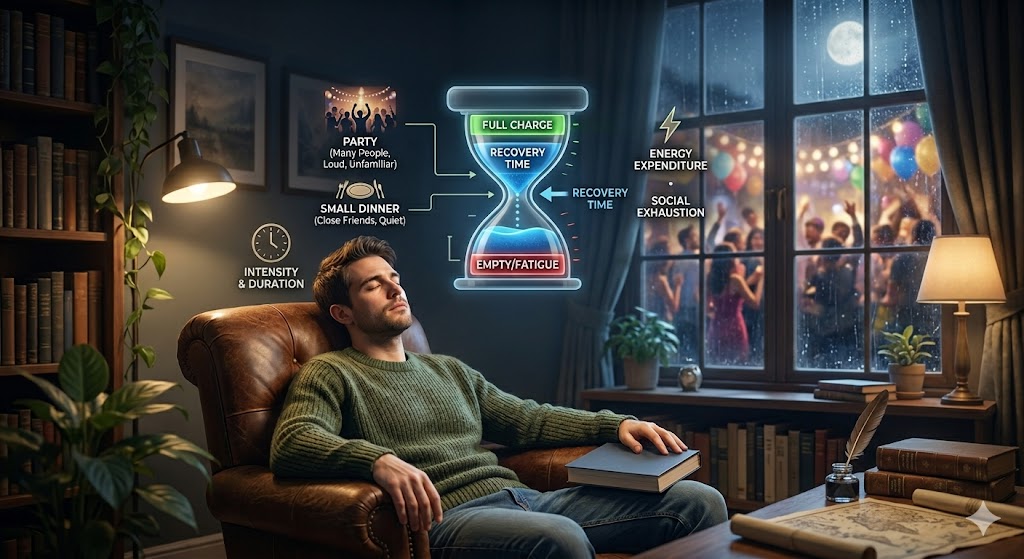
Introvert recovery time is real, it varies widely, and there is no single right answer. Some people need an hour of quiet after a dinner party. Others need an entire day, sometimes two, before they feel like themselves again. What you need depends on factors most articles do not bother to explain — and understanding them makes it easier to stop feeling guilty about how long it takes.
Understanding Introvert Recovery Time After Socializing
The dominant theory, going back to Carl Jung, is that introverts restore energy through solitude and lose it through social interaction. Modern neuroscience adds more texture to this. Research suggests introverts and extroverts process dopamine differently. Extroverts tend to be more responsive to dopamine reward signals, which makes social stimulation feel energising. Introverts appear to rely more heavily on acetylcholine, a neurotransmitter associated with calm focus and inward attention. Social environments flood you with stimulation — noise, eye contact, emotional reads, performance — and your nervous system works hard to process all of it.
This is not weakness. It is a different wiring that has real costs attached to social engagement. The bigger and louder the event, the more unfamiliar the people, the less control you had over your exit — the higher the cost. Introvert recovery time is essentially the period your nervous system needs to return to baseline after spending that energy.
It is also worth noting that introversion exists on a spectrum. Where you fall on the Big Five personality trait of extraversion affects how sensitive your system is to stimulation, and therefore how long recovery takes.
What Introvert Social Exhaustion Actually Looks Like
It does not always look like tiredness. Sometimes it shows up as irritability — a short fuse with people you actually like. You might notice a strong desire to cancel plans that were fine yesterday, or a flatness where your thoughts feel slow and your words do not come easily. Some people experience a kind of emotional numbness after heavy social contact, not sadness exactly, more like a dimming.
Physical signs are common too. Tension headaches, a heaviness behind the eyes, an inability to concentrate on anything that requires sustained thought. You might be physically capable of functioning but find it hard to read, write, or hold a complex idea in your head. That mental fog is your brain still running cleanup operations from the social processing it just did.
Recharge after socializing often gets mistaken for antisocial behaviour or depression by people who do not understand how introvert energy actually works. It is neither. It is maintenance.
What Actually Affects How Long Recovery Takes
The type of interaction matters more than the duration. A two-hour conversation with one close friend costs far less than forty-five minutes of small talk with strangers. Events where you had to perform — presentations, parties where you knew nobody, situations requiring constant social monitoring — drain significantly faster than low-stakes contact.
Your overall baseline state matters too. If you are already sleep-deprived, anxious, or mid-way through a heavy week, introvert social exhaustion hits harder and takes longer to clear. Recovery is not just about the event itself but about the reserves you had going in.
Environment during recovery makes a real difference. Silence, or sound you chose deliberately — music, rain, ambient noise — accelerates it. Passive scrolling through social media often does not help, because it continues feeding your brain low-level social stimulation. Walking alone, sitting quietly, reading something absorbing, or doing something with your hands tends to work better.
A reasonable range: one to four hours after a moderate social event if your reserves were solid. Up to a full day or two after something intense, large, or emotionally demanding. If you are consistently needing more than three days to feel normal, that is worth paying attention to.
When to Take This Seriously
Needing time alone after socializing is normal for introverts. But if recovery never quite happens — if you feel depleted for days regardless of how much solitude you get, or if the thought of any social contact has shifted from tiring to genuinely distressing — that is worth exploring with a therapist or doctor. Chronic exhaustion, persistent low mood, and social withdrawal that feels compulsive rather than restorative can signal something beyond introversion that deserves proper attention.
A Few Questions Worth Answering
What determines introvert recovery time?
Introvert recovery time is set by the number of separate interactions and their unpredictability, more than by the hours involved.
How long do introverts need to recover, typically?
How long do introverts need to recover ranges from an hour after a dinner to two days after a wedding weekend.
What does recovery after socialising require?
Recovery after socialising requires uninterrupted solitude. Introvert recovery time lengthens sharply when the quiet keeps getting broken.
Does introvert recovery time change over life?
Introvert recovery time tends to lengthen gradually with age, in line with slower recovery generally.
- Is needing two days to recover after a party normal for introverts?
- Yes, for many introverts it is. Large gatherings with unfamiliar people, loud environments, and little control over your time are high-cost events. Two days of introvert recovery time after something like that is well within the normal range, especially if you were already running low before you went.
- Why do I feel worse after socializing even when I enjoyed myself?
- Enjoyment and energy cost are separate things. You can genuinely like the people, have a good time, and still pay a significant price in terms of stimulation and emotional processing. Introvert social exhaustion is not a sign something went wrong — it is what happens when your system runs at high capacity for a sustained period.
- Does recharge after socializing get faster with practice?
- Not really, no. Social skills can improve with practice, which may reduce anxiety around certain interactions. But the fundamental need to recharge after socializing does not disappear or shrink significantly. What tends to improve is your ability to protect recovery time and to identify what restores you most efficiently.
- Can introverts and extroverts manage energy differences in a relationship?
- Yes, when both people understand what is happening. The problem usually is not incompatibility — it is one person interpreting the introvert’s need to recover as rejection or indifference. Clear, calm communication about what recovery looks like, and why it matters, tends to close most of that gap.
Knowing your own introvert recovery time is not self-indulgence. It is information. When you understand how long you actually need — and what shortens or lengthens it — you can make better decisions about how you spend your time, what you agree to, and what you protect.