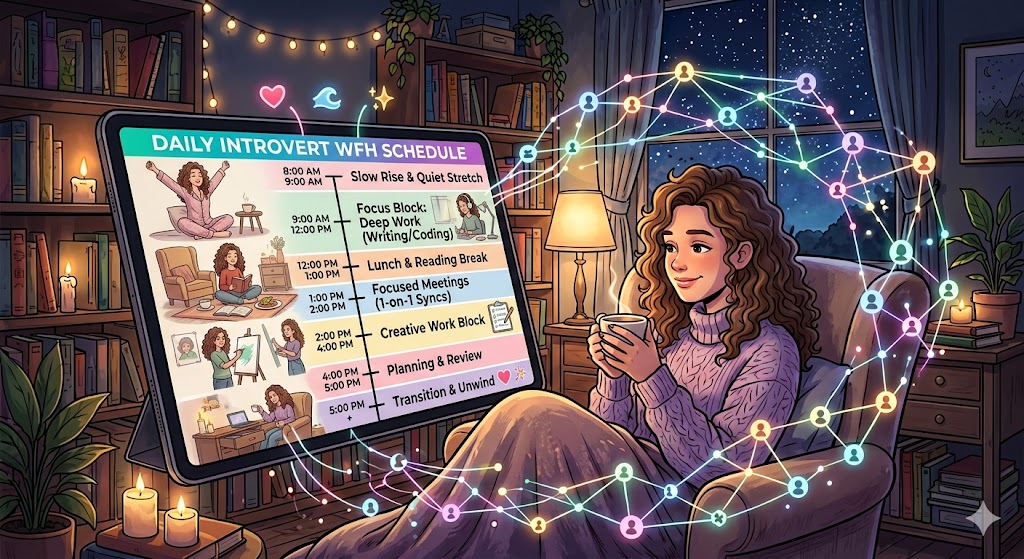
If you’ve ever ended a work-from-home day feeling like you got nothing done but somehow also feel completely drained, the problem probably isn’t your to-do list — it’s the shape of your day. A good introvert work from home daily schedule isn’t about cramming in more hours or more meetings. It’s about arranging the hours you already have so your energy actually matches the demands placed on it. This post gets specific: an hour-by-hour example schedule, why each block is placed where it is, and how to adapt it to your own rhythm.
Why the Shape of Your Day Matters More Than the Length
Most productivity advice is written for people who recharge around other people. Introverts recharge in the opposite direction — quiet, low-stimulation time restores energy, while back-to-back interaction drains it, even when the interaction is pleasant. That means a workday that looks efficient on paper (meetings stacked in the morning, deep work squeezed in wherever it fits) can quietly wreck you by 3pm. Building an introvert work from home daily schedule means designing around energy, not just around tasks. The goal is to protect your highest-focus hours for the work that needs them, and to place the more socially demanding parts of your day where they’ll cost you the least.
A Sample Introvert Work From Home Daily Schedule, Hour by Hour
Here’s a realistic example. It won’t fit everyone’s job exactly, but the logic behind each block is what you’re borrowing, not necessarily the exact clock times.
7:00–7:45am — Quiet start. No email, no Slack, no news. Coffee, a walk, journaling, stretching — anything that lets your nervous system wake up gradually instead of getting hit with input the second you’re conscious.
7:45–8:15am — Light planning. Look at the day, pick your one or two priority tasks, and glance at your calendar so nothing ambushes you later. This is administrative, not social, so it’s a gentle bridge into the workday.
8:15–10:30am — Deep work block one. This is the most valuable stretch of the day for most introverts: fresh energy, no meetings yet, minimal interruptions. Close notifications and put your hardest, most focus-intensive task here — writing, coding, analysis, planning, whatever requires sustained concentration.
10:30–10:45am — Real break. Step away from the screen entirely. Not scrolling — actually away. A short walk, water, fresh air.
10:45am–12:00pm — Second work block or async communication. Emails, messages, smaller tasks that need attention but not total immersion.
12:00–1:00pm — Lunch, alone if possible. If your job allows it, eat away from your desk and away from video calls. A midday break that’s actually restful sets up the entire afternoon.
1:00–2:30pm — Meetings, if you have them. Early-to-mid afternoon tends to be a better spot for meetings than first thing in the morning, because you’ve already had a win from your deep work block and you’re not starting the day depleted. Batch meetings together rather than scattering them across the day — each one carries a re-entry cost when you have to switch back to focused work.
2:30–2:45pm — Recovery buffer. After any meeting-heavy stretch, build in a short reset before moving to the next task. Even five to ten minutes of quiet helps your nervous system come down.
2:45–4:15pm — Lower-stakes work. Energy naturally dips here for most people, so this is a good place for tasks that don’t require peak focus: organizing, reviewing, responding to messages, tidying up loose ends.
4:15–4:30pm — Shutdown ritual. Close tabs, write tomorrow’s top priority, and mentally close the laptop. This single habit does more for evening energy than almost anything else on this list.
4:30pm onward — Off. Genuinely off. Not “off but checking Slack.” The wind-down matters as much as the workday itself.
Placing Meetings Without Wrecking Your Energy
Meetings are usually the biggest energy cost in any introvert work from home daily schedule, so where you put them matters as much as how many you have. Avoid opening your day with back-to-back calls — you’ll spend your freshest hours on interaction instead of on the deep work that actually needs your best focus. Instead, cluster meetings into one or two windows and protect the rest of the day for quiet, uninterrupted work. If you have any control over your calendar, ask for meeting-free mornings; it’s a small request that changes the entire texture of your day.
Building in Recovery, Not Just Breaks
There’s a difference between a break and actual recovery. Scrolling your phone during a five-minute gap between calls isn’t recovery — it’s more input on top of input. Real recovery means low-stimulation time: staring out a window, a short walk without your phone, silence. This is where energy management becomes concrete instead of abstract. Without deliberate recovery blocks, small amounts of daily depletion accumulate, and that accumulation is exactly what leads to burnout over weeks and months, even when no single day felt overwhelming.
Adjusting the Template to Your Actual Job
Not every schedule can bend the way the example above does, and that’s fine — the underlying principles still apply even in a rigid role. If your job has fixed meeting times, protect whatever quiet time exists around them as fiercely as you can. If you can’t control your calendar at all, focus on the transitions instead: a two-minute buffer before and after each call, a proper lunch break away from screens, a real shutdown ritual at the end of the day. An introvert schedule doesn’t have to be perfectly ideal to work — it just has to consistently protect a few pockets of quiet, focused time.
Questions People Ask About an Introvert Work From Home Daily Schedule
Should an introvert work from home schedule include social contact?
An introvert work from home schedule needs one deliberate contact point a day, or the isolation compounds. The introvert work from home schedule that fails is the one with no exit from the flat at all.
What does a good introvert work from home schedule look like?
A good introvert work from home schedule front-loads deep work and clusters calls into one block, so the day has one social window rather than six interruptions.
How do you build a wfh routine introvert workers can sustain?
A wfh routine introvert workers sustain needs a hard start and a hard stop. Without them the day spreads and the introvert work from home schedule stops protecting anything.
What should a remote work schedule introvert employees use include?
A remote work schedule introvert employees benefit from includes a no-meeting block, a stated response window, and a real lunch away from the desk.
How many hours of deep work should an introvert work from home daily schedule include? Most people can sustain two to four hours of genuinely deep, focused work per day. Trying to force more than that usually backfires — quality drops and fatigue sets in faster. Two solid blocks, ideally with your hardest task in the first one, is realistic for most jobs.
What if my job requires meetings all day? Focus on the transitions rather than the schedule itself. Even sixty seconds of silence between calls, camera off when it’s allowed, and a firm end-of-day shutdown can meaningfully reduce the cumulative toll of a meeting-heavy day.
How do I know if my current schedule is causing burnout? Watch for signs like dreading calls you’d normally be fine with, feeling wiped out by early afternoon, or needing your entire evening just to “recover” from the day. These are signals that your schedule is out of balance with your actual energy capacity, and it’s worth restructuring rather than just pushing through.
There’s no single correct version of an introvert work from home daily schedule — the example above is a starting point, not a rulebook. What matters is the underlying pattern: protect your best hours for your hardest work, cluster the socially demanding parts of your day instead of scattering them, and build in real recovery rather than just gaps. Get that structure right and the rest of the day tends to take care of itself.