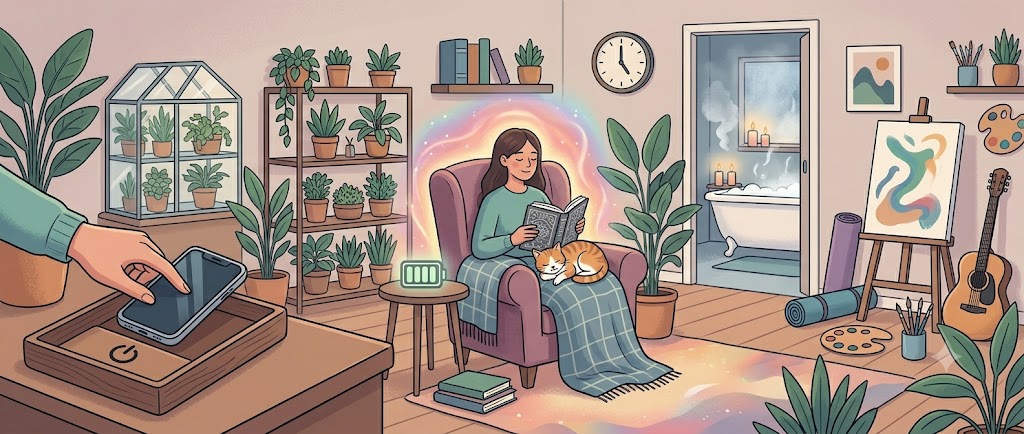
After a full workday of conversations, eye contact, and being switched on, many introverts arrive home feeling scraped hollow. The exhaustion is real, even if nothing obviously bad happened. Knowing how to recharge as an introvert is not a luxury — it is what separates a sustainable life from one that slowly grinds you down. The good news is that recovery does not require much. It requires the right things.
Why Introverts Lose Energy at Work
The difference between introverts and extroverts is not about shyness or social skill. It is about how the brain processes stimulation. Research linking introversion to acetylcholine sensitivity suggests that introverts tend to respond more strongly to external input — noise, interaction, expectation. Where an extrovert might feel energised by a busy open-plan office, an introvert’s nervous system registers that same environment as high-cost.
Carl Jung, who originally described introversion, framed it as a natural orientation toward the inner world. That inner world is where introverts restore themselves. Social interaction draws from that reserve. A workday full of meetings, collaborative tasks, and casual hallway exchanges can deplete it significantly, even when you genuinely like your colleagues and your job.
The problem is not work itself. It is that most workplaces are designed around extrovert-friendly norms — open offices, constant availability, spontaneous conversation. Introvert burnout often builds slowly, across weeks of not getting enough recovery time, until the tiredness stops feeling like tiredness and starts feeling like something worse.
Signs Your After-Work Energy Is Depleted
You might notice that you arrive home and feel irritable with people you love, not because anything is wrong with them but because you simply have nothing left. Small requests — a question, a noise, the television too loud — feel unreasonably sharp. This is not a character flaw. It is your nervous system signalling that it has run out of processing capacity.
It often shows up as a pull toward numbing rather than genuine rest. Scrolling through your phone for two hours might feel like downtime, but passive screen use often keeps your brain in a low-grade reactive state. You end the evening still tired, maybe more so. Another pattern: avoiding activities you actually enjoy — reading, a walk, cooking — because they feel like too much effort. That specific tiredness, where even pleasant things feel heavy, is a clear sign that you need to recharge as an introvert before the depletion gets worse.
If you are regularly arriving at Friday feeling as depleted as Monday, the problem is not the work week. It is that evenings are not actually restoring you.
How to Recharge as an Introvert After Work
The first thing that helps is a deliberate transition ritual between work and home. This does not need to be elaborate. A short walk, even ten minutes, creates physical separation between the two states. Changing your clothes works for the same reason — it signals to your brain that the performance is over. Without some kind of transition, your nervous system stays in work mode long after you have left the building.
Protect silence in the first thirty minutes after you get home. This is not antisocial if you live with others — it is a reasonable need. Communicating it plainly in advance, once, usually works: “I need about half an hour to decompress when I get in, then I’m genuinely present.” Most people respect this when it is stated clearly rather than silently withdrawn into.
Solitary, low-stimulation activities restore introvert energy after work more efficiently than passive entertainment. Reading a novel, cooking with familiar recipes, sitting outside, working with your hands — these replenish. They give your brain something quiet to do without demanding social processing.
When you leave a social obligation in the evening — a friend’s birthday, a work dinner — do not over-explain your exit. Say goodnight, leave, and do not apologise for it. The guilt of leaving often costs more energy than the event itself.
Finally, treat sleep as a non-negotiable part of introvert recovery. Sleep is when the brain consolidates and resets. Cutting it short to get more done is a trade that never pays off for people who are already running on a depleted nervous system.
When to Get Support
If rest no longer feels restoring — if you wake up tired, feel detached from things you used to care about, or notice a persistent flatness that does not lift after a few quiet evenings — that is worth taking seriously. Chronic introvert burnout can shade into anxiety or depression, both of which respond well to proper support. A therapist familiar with sensitivity or high-stimulation environments can help you understand what is happening and what to change.
A Few Questions Worth Answering
Is how to recharge after work introvert advice different on a bad day?
How to recharge after work introvert style scales with the damage. A normal day needs an hour; a day of back-to-back meetings needs the evening, and how to recharge after work introvert energy fails when you treat both the same.
What is the best way to recharge after work introvert style?
How to recharge after work introvert style means protecting the first hour. What you do in that hour matters less than that nobody asks anything of you during it.
What should an introvert after work routine include?
An introvert after work routine works best with a transition marker — a walk, a shower, a changed set of clothes — that separates the performing day from the private evening.
Why is recovering after work introvert energy so slow some days?
Recovering after work introvert energy takes longer after days with many short interactions than after one long meeting. How to recharge after work introvert style should be scaled to the number of switches, not the hours.
Is collapsing on the sofa a real recharge?
How to recharge after work introvert style rarely works through scrolling. The input continues; only the social part stops.
- How long does it take for an introvert to recharge after work?
-
It varies, but most introverts need between thirty minutes and two hours of genuine solitude to feel restored after a standard workday. After unusually demanding days — heavy meetings, conflict, travel — that window can extend. The key variable is the quality of rest, not just the amount of time spent at home.
- Is it normal to feel exhausted after work as an introvert even if you like your job?
-
Yes, completely. Introvert energy after work is depleted by social processing, not by whether the work is meaningful. You can love what you do and still need significant recovery time. The two are not in conflict. Feeling drained is about nervous system cost, not job satisfaction.
- What is the difference between introvert burnout and just being tired?
-
Ordinary tiredness improves after a night’s sleep. Introvert burnout is cumulative — it builds over weeks of insufficient recovery time and does not clear with a single good night. Signs include persistent irritability, emotional numbness, difficulty enjoying things that used to feel easy, and a sense that you are always running behind on rest.
- Can introverts recover from burnout without taking time off work?
-
Sometimes, if the burnout is caught early. Protecting evenings consistently, reducing optional social commitments, and improving sleep quality can make a real difference. But if the depletion is deep, time off may be necessary. Pushing through severe introvert burnout rarely works and often extends recovery time significantly.
Recharging as an introvert after work is less about finding tricks and more about being honest with yourself about what actually costs energy and what restores it. Quiet is not laziness. Solitude is not avoidance. Knowing what you need and building your evenings around it is just clear thinking.