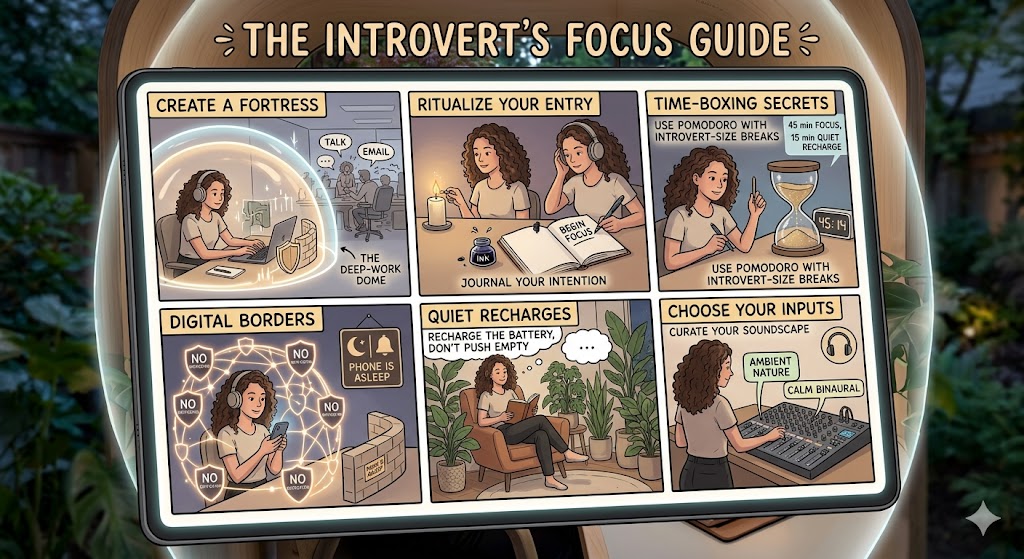
If you’ve ever sat down to finish a report, only to feel your attention scatter into a dozen directions within ten minutes, you already know why introvert focus tips matter so much more than generic productivity advice. Introverts don’t just prefer quiet — many of us actually think better in it, process information more thoroughly in it, and produce our best work when the noise (literal and social) drops away. The trouble is that most workplaces and most productivity content are built around collaborative, high-stimulation environments that drain introverted focus rather than protect it. What follows isn’t a list of app recommendations. It’s a practical approach to structuring your day, your space, and your energy so that deep, sustained attention becomes the default instead of something you have to fight for.
Why Introvert Focus Tips Look Different From Standard Productivity Advice
Most mainstream focus advice assumes a baseline of constant stimulation — open offices, back-to-back meetings, notification pings treated as unavoidable background noise. Introverts process stimuli differently; research on temperament consistently points to introverts having a lower threshold for external arousal, meaning noise, social interaction, and visual clutter cost us more cognitive energy per minute than they cost extroverted colleagues. That’s not a weakness, it’s a design constraint, and once you treat it as one, everything about how you structure a workday changes. Instead of asking “how do I power through distraction,” the better question is “how do I remove distraction before it starts.” That reframing is the foundation of every genuinely useful introvert focus tip in this article.
Protecting Deep Work Blocks Like They’re Meetings You Can’t Miss
The single highest-leverage habit I’ve seen work, both in my own routine and in conversations with introverted colleagues, is treating a focus block as a non-negotiable calendar event rather than something you’ll “get to” between interruptions. Block out ninety minutes to two hours — introverts often sustain deep concentration longer than average once the environment is right, because we’re not spending energy managing social input at the same time. Put the block on your shared calendar labeled plainly, whether that’s “focus time” or something more specific. The point is that a labeled block gets respected in a way an empty slot doesn’t. If your job allows it, choose the first two hours of the day before messages start arriving, or the last two hours after most colleagues have logged off. Deep work needs an unbroken runway, and introverts are unusually good at using that runway once it’s actually clear.
Minimizing Environmental Interruption
Interruptions cost introverts more than they cost most people, because re-engaging with a task after a social interruption means re-processing both the task and the interaction. A few concrete changes make an outsized difference. Close the door if you have one, or use a simple visual signal — headphones on, a small sign, a closed laptop lid at a shared desk — that trains coworkers or family members to recognize “not now” without you having to say it out loud every time. Turn off non-essential notifications entirely during a focus block rather than just muting the sound; a silent badge or banner still pulls your eyes and resets your attention. If you work in an open office, noise-canceling headphones with instrumental music or white noise aren’t a luxury, they’re a functional wall you’re allowed to build. And batch your unavoidable interruptions — check messages at set intervals rather than as they arrive — so your brain learns that focus blocks are actually protected, not just labeled that way.
Small environmental tweaks compound. A tidy desk, a single monitor showing only the task at hand, and a phone left in another room all reduce the number of tiny decisions your brain has to make before it can settle into real concentration.
Energy Management Matters More Than Time Management
Introverts recharge through low-stimulation time, which means focus isn’t purely a scheduling problem — it’s an energy problem. You can carve out a perfect two-hour block and still produce shallow work if you’re running on social or sensory depletion from the hours before it. Pay attention to what precedes your focus blocks. A morning full of quick chats, an open-plan commute, or a cluttered inbox review can quietly drain the reserves you need for deep work before you’ve even started. Build a short buffer — five to ten minutes of genuine quiet, even just sitting without a screen — between high-stimulation activity and a focus block. This isn’t indulgent, it’s functional: it’s the difference between starting a deep work session with a full tank or an already-half-empty one. Introverts who manage energy deliberately tend to need fewer, more effective focus blocks rather than many scattered short ones.
Avoiding Burnout While Protecting Solo Focus Time
There’s an irony worth naming: introverts are often so relieved to find quiet, productive stretches that we overfill them, stacking deep work block after deep work block with no recovery in between. That pattern leads straight to burnout, because sustained concentration, even when it feels natural, is still cognitively expensive. Treat recovery breaks as part of the work, not a reward for finishing it. A five-minute walk, a stretch away from the screen, or simply sitting in silence between blocks lets your nervous system reset before you ask it to concentrate again. The goal of introvert focus tips isn’t to maximize hours of uninterrupted work — it’s to sustain high-quality attention across a whole week without draining yourself by Wednesday. Pacing, not just protecting, is what keeps deep work sustainable long-term.
Questions People Ask About Introvert Focus Tips
How long should an introvert’s deep work block actually be?
There’s no universal number, but many introverts find ninety minutes to two hours sustainable once interruptions are minimized. Start shorter if you’re new to protecting focus time, and extend the block gradually as your environment gets quieter and more predictable.
Are introvert focus tips different for remote versus office workers?
The core principles are the same — reduce stimulation, protect blocks, manage energy — but remote workers usually have more control over environment while office-based introverts need to rely more on signals like headphones or closed doors to communicate availability without constant verbal explanation.
What’s the fastest way to recover focus after an interruption?
Rather than diving straight back into the task, take thirty seconds to re-read where you left off and restate your next concrete step out loud or in writing. This small reset reduces the mental cost of re-engagement and gets you back into deep work faster than trying to push through the fog.
Introvert focus tips work best when they’re treated as a system rather than a checklist — protected blocks, a quieter environment, deliberate energy management, and real recovery time between sessions. None of this requires becoming a different kind of worker. It simply means designing your day around the way your attention already wants to function, instead of fighting it. Give yourself permission to build a quieter, more deliberate workday, and the deep, sustained focus you’ve been chasing will start to feel less like an occasional lucky streak and more like your normal, reliable baseline.