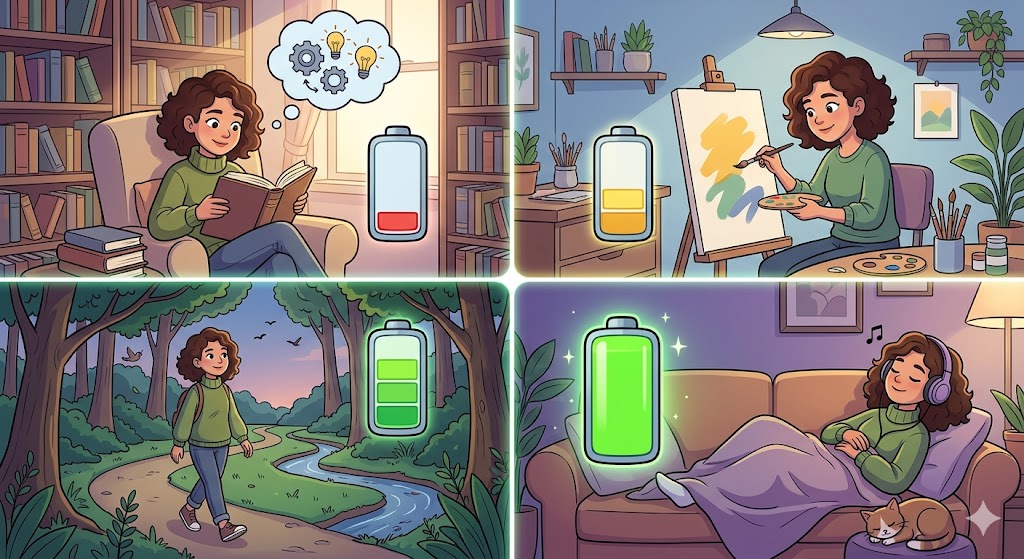
When introverts recharge energy, it almost always involves one thing: less. Less noise, less input, fewer people. That is not antisocial behaviour or a personal flaw — it is how your nervous system works. Understanding the actual mechanism behind it changes everything, because then you stop feeling guilty for needing what you genuinely need.
Why Introverts Lose Energy Around People
The most useful framework here comes from neurochemistry, not personality typing. Research suggests that introverts and extroverts respond differently to dopamine stimulation. Extroverts tend to feel rewarded by high-stimulation environments — crowds, noise, rapid conversation. Introverts are more sensitive to that same stimulation, which means they hit a saturation point faster and feel drained rather than energised.
Carl Jung, who introduced the introvert-extrovert distinction in the 1920s, described it as a matter of where you direct your energy — inward or outward. Modern personality research, including Big Five studies, consistently shows that introversion correlates with a lower threshold for external arousal. It is not that social interaction is unpleasant — many introverts enjoy it deeply — but it costs something. And that cost accumulates.
Acetylcholine, a neurotransmitter associated with calm focus and internal reflection, tends to dominate in introvert reward pathways. This is partly why quiet, focused activity — reading, walking alone, making something with your hands — genuinely restores rather than just distracts. You are not hiding. You are refuelling on the right kind of fuel.
What Introvert Energy Drain Actually Looks Like
Introvert overstimulation recovery is often misread — by others and by introverts themselves. You might notice it as a heaviness after a long day of meetings, even ones that went well. You might feel oddly irritable with people you love, not because anything is wrong, but because your capacity for social processing is simply full. Some introverts describe it as a kind of static in the head, where thinking clearly becomes harder the longer they stay in demanding social environments.
It often shows up physically too. Tension in the shoulders, shallow breathing, a vague restlessness that does not have a name. You might scroll your phone without really seeing it, or find yourself going through the motions of a conversation while something in you has already left the room. These are not signs of depression or rudeness. They are your system telling you it is at capacity.
The pattern is consistent: the more your day has required performing, explaining yourself, or staying switched on for others, the more deliberately you need to recover. Solitude and rest for introverts is not optional downtime. It is maintenance.
How Introverts Recharge Energy
Unstructured alone time is the single most reliable way introverts recharge energy. Not alone time with a podcast running and notifications on. Genuinely quiet time, where nothing is being demanded of you. Even thirty minutes of this — a walk without headphones, sitting with a coffee and no agenda — can shift your state noticeably.
Transition time matters more than most introverts realise. The twenty minutes between leaving work and arriving home, or between one social event and the next, are not wasted. Treat them as buffer zones. Sit in your car before going inside. Take the longer route. Do not rush yourself into the next thing before the last thing has finished processing.
Single-focus activity works particularly well for introvert recovery — cooking something from scratch, drawing, reading a physical book, tending plants. These activities engage the mind just enough to quiet the social noise without adding new demands. They occupy the part of you that needs occupation while letting the overstimulated part rest.
When you leave a gathering, do not apologise for leaving. Just leave. The guilt loop of explaining your exit or justifying your limits costs energy you do not have spare. A simple, warm goodbye is enough. You do not owe anyone a performance of sociability you have already exhausted.
Finally, sleep is not a backup plan — it is central. Introvert energy drain is cumulative, and insufficient sleep removes your ability to manage overstimulation the following day. Protecting your sleep is one of the most direct things you can do to maintain your baseline.
When to Get Support
Needing solitude is normal for introverts. But if you find yourself unable to engage with people even when you want to, if exhaustion persists no matter how much alone time you get, or if withdrawal is affecting your work or relationships in ways you cannot manage, that is worth talking to someone about. A therapist familiar with introversion and anxiety can help you tell the difference between healthy recovery and something that deserves closer attention.
A Few Questions Worth Answering
What does how introverts recharge actually involve?
How introverts recharge almost always involves less rather than more: less noise, less input, fewer people, for a defined stretch.
Is introvert recharging the same as resting?
Introvert recharging is not the same as rest. You can sleep eight hours and remain socially empty, because the input never stopped.
How do introverts recharge energy fastest?
How do introverts recharge energy fastest is usually through solitude plus something absorbing but undemanding — walking, cooking, reading.
What does full introvert recovery require?
Introvert recovery requires uninterrupted time rather than long time. How introverts recharge fails when the hour is broken into fragments.
- How long does it take for introverts to recharge after socialising?
-
It depends on the intensity and duration of the social interaction, and on how depleted you were going in. A draining two-hour work event might need an evening to recover from. A weekend of sustained social contact might need several days of quieter routine before you feel like yourself again.
- Is it normal for introverts to need a lot of alone time?
-
Yes. The amount varies from person to person, but needing regular, meaningful solitude is a core feature of introversion — not a symptom of something wrong. The problem usually arises when life structures do not allow for it, not from the need itself.
- Can introverts recharge energy around other people?
-
Sometimes, with the right person. One-on-one time with someone you trust and feel completely at ease with can be restoring rather than draining. But it requires low social pressure and genuine comfort. Large groups or performative socialising rarely count, even if the people involved are ones you care about.
- What is introvert overstimulation and how do you recover from it?
-
Introvert overstimulation happens when external demands — noise, social interaction, sensory input — exceed your processing capacity. Recovery involves reducing stimulation as quickly as possible: a quiet space, minimal demands, no screen noise. It is not a mood. It is a physiological state that resolves with the right conditions.
Knowing how you actually recharge is more useful than any general advice about rest. Once you understand that solitude and quiet are not indulgences but functional requirements, it becomes easier to protect them without apology — and to notice sooner when you are running low.