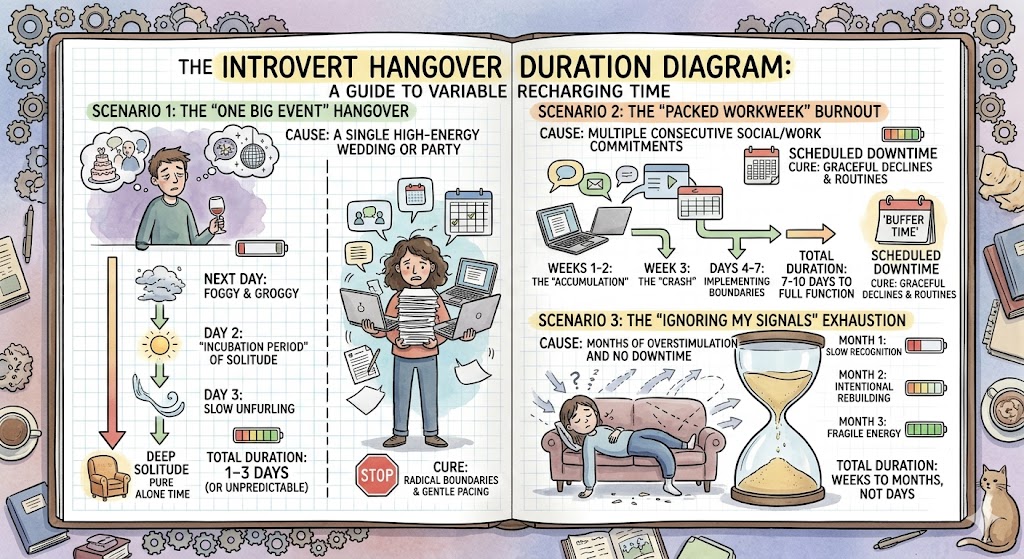
You made it through the weekend, but the introvert hangover that follows is still here. The dinner, the party, maybe even the after-part you didn’t plan on. And now it’s Sunday — or Monday, or Tuesday — and you’re still not back. Still flat. Still the kind of tired where even texting back feels like too much, where the thought of one more conversation makes something in you quietly close a door.
This is the introvert hangover. And if you’re wondering how long it’s supposed to last, you’re not broken for asking.
What’s Actually Going On With an Introvert Hangover
The introvert hangover isn’t a metaphor. It has a real neurological basis. Research into introversion — particularly work building on Carl Jung’s original framework and later studies on the Big Five personality trait of extraversion — suggests that introverted brains process social stimulation differently. Where an extrovert’s brain responds to social interaction with a dopamine reward hit that feels energizing, the introvert’s brain runs more heavily on acetylcholine, a neurotransmitter associated with internal focus, reflection, and calm.
What this means practically: social interaction costs you more. Your nervous system has been working hard — reading the room, managing small talk, staying present — and after enough of that, it needs time offline to recalibrate. The fatigue you’re feeling isn’t weakness or antisocial behavior. It’s your brain asking for what it actually runs on: quiet.
The length of the hangover depends on how much you spent. A two-hour dinner with people you like might cost you an evening. A full weekend of obligations, performances, and people-pleasing can leave you hollowed out for days.
The Signs You Might Be Experiencing This
It often looks like irritability that comes from nowhere. Someone asks you a simple question and something in you resists answering, not because you’re angry at them, but because forming words feels expensive right now.
You might notice that you’re physically tired but can’t sleep, or that you sleep for ten hours and still wake up foggy. You probably want to cancel everything — and feel guilty about wanting that.
It can look like staring at your phone without opening anything. Eating something easy and not tasting it. Sitting in a quiet room and not reading, not watching anything, not doing anything — just existing, because existing is about all you have left.
Some people describe a kind of emotional flatness, like the volume has been turned down on everything. You’re not sad, exactly. You’re just… muted. Waiting to come back online. That’s the hangover. That’s what recovery actually looks like from the inside.
What This Actually Looks Like
It’s Monday morning. Jordan had a birthday party Friday night, a family lunch Saturday, and a friend’s housewarming Sunday. Three events. All people Jordan likes. None of it optional.
By Sunday evening, Jordan is sitting in the car outside the apartment for eleven minutes before going inside. Not on the phone. Not listening to anything. Just sitting.
Monday, Jordan calls in for a meeting from the bedroom, camera off, and eats cereal for dinner. Not depressed. Not sick. Just completely, utterly spent in a way that has no clean name most people would recognize. The hangover will lift. But today, it is very much still here.
What Tends to Help
First: stop scheduling recovery time around other people’s comfort. If you need to leave early, leave. You don’t need a reason that makes sense to an extrovert. “I’m tired” is a complete sentence.
Spend time in environments that don’t ask anything of you — a walk where you won’t run into anyone, a room where nothing needs doing. Not productive quiet. Just quiet.
Avoid the temptation to “push through” with more socializing to prove you’re fine. That’s like running on a sprained ankle to show it doesn’t hurt. It extends the recovery, it doesn’t shorten it.
Eat something real. Drink water. These sound embarrassingly simple, but when your nervous system is depleted, basic physical care actually moves the needle. Your body and your brain are the same system.
And give yourself a rough timeline without holding it rigidly. A moderate hangover — one heavy event — often clears in 24 to 48 hours with proper rest. A significant one, after days of sustained output, can take three to five days. Sometimes a full week. That’s not dramatic. That’s honest.
When to Get Some Support
If the flatness doesn’t lift after a week of real rest, that’s worth paying attention to. If you’re noticing that even small amounts of socializing leave you wrecked for days, or that you’re dreading all interaction — not just recovering from a lot of it — that can sometimes signal anxiety, depression, or burnout that’s deeper than a standard introvert hangover. A therapist who understands introversion can be genuinely useful here, not to fix you, but to help you figure out what’s actually going on.
A Few Questions Worth Answering
How long does an introvert hangover last, typically?
How long does an introvert hangover last depends on the number of separate interactions rather than the hours. Most resolve within a day; heavy weekends can run to three.
What affects introvert hangover duration most?
Introvert hangover duration is extended by poor sleep, unfamiliar people and events with no clear end. How long does an introvert hangover last is largely set by those three.
Social hangover how long is too long?
Social hangover how long becomes a concern past three or four days, or when the recovery keeps lengthening across months.
Does how long does an introvert hangover last change with age?
How long does an introvert hangover last does tend to lengthen with age, in line with slower general recovery.
Is an introvert hangover the same as social anxiety?
Not exactly. Social anxiety involves fear or dread around social situations. An introvert hangover is about depletion after them — you may have been totally fine during the event and still feel wiped out after. They can overlap, but they’re not the same thing.
Can extroverts get an introvert hangover?
Anyone can get socially overloaded under the right conditions — wrong crowd, too long, too intense. But for introverts, it happens at a lower threshold and more consistently. It’s a default setting, not an occasional glitch.
Why do I feel worse the day after socializing, not during?
Because adrenaline and the effort of being present can mask the depletion while it’s happening. The crash comes later, when your system finally stops performing and lets itself feel the cost.
Does an introvert hangover get worse with age?
Many introverts report this. Tolerance for overstimulation can decrease as you get older — but it may also be that you’re just more honest about what it costs you, and less willing to pretend otherwise.
You’ll come back. You always do. And the version of you that returns after real rest — not rushed rest, not guilty rest, but actual quiet — is usually the one that actually feels like you. That’s not a flaw in how you’re built. That’s just how you work.