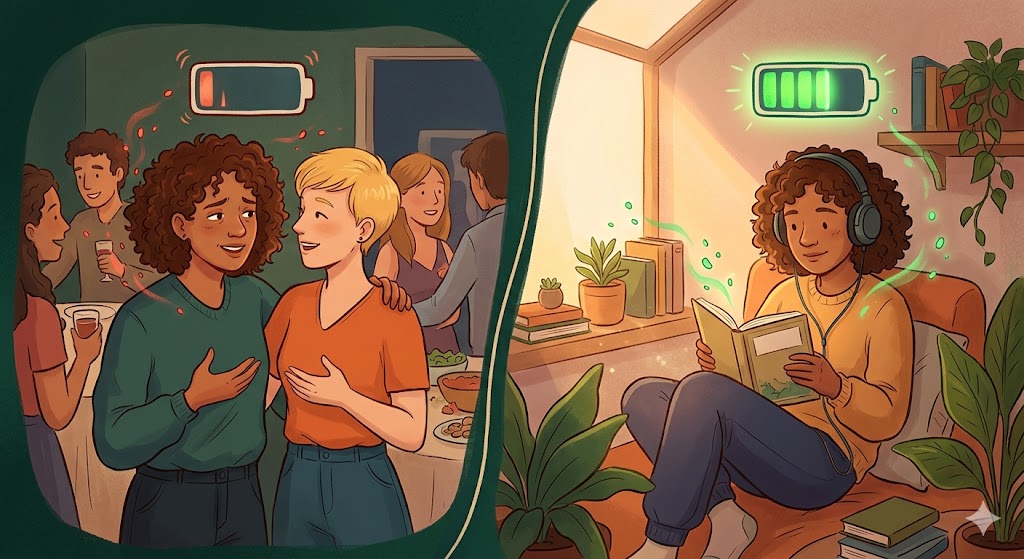
You love this person. You genuinely do. And still, after a full evening together, something in you is counting down to the moment you can be alone. Not because anything went wrong. Just because you’re full — the kind of full where more talking, more eye contact, more anything feels like it might actually break something in you. That’s not a red flag about your relationship. It’s just what it means to be an introvert who loves someone.
What’s Actually Going On
Introversion isn’t shyness, and it’s not about disliking people. Psychologist Carl Jung described it as where you direct your energy — inward versus outward. For introverts, social interaction, even the good kind, draws on a finite internal reserve. Time alone is how that reserve gets rebuilt.
There’s a neurological layer to this too. Introverts tend to be more sensitive to dopamine stimulation, meaning social environments that feel exciting to an extrovert can feel genuinely overwhelming to you. The brain’s acetylcholine pathway, which introversion leans toward, rewards quiet, reflection, and inward focus rather than external novelty.
This means needing alone time in a relationship isn’t emotional withdrawal. It isn’t a sign you love your partner less. It’s your nervous system doing exactly what it was built to do — asking for the conditions it needs to function well. Ignoring that need doesn’t make you a better partner. It makes you a depleted one.
The Signs You Might Be Experiencing This
You might notice that after a long weekend with your partner, you feel a specific kind of exhausted that sleep alone doesn’t fully fix. It often looks like irritability over small things — not because they did anything wrong, but because your internal reserves are running on empty and you’ve got nothing left to buffer with.
It might show up as going quiet mid-conversation, not because you’re upset, but because your brain has genuinely stopped generating words. Or that slightly panicked feeling when a planned solo evening suddenly gets filled. Or the guilt — god, the guilt — of wanting to be alone when someone who loves you is right there.
Sometimes it looks like physical restlessness. You’re present in the room but some part of you keeps pulling toward the bedroom, the walk, the quiet corner. You’re not checked out. You’re full. There’s a difference, even if it doesn’t always look like one from the outside.
What This Actually Looks Like
It’s a regular Tuesday. Maya gets home from work and her partner is already there, wanting to talk about their day. She loves him. She’s also been in back-to-back meetings for seven hours and made small talk in the elevator four separate times. She sits down, asks questions, tries to be present. By 8pm she’s gone so quiet he asks if she’s okay. She says she’s fine. She’s not lying — she’s just used up. What she actually needs is an hour with a book and no one needing anything from her. What she gets is guilt for feeling that way. The evening ends with both of them feeling vaguely unseen.
What Tends to Help
Name the need before the depletion hits. When you’re already running low, asking for space feels like a confrontation. When you say it early — “I’m going to need some quiet time tonight after dinner” — it becomes information, not rejection.
Create solo rituals that your partner understands are non-negotiable. Not because you’re being rigid, but because consistency removes the guesswork. Saturday morning walks alone, reading before bed without the TV on, thirty minutes after work before you transition into couple time. These aren’t walls. They’re the thing that makes the rest possible.
Stop apologizing for leaving. When you leave a gathering, don’t explain yourself into the ground. A quiet “I’m heading out, thanks for having me” is complete. The apology makes it about them. The clean exit keeps it about you.
Talk about it outside the moment. Not when you’re depleted and they’re confused, but on a calm afternoon. Explain what recharging actually feels like from the inside. Most partners aren’t hurt by the need — they’re hurt by not understanding it.
And let your partner have their own life during your alone time. If they’re also doing something they love, your solitude stops feeling like subtraction.
When to Get Some Support
Needing alone time is normal for introverts. But if you’ve started dreading time with your partner rather than just needing breaks from it, or if the guilt around your need for space has become constant and crushing, it’s worth talking to someone. A therapist who understands introversion can help you figure out whether what you’re feeling is a wiring thing or something else worth looking at more closely.
A Few Questions Worth Answering
Does needing alone time mean I don’t love my partner enough?
No. Needing to recharge alone is a function of how your nervous system works, not a measurement of how much you care. Depleted people make worse partners. Time alone often means more presence when you’re actually together, not less love overall.
How do I explain this to a partner who takes it personally?
Try being specific rather than abstract. Instead of “I need space,” say “After social time, my brain genuinely goes quiet and I need about an hour to come back to myself. It’s not about you. It’s more like refuelling.” Concrete descriptions land better than concepts.
What if my partner is an extrovert who needs togetherness to feel close?
This is common and genuinely workable. The key is making sure your together time is good quality — fully present, not just physically in the same room. Extroverts often need connection, not just proximity. You can meet that need without abandoning your own.
Is it possible to need too much alone time?
Yes. If alone time has become avoidance — if you’re using solitude to dodge conflict, intimacy, or difficult feelings — that’s a different thing worth noticing. Recharging and withdrawing can look similar from the outside but feel very different from the inside.
You don’t need to choose between being a good partner and taking care of your own mind. The two aren’t in competition. Wanting quiet isn’t the same as wanting distance. Some people love deeply and still need to come home to themselves at the end of the day. That’s not a flaw. It’s just the shape of how you love.