You don’t hate people. You’re just exhausted by them — and there’s a difference most job listings completely ignore. The open-plan office, the mandatory team lunches, the “quick syncs” that steal the last bit of quiet you had. If you’ve ever come home from work and needed two hours of silence just to feel like yourself again, this is for you — and yes, jobs with no social interaction really do exist.
What’s Actually Going On
Introversion isn’t shyness, and it isn’t antisocial behavior. Carl Jung, who first mapped the introvert-extrovert spectrum, described introverts as people who restore energy through solitude rather than social contact. Modern neuroscience backs this up — introverts tend to have higher baseline arousal in the brain’s cortex, which means external stimulation, including constant conversation, pushes them past their comfortable threshold faster.
The Big Five personality research also shows that lower extroversion scores correlate with a preference for focused, independent work over collaborative environments. That’s not a flaw. It’s wiring. The problem isn’t you — it’s that most workplaces are designed by and for extroverts, with noise and constant contact baked into the structure.
Finding work that matches your nervous system isn’t giving up. It’s getting honest about where you actually do your best thinking.
The Signs You Might Be Experiencing This
You might notice that Sunday evenings feel heavier than they should — not because of the work itself, but because of the people-facing parts of it. It often looks like dreading a meeting more than the actual deadline attached to it.
You might find yourself logging off and feeling the kind of tired where even texting back feels like too much, even though you sat at a desk all day. Conversations that others seem to find energizing leave you needing a long, quiet walk before you can think straight again.
It often looks like doing your best work at 6am before anyone else arrives, or staying late not for productivity but for the silence. You’re not burned out on work. You’re burned out on performing sociability while trying to actually get something done. That distinction matters, and it should shape where you work next.
What This Actually Looks Like
Sam works in a busy marketing agency. The work itself — writing copy, analyzing data — suits him perfectly. But every day includes three stand-ups, a team lunch someone organized on Slack, and a constant stream of “just wanted to loop you in” emails that require cheerful, immediate responses.
By Wednesday, he’s running on empty. Not because the job is hard. Because the job requires him to be “on” for seven hours straight. He’s started researching roles where he can close a door, or not have one to begin with. What he actually wants isn’t isolation — it’s just the ability to do good work without spending half his energy managing how he’s coming across to other people.
Finding Jobs With No Social Interaction
First, get specific about what drains you. Some people are fine with written communication but wilt under phone calls. Others handle one-on-one conversations well but fall apart in group settings. Knowing your particular version of this helps you filter job descriptions more accurately.
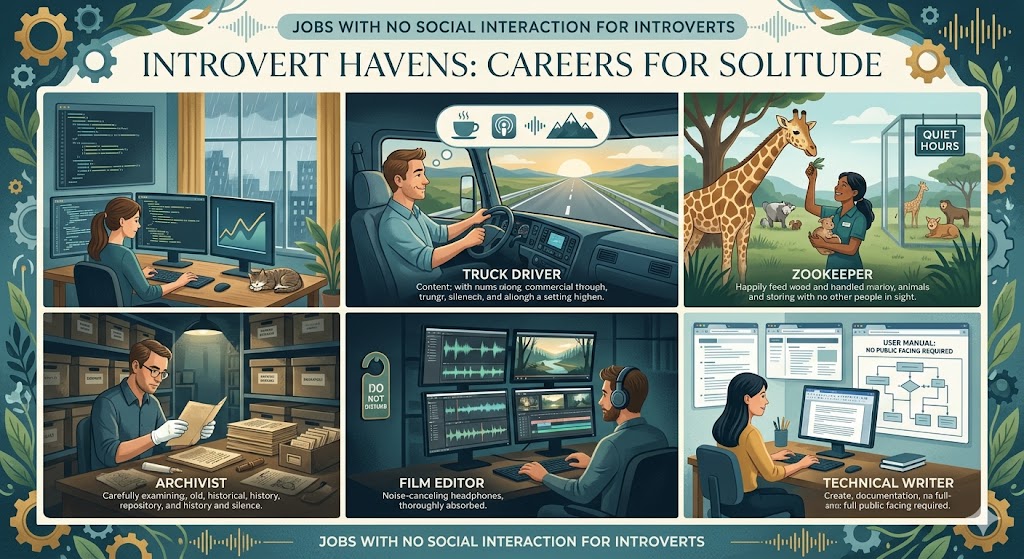
Second, look at these roles seriously — they’re not consolation prizes, and several genuinely count among the best jobs with no social interaction available right now. Data entry specialist, transcriptionist, software developer, technical writer, graphic designer, archivist, night-shift security monitor, laboratory technician, freight truck driver, agricultural worker, wildlife biologist, and bookkeeper all involve long stretches of independent work with minimal required interaction. Many pay well. Several are growing fields.
Third, when you interview, ask directly: “What does a typical Tuesday look like in terms of meetings and collaboration?” The answer tells you everything.
Fourth, remote work isn’t automatically better — some remote roles are meeting-heavy. Filter for async-first companies, which communicate primarily through written documentation rather than video calls.
Finally, when you find a role that fits, don’t apologize for wanting it. Choosing work that matches your brain isn’t settling. It’s strategy.
When to Get Some Support
If avoiding social interaction has moved beyond a preference and is starting to feel like fear — if the idea of any interaction, even low-stakes ones, fills you with dread — it’s worth talking to a therapist who understands introversion and anxiety as separate things. Not because anything is broken, but because a good therapist can help you tell the difference between a healthy preference and something that’s quietly shrinking your world.
A Few Questions Worth Answering
What are the best jobs for introverts with no people contact?
The strongest jobs for introverts with no people contact cluster in data, code, writing, laboratory work, logistics and the trades — roles where the output is inspected rather than the performance.
Do low interaction jobs pay well?
Many do. Low interaction jobs are often technical, and technical work is priced on scarcity of skill rather than on visibility, which is exactly the market where quiet competence gets paid properly.
Are solitary jobs bad for your mental health?
They can be, if solitary jobs become your only environment. The risk is not the quiet work itself but the loss of incidental contact that a workplace used to supply without you having to arrange it.
What jobs let you work completely alone?
Night-shift data processing, long-haul truck driving, freelance writing, transcription, and remote software development can all involve very little daily human contact. The key word is “little” — almost no job is entirely zero interaction, but these come close on most days.
Can introverts be successful in their careers?
Completely. Research consistently shows introverts outperform in roles requiring deep focus, careful analysis, and written communication. The issue is fit, not ability. Put an introvert in the right environment and the results tend to speak for themselves.
Is it okay to choose a job specifically to avoid people?
Yes. Choosing work that fits your actual energy levels is a legitimate career consideration — the same way someone might choose a job for its physical environment or commute. You don’t need to justify why you work better with fewer interruptions.
What remote jobs have the least social interaction?
Data entry, freelance editing, SEO writing, back-end development, bookkeeping, and digital illustration all tend to be async-heavy. Look for companies that describe themselves as “documentation-first” or “async by default” — that language usually means fewer mandatory calls.
The right job won’t fix everything. But spending eight hours a day in an environment that works with your brain instead of against it — that changes things in ways that are hard to describe until you’ve felt it. You already know what drains you. You’re allowed to build a career around that knowledge.