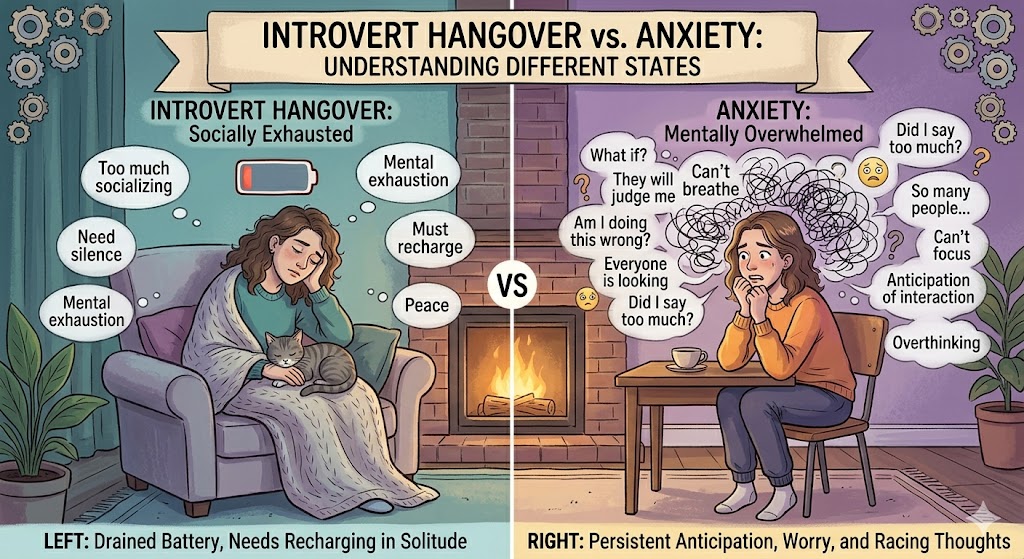
You canceled the plans. You came home, put on something comfortable, and now you’re lying there — not exactly sad, not exactly okay, just completely hollowed out. But there’s a second feeling underneath it, one that won’t sit still. And you’re not sure if what you’re feeling is introvert hangover vs anxiety — normal introvert exhaustion, or something that has a different name.
That question — introvert hangover vs anxiety — matters. Because treating them the same way doesn’t work.
Introvert Hangover vs Anxiety: What’s Actually Going On
Introversion isn’t shyness and it isn’t social anxiety. It’s a neurological preference. Research suggests introverts rely more heavily on acetylcholine — a neurotransmitter linked to internal focus and calm — while extroverts run on dopamine, which spikes with external stimulation. When you spend hours in a loud room full of people making small talk, you’re running a system that wasn’t built for high-volume input on a prolonged high-volume setting. The exhaustion afterward is the system cooling down. It’s physiological. It’s real.
Anxiety is a different mechanism. It involves the amygdala firing threat responses — the kind tied to perceived social danger, judgment, or loss of control. Anxiety doesn’t clock out when you get home. It follows you through the door. It replays the conversation you had at 7pm while you’re trying to sleep at midnight. It asks questions like did I say something wrong and refuses to let you answer.
The overlap is where things get confusing. Both can show up after social situations. Both feel bad. But they have different roots, and they need different things from you.
The Signs You Might Be Experiencing This
An introvert hangover often looks like total depletion. You might notice that words feel like too much effort — even typing a reply takes more than you have. Sounds seem sharper than usual. Bright lights feel aggressive. You want to be horizontal. You’re not upset with anyone, you’re just done. The kind of done where even choosing what to watch feels like a decision you can’t make.
Anxiety after socializing looks different. It often looks like a mental loop you can’t turn off. You might catch yourself replaying something specific — a joke that landed wrong, a silence that went too long, a moment where you felt watched. Your body might feel tense rather than heavy. There’s a restlessness to it. You can’t fully rest because part of your brain is still in the room, running the tape back, looking for what you should have done differently.
Sometimes both happen at once. You’re exhausted and wired. That particular combination — bone-tired but unable to stop thinking — is worth paying attention to.
What This Actually Looks Like
Sam leaves a birthday dinner at 9pm. There were twelve people, a loud restaurant, two hours of conversation that required full attention. On the drive home, Sam feels the familiar flatness — not sad, just empty. Gets inside, doesn’t turn on the TV, doesn’t text anyone back. Sits quietly for forty minutes. By 10:30, Sam feels mostly fine. Tired, but fine.
The next week, a work happy hour. Smaller group, less noise. But Sam spends the whole drive home picking apart a comment made about a project. Lies in bed at midnight still composing responses to a conversation that ended three hours ago. Wakes up already tense. That’s not a hangover. That’s anxiety wearing the same coat.
What Tends to Help
For an introvert hangover, the only real fix is unstructured quiet. Not productive quiet. Not a podcast that’s technically calm. Actual silence, or something close to it — a walk without headphones, sitting by a window, lying down without a screen in your hand. Give your nervous system a chance to stop processing input. Most introverts find they need somewhere between ninety minutes and half a day to feel like themselves again, depending on how long the event was.
For anxiety, stillness alone can backfire. Sitting quietly with a looping anxious thought just gives it more airtime. What tends to interrupt the loop: physical movement, even a short walk around the block. Writing down the specific thought and asking yourself once — just once — whether there’s actual evidence for it. Talking to one person you trust, not to process endlessly, but just to say it out loud and have it witnessed.
One thing that helps both: when you leave a gathering, don’t over-explain your exit. Don’t apologize for being tired. Just leave at the time that’s right for you. The guilt that comes from over-justifying your departure adds a layer of stress on top of whatever you’re already carrying home.
And if you notice the anxiety pattern appearing consistently after social events, it might be worth tracking it — not obsessively, just noticing. Which situations trigger the loop. That information is useful.
When to Get Some Support
If the replaying, the self-monitoring, or the dread before social events is starting to shrink your life — if you’re declining things not because you need quiet, but because the anxiety has made the cost feel too high — that’s a signal worth listening to. A therapist who understands introversion (not one who treats it as the problem to fix) can help you tell the difference and work with what’s actually happening.
A Few Questions Worth Answering
How do you tell introvert hangover vs anxiety apart?
Introvert hangover vs anxiety separates on what solitude does. The hangover eases in a quiet room; anxiety often does not, because the source is internal.
Is it anxiety or introvert hangover if I feel wired?
Is it anxiety or introvert hangover is best tested by an hour alone. Introvert hangover vs anxiety differ mainly in whether removal of input helps.
Can you have social exhaustion or anxiety at the same time?
Social exhaustion or anxiety frequently occur together, one triggering the other, which is why the distinction matters for what you do next.
Does introvert hangover vs anxiety change the response?
Introvert hangover vs anxiety changes everything about the response: one needs less input, the other needs the thought underneath it addressed.
- Can introverts have social anxiety?
- Yes, and the two aren’t the same thing. You can be introverted without any anxiety at all. You can also be extroverted and struggle with social anxiety. Being introverted means you prefer less stimulation. Social anxiety means social situations trigger a fear response. They can overlap, but one doesn’t cause the other.
- How long does an introvert hangover last?
- Usually a few hours to a full day, depending on how long or intense the social situation was. If you’re still feeling completely depleted three days later, that’s closer to burnout territory — which typically builds from not getting enough recovery time over a longer stretch.
- Why do I feel anxious after socializing even if it went well?
- Sometimes the anxiety isn’t about how it went — it’s anticipatory relief collapsing into a kind of post-event crash. Your nervous system was braced for something, and now it’s releasing. That can feel a lot like anxiety even when there’s nothing specific to worry about.
- Is it bad to cancel plans to recover?
- Canceling occasionally because you genuinely need rest isn’t avoidance — it’s maintenance. The difference is whether you’re recovering so you can show up for the things that matter, or whether the canceling is slowly becoming the only strategy you have. One is healthy. The other might need a closer look.
You don’t have to pick one label and stick with it. Most people are carrying a little of both. What matters is learning to tell them apart in your own body — because the thing that restores you after one can make the other worse. That distinction, quiet as it is, changes things.