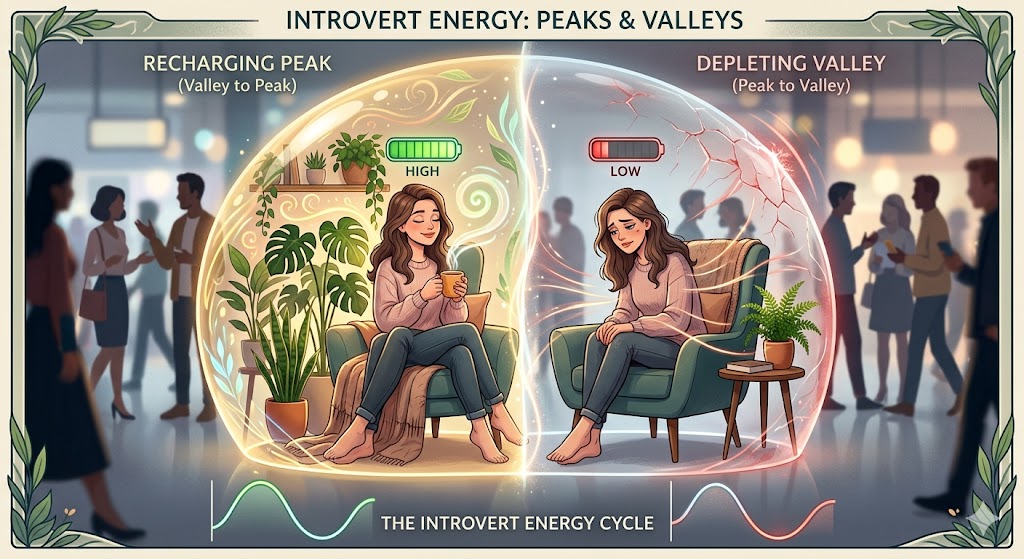
If you’ve ever wondered why some days feel completely manageable while others leave you flattened by noon, you’ve bumped into one of the most useful concepts in introvert psychology: introvert energy peaks and valleys. Your social and mental energy isn’t a flat line that stays the same from the moment you wake up until the moment you go to bed. It rises, falls, and rises again in a pattern that’s fairly consistent once you start paying attention to it. Learning to recognize your own introvert energy peaks and valleys isn’t about forcing yourself into someone else’s schedule — it’s about working with your actual biology instead of constantly fighting it.
Most productivity advice is written for a generic person who doesn’t exist. It tells you to front-load your hardest work, batch your meetings, or power through the afternoon slump with caffeine. For introverts, that advice often misses the real issue. The slump isn’t just about blood sugar or sleep debt — it’s frequently a sign that your social and cognitive battery has dipped into a valley, and no amount of coffee will refill a battery that needs quiet instead of stimulation.
Why Introvert Energy Peaks and Valleys Happen
Energy for introverts is tied closely to stimulation levels, not just physical rest. Every conversation, meeting, open-plan office, group text thread, and even a crowded grocery store draws from the same pool. When that pool empties, you hit a valley: irritability, trouble concentrating, a strong pull toward silence or solitude. When the pool is full, you hit a peak: you’re witty, focused, willing to make small talk, even excited about a project or a plan with friends.
The tricky part is that these peaks and valleys don’t run on the same schedule for everyone. Some introverts are sharpest first thing in the morning before the world wakes up and starts asking things of them. Others need an hour or two to warm up and don’t hit their stride until mid-morning. Still others do their best thinking late at night when the house is finally quiet. There’s no universally “correct” introvert rhythm — there’s only your rhythm, and it’s worth the effort to map it out.
Mapping Your Own Introvert Energy Peaks and Valleys
The most reliable way to find your pattern is to track it for one or two ordinary weeks. Every few hours, jot down a quick number from one to ten describing your energy and willingness to engage with people. You don’t need a fancy app — a notes file or a small notebook works fine. After a week or two, patterns usually jump out. Maybe you notice a reliable peak from 9 to 11 a.m., a dip after lunch, a smaller second peak in the late afternoon, and a hard crash by 7 p.m. Maybe your pattern is entirely different. The goal isn’t to match anyone else’s chart; it’s to see your own data honestly.
Pay attention to the difference between plain tiredness and social depletion, too. Physical fatigue from a poor night’s sleep feels different from the specific, jittery exhaustion of having talked to too many people. Both matter, but only one of them responds to solitude rather than sleep. Once you can tell them apart, your energy log becomes far more useful, because you’ll know whether the fix is a nap or an hour of silence with the phone off.
Scheduling Around Your Peaks and Valleys
Once you know your pattern, the real payoff is in how you build your week. Put your highest-stakes, highest-stimulation commitments — presentations, difficult conversations, networking events, big social gatherings — during your documented peaks whenever you have any control over the calendar. This is energy management in its most practical form: not doing less, but doing the demanding things when you actually have the capacity to do them well.
Just as important is protecting your valleys instead of scheduling over them out of guilt or habit. If your energy reliably drops between 2 and 4 p.m., that’s a poor window for a client call if you can avoid it, but a good window for solo tasks like emails, filing, data entry, or quiet focused work that doesn’t require you to perform for anyone. If you’re a manager or business owner, you have more control here than you might think — even small shifts, like moving a weekly team meeting from 3 p.m. to 10 a.m., can noticeably change how depleted you feel by dinner.
Weekly patterns matter too, not just daily ones. Many introverts find that Mondays and the day after a big social event are lower-capacity days across the board, while midweek tends to be steadier. If you can, save your most demanding personal commitments — big family gatherings, long phone calls with relatives, apartment hunting, anything emotionally heavy — for days that aren’t already competing with a low point in your weekly rhythm.
Protecting Valleys to Prevent Burnout
Ignoring your valleys long enough doesn’t make you tougher; it usually leads to burnout. Burnout in introverts often looks less like exhaustion and more like a sudden, total unwillingness to engage — canceling plans you actually wanted to keep, snapping at people you like, losing interest in hobbies that normally recharge you. That’s usually a sign the valleys have been overridden for too long without enough recovery time built back in.
Recovery doesn’t have to mean a dramatic day off, either. Ten or fifteen minutes of true quiet between meetings, a lunch eaten alone instead of in the break room, a commute spent in silence instead of on a call — these small deposits add up. Think of your valleys as scheduled maintenance rather than a failure of willpower. A car that never gets an oil change eventually breaks down; an introvert who never protects a valley eventually does too.
Questions People Ask About Introvert Energy Peaks and Valleys
How do introvert energy levels actually behave?
Introvert energy levels are not a flat line depleting steadily. They rise and fall predictably, and the shape matters more than the total.
What are the typical energy peaks and valleys?
Energy peaks and valleys for most people follow a morning high and an afternoon dip, with social capacity falling faster than physical energy.
What does managing introvert energy involve?
Managing introvert energy means scheduling demanding contact into the peaks and protecting the valleys, rather than distributing tasks evenly.
Can you learn your own energy patterns introvert style?
Energy patterns introvert readers map over a fortnight are usually stable enough to plan around. Introvert energy levels are more predictable than they feel.
Do introvert energy peaks and valleys change with age or life stage? Yes. Many people notice their pattern shifts with new jobs, parenthood, or simply getting older. It’s worth re-tracking your energy every year or so, especially after a major life change, rather than assuming your twenty-year-old rhythm still applies.
Can extroverts have energy peaks and valleys too? Everyone has some natural variation in energy across the day, but for extroverts the valleys are usually tied to physical rest rather than social depletion, and socializing often refills their tank rather than draining it. That’s the core difference introvert psychology points to.
What’s the fastest way to recover during a valley if I can’t leave a social event? A short bathroom break, a few minutes outside, or even closing your eyes and taking slow breaths for sixty seconds can take the edge off. It won’t fully refill you, but it can buy enough capacity to get through the rest of the event without a full crash.
Understanding your introvert energy peaks and valleys won’t eliminate hard days entirely, but it does give you a map instead of a mystery. Once you know roughly when you shine and when you need shelter, you can start building a life — and a schedule — that works with your energy instead of constantly apologizing for it.