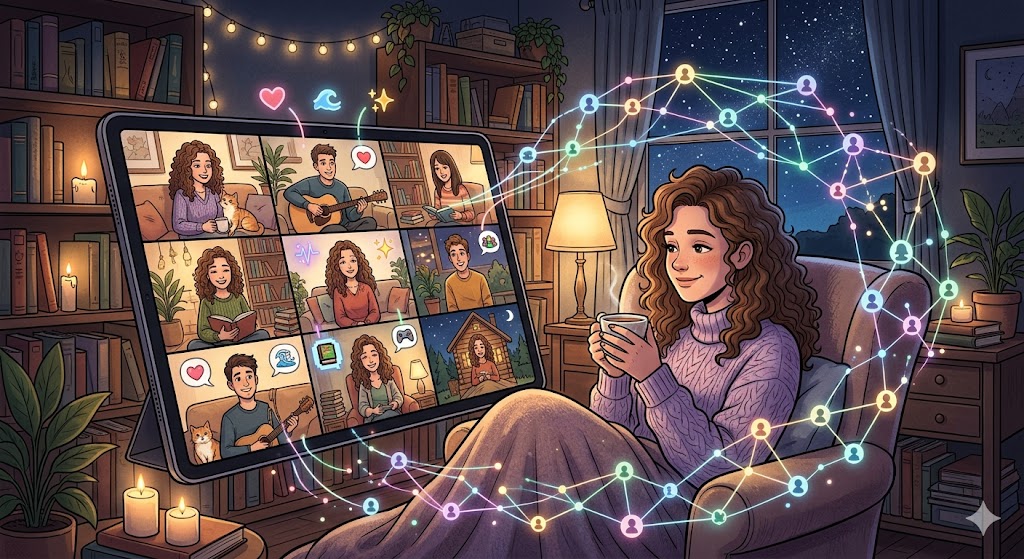
If you have ever felt more like yourself in a text conversation than in a crowded room, you already understand why introvert and online friendships tend to fit so naturally together. The appeal is not that introverts prefer screens to people. It is that digital connection removes so many of the sensory and social demands that make in-person interaction draining, while still leaving room for the depth, honesty, and mutual understanding that real friendship requires. Understanding introvert and online friendships means understanding introvert psychology itself: the need for lower stimulation, more processing time, and communication that doesn’t ask you to perform in real time.
For many introverts, a phone buzzing with a new message feels far less overwhelming than a phone ringing. That distinction sounds small, but it says a lot about why introvert and online friendships work so well. A text can be read, absorbed, and answered on your own schedule. A call demands an immediate, unscripted response, often while you’re already tracking tone of voice, background noise, and the pressure to fill silence. Online communication strips away that pressure. There is space to think before you speak, which for introverts often means finally saying what you actually mean instead of whatever comes out under social pressure.
Why Introvert and Online Friendships Match Introvert Communication Style
Introverts tend to process language internally before they externalize it. In face-to-face conversation, this can create a lag that feels awkward — the pause before a response, the sense of being one beat behind the rhythm of the room. Written communication erases that lag entirely. There is no visible gap between thought and reply, because the thinking happens invisibly, at whatever pace the person needs. This is one of the clearest reasons introvert and online friendships flourish: the format finally matches the internal tempo introverts already operate on, instead of forcing them to match someone else’s.
There’s also the matter of sensory load. In-person socializing is a full-body experience — eye contact, physical proximity, ambient noise, the effort of reading microexpressions in real time. Even wonderful conversations can leave an introvert quietly depleted, not because the connection wasn’t good, but because the nervous system was working overtime the whole time. Digital connection removes almost all of that sensory input. A conversation can happen in a quiet room, at your own pace, with nothing competing for your attention except the words themselves. That’s not a lesser form of friendship — for many introverts, it’s the form where their personality actually gets to show up fully.
The Honesty That Distance Can Create
Something counterintuitive tends to happen in online friendships: people often become more open, not less. Without the immediate feedback loop of facial expressions or body language, there’s less second-guessing and less self-editing in the moment. Many introverts describe feeling able to be more vulnerable in writing than they ever could face-to-face, simply because the format removes the fear of watching someone’s reaction unfold in real time. This is part of what makes introvert and online friendships so genuinely intimate — not despite the distance, but sometimes because of it. Writing gives you the chance to say something carefully, to revise it, to sit with it before sending, which often results in more thoughtful and more honest communication than a spontaneous conversation ever could.
None of this means digital friendship is effortless or automatic. It still requires consistency, curiosity about the other person’s life, and a willingness to be vulnerable in return. What changes is the delivery mechanism, not the underlying emotional labor of showing up for someone. Introverts who thrive in online friendships are usually not avoiding connection — they’re finding the format where connection costs them the least energy while still asking real, sustained effort of them.
What Online Friendship Can’t Fully Replace
It would be dishonest to present digital connection as a complete substitute for in-person closeness, and most introverts sense this intuitively. Shared physical presence carries something that text cannot fully replicate: the comfort of sitting quietly next to someone without needing to fill the silence, a hand on your shoulder during a hard moment, the simple fact of being chosen to be in the same room. Online friendships can be deeply real and deeply sustaining, but they often work best as one part of a fuller social life rather than the entire structure of it. The healthiest approach tends to treat digital connection as a genuine friendship format in its own right — not a placeholder for “real” friendship, but not a total replacement for embodied presence either.
There’s also the risk of using online friendship as a way to avoid social discomfort altogether, rather than as a legitimate preference. There’s a real difference between choosing digital connection because it suits your introvert relationships and communication style, and retreating into it because in-person interaction feels too hard to ever attempt. The first is self-knowledge. The second, left unexamined, can quietly narrow a life. Introverts benefit from checking in with themselves occasionally: is this friendship format serving connection, or is it primarily serving avoidance?
Questions People Ask About Introvert and Online Friendships
Why do introvert online friendships form so easily?
Introvert online friendships form easily because text removes the two costs that make conversation expensive: instant response and visible hesitation.
Are online friends introvert readers make real friends?
Online friends introvert readers make are real by every measure that matters — disclosure, reliability, and being missed when absent.
Do online friendships count the same as offline ones?
Do online friendships count? They count differently. They tend to go deeper faster and offer less practical help in a crisis.
What makes digital friendships last?
Digital friendships last when they have a shared activity rather than only conversation. Introvert online friendships that are pure chat tend to fade quietly.
Are online friendships as meaningful as in-person ones? Yes, for many introverts they can be equally meaningful, and sometimes more emotionally honest, because the lower-pressure format allows for more thoughtful, less performative communication. Meaning comes from consistency and care, not from the medium the friendship happens through.
Why do introverts often prefer texting over calling? Texting removes the real-time performance pressure of a phone call — no need to fill silences, manage tone on the spot, or respond instantly. It allows introverts to process and reply at their own pace, which fits naturally with introvert psychology.
Can online friendships eventually lead to in-person closeness? Often, yes. Many online friendships deepen further once video calls or in-person meetups are introduced, because the trust and openness built through writing creates a strong foundation. The digital connection becomes the starting point, not the ceiling.
Introvert and online friendships work because they honor something true about how introverts are wired: the need for space to think, lower sensory demands, and communication that doesn’t require constant real-time performance. They are not a workaround or a lesser version of friendship — they are a format that lets many introverts show up as their most honest, most present selves. The healthiest path forward isn’t choosing digital connection over in-person closeness, but understanding what each offers, and building a social life that draws thoughtfully from both.