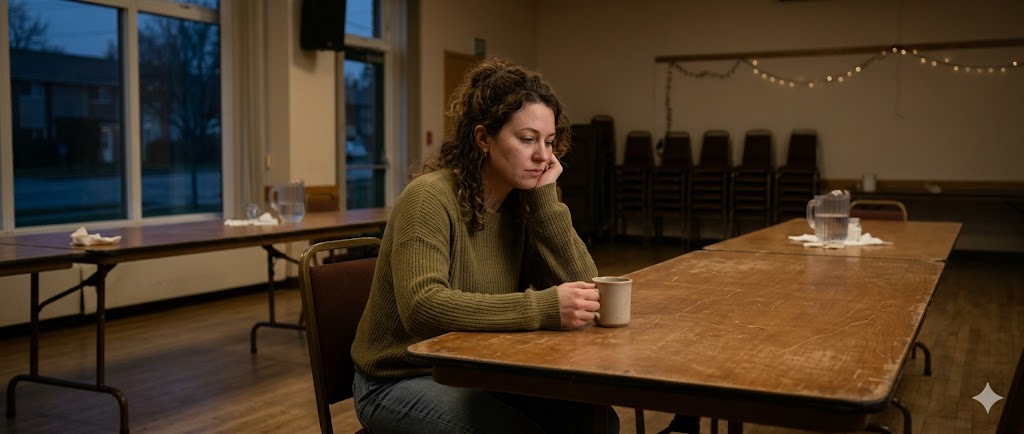
That hollow, wrung-out feeling after a social event — even one you genuinely enjoyed — is one of the most disorienting experiences for introverts. You said the right things, laughed at the right moments, maybe even had a good time. And now you’re sitting alone feeling scraped clean, like something essential was taken without your permission. This is not ingratitude. It is not social anxiety. It is your nervous system doing exactly what it was built to do — and understanding why introverts feel empty after socializing changes how you manage it entirely.
What’s Actually Happening in Your Brain When Introverts Feel Empty After Socializing
The neurological explanation starts with arousal sensitivity. Introversion is strongly associated with a baseline of higher central nervous system (CNS) arousal. Because your brain is already running closer to its stimulation threshold, social interaction — which adds noise, unpredictability, eye contact, emotional processing, and the constant monitoring of conversational cues — pushes you past that threshold faster than it would for someone with lower baseline arousal. Your brain hasn’t been drained of energy in the way a battery discharges. It has been overstimulated, and the emptiness is the aftermath of that overload.
Neurochemistry matters here too. Introverts are more sensitive to dopamine, the neurotransmitter linked to external reward and stimulation. Research by psychologist Brian Little and others building on Hans Eysenck’s arousal theory suggests that introverts reach dopamine saturation more quickly in social settings. Meanwhile, acetylcholine — associated with calm focus, inner reflection, and the reward introverts get from solitude — gets depleted when you’re spending hours in reactive, outward-facing mode. The emptiness you feel is partly the gap left when acetylcholine pathways haven’t had time to restore.
Cortisol is the third piece. Extended social performance — especially with people you don’t know well, or in groups where you’re managing impressions — elevates cortisol. After the event ends, your cortisol doesn’t drop immediately. It tapers. That window between leaving the social situation and returning to baseline is often when the emptiness feels most acute. You’re post-peak, running on fumes, and your nervous system is signalling clearly: stop now.
Signs That Introvert Social Exhaustion Is What You’re Dealing With
It often shows up as a specific kind of blankness rather than sadness. You might stare at your phone without actually reading anything on the screen. Conversations feel like they happened to someone else. You want to eat something but can’t decide what. Small sounds — a TV in another room, a notification ping — feel disproportionately irritating.
You might notice that your thinking goes flat. Introverts typically have a rich internal monologue, but after heavy socializing it goes quiet in an unpleasant way, like a radio with no signal. Decision-making feels genuinely hard. Choosing what to watch, whether to text someone back, what to do next — all of it requires more cognitive effort than it should.
Physically, introvert social exhaustion can feel like mild flu-adjacent symptoms: slight headache behind the eyes, tension in the jaw and shoulders, a vague heaviness in the chest. Some people describe it as feeling slightly behind glass — present but not quite connected to the room around them. These are real physiological responses, not melodrama.
What Actually Helps Your Social Battery Recharge
Recovery is not simply waiting. Passive time in front of a screen often delays recovery rather than accelerating it, because your CNS is still processing visual and auditory input. What restores your introvert nervous system is low-stimulation, low-demand activity that uses acetylcholine pathways — the ones associated with inner focus and reflection.
- Block the first 90 minutes intentionally. When you get home after socializing, treat the first 90 minutes as protected transition time. No phone calls, no scrolling social media, no group chats. Your nervous system needs a genuine off-ramp. Even if you feel fine, give it this window — the crash often arrives 45-60 minutes after you stop socializing, not immediately.
- Do one solitary physical thing. A 20-minute walk without headphones, stretching, or making tea slowly and deliberately — anything that keeps your body mildly active but your social brain offline. This helps cortisol taper faster than lying still does, because gentle movement supports cortisol metabolism without adding stimulation.
- Eat something with protein and complex carbohydrates. Sustained social performance is metabolically costly. Your brain has burned through glucose maintaining alertness, managing social cues, and regulating emotional responses. A small meal — not junk food, which spikes and crashes blood sugar — stabilises your mood and supports neurotransmitter production.
- Give yourself permission to do something absorbing and solitary. Reading, a single-player game, a craft, cooking something new — anything that channels your attention inward and requires gentle focus. This is what activates acetylcholine reward pathways and produces the specific calm that introverts need to feel like themselves again.
- Sleep is not optional recovery — it is the recovery. If the event was genuinely draining, one evening of quiet activity is often not enough. The deeper restoration happens during sleep, when your brain consolidates the social information it processed and your nervous system resets. Prioritising a full night of sleep after a heavy social day is not weakness; it is accurate biology.
- Build buffer time before the next obligation. The most common mistake is scheduling something the morning after a draining evening. If you know an event will cost you, protect the following morning. Even two hours of unscheduled quiet before your next demand makes a measurable difference in how fully you recover.
Social Battery Recovery Estimator
Answer 5 questions about your recent social event. You’ll get a personalised recovery window and two specific tips.
1. How long did the social event last?
2. How well did you know the people there?
3. What was the noise / stimulation level?
4. Did you feel pressure to perform or be “on”?
5. How do you feel right now?
When to Pay Attention to the Pattern
Feeling empty after socializing is normal for introverts. But if the emptiness extends for days rather than hours, bleeds into relationships you normally value, or arrives even after low-effort social contact with people close to you, that is worth paying attention to. Chronic depletion without adequate recovery can deepen into introvert burnout — a state where even solitude stops feeling restorative. If recovery is no longer working the way it used to, talking with a therapist familiar with high-sensitivity or introvert psychology is a reasonable and practical step.
Questions People Ask
Why do introverts feel empty after socializing even when they had a good time?
Enjoyment and depletion are not opposites. Your brain can reward you with genuine pleasure during a conversation while simultaneously accumulating the CNS overload that causes the emptiness afterward. The two processes run in parallel. Enjoying yourself doesn’t reduce the neurological cost of sustained social engagement for an introvert nervous system.
How long does introvert social exhaustion last?
For a typical social event of 2–4 hours, most introverts feel meaningfully restored after one evening of low-stimulation activity plus a full night of sleep. Longer or higher-pressure events — work conferences, multi-day family gatherings, weddings — can require two to three days of protected recovery time before the social battery is genuinely recharged.
Is feeling empty after socializing the same as social anxiety?
No. Social anxiety involves fear and apprehension before or during social situations. Introvert social exhaustion is a post-event phenomenon rooted in CNS arousal and neurochemical depletion, not fear. Some introverts also have social anxiety, but the two are separate. You can dread nothing about an event and still feel completely emptied by it.
Does the social battery recharge faster with certain types of socializing?
Yes, consistently. One-on-one conversations with people you trust are significantly less costly than group settings. Familiar environments reduce the monitoring load on your brain. Conversations with a clear purpose — working through a problem together, a shared interest — are less draining than open-ended small talk, which requires constant impression management without a cognitive anchor.
Can introverts build up a tolerance to social exhaustion over time?
Skills that reduce the cognitive cost of socializing — knowing what to say in common situations, feeling confident in a particular setting — can reduce how draining specific contexts are. But the underlying CNS sensitivity doesn’t disappear with practice. What changes is your efficiency, not your fundamental wiring. Managing your schedule and recovery remains more effective than trying to override your neurology.
The emptiness you feel after socializing is not a flaw in your character or a sign that something went wrong. It is information. Your nervous system is precise about what it needs, and the more accurately you read that signal — and respond to it rather than push through it — the more fully present you can be the next time you choose to show up.