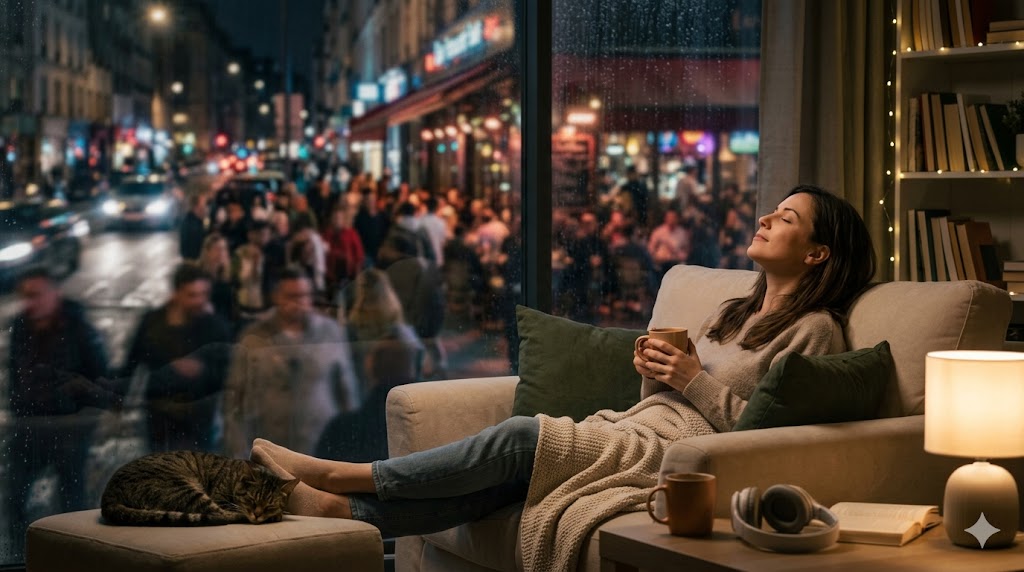
For introverts, needing alone time after socializing is not a preference or a quirk. It is a biological necessity. You can enjoy a dinner party, a work event, or a long phone call with someone you love — and still walk away feeling like you ran a marathon. That gap between enjoying something and being depleted by it confuses a lot of people, including introverts themselves.
What Happens to Your Brain When You Need Alone Time After Socializing
The clearest explanation comes from neurochemistry. Research into introversion consistently points to differences in how introverted brains process dopamine. Extroverts tend to seek dopamine hits from external stimulation — conversation, crowds, novelty. Introverts are more sensitive to dopamine and also rely more heavily on acetylcholine, a neurotransmitter associated with quiet focus and internal reward. Social situations flood the introvert’s system with more stimulation than it needs or wants.
Psychologist Carl Jung, who first mapped introversion as a personality orientation, described introverts as people who draw energy from their inner world. External engagement costs that energy. This maps closely onto what modern personality research calls high reactivity to stimulation — a trait measured consistently in Big Five studies under the domain of extraversion.
None of this means socializing is harmful. It means your nervous system is working exactly as designed. After meaningful social contact, your brain needs time to process, consolidate, and return to a lower arousal state. Alone time after socializing is how that happens. It is not avoidance. It is recovery.
Signs Your Social Exhaustion Is Real, Not Imaginary
You might notice it as a specific kind of tiredness that sleep does not immediately fix. After a full day with people, you get home and feel simultaneously wired and drained — too tired to do anything, too overstimulated to rest easily.
It often shows up as irritability that has nothing to do with the people you were with. You had a perfectly fine time. Now you are home and small things are aggravating in a way that feels disproportionate. That is your nervous system signalling overload, not a character flaw.
Social exhaustion in introverts also tends to affect concentration. After a heavily social day, reading feels harder. Following a film feels like effort. You are not becoming less intelligent — your cognitive resources have been redirected toward processing all that interpersonal data: tone, expression, conversation, social cues. Your brain has been working hard in ways that are largely invisible.
What Actually Helps With Introvert Energy Recovery
The single most effective thing is protecting the transition. When you leave a social situation, do not schedule anything immediately after. Even thirty minutes of unstructured time — no phone, no obligations — makes a measurable difference to how quickly you recover.
Silence is more restorative than ambient noise for most introverts. This is not about being antisocial at home. It is about letting your auditory system stop processing. A podcast or background TV keeps part of your brain engaged. Actual quiet does not.
Physical movement in solitude — a walk alone, not with someone else — can accelerate introvert recharge. It is not the exercise that helps as much as the combination of mild physical engagement with mental freedom. Your thoughts settle when your body is moving and nobody is talking to you.
Stop explaining or apologising for needing to leave gatherings early, or for going quiet after a social day. Every time you justify your need for alone time after socializing, you add a small social cost to the recovery process itself. You do not owe anyone an explanation for how your nervous system works.
Finally, give the recovery window a realistic length. One hour is rarely enough after a full social day. Many introverts find they need an entire quiet evening, sometimes extending into the following morning, before they feel genuinely restored. Building that expectation in honestly — rather than hoping to bounce back quickly — reduces the secondary frustration of feeling like something is wrong with you.
When to Get Support
Needing alone time after socializing is normal for introverts. But if social exhaustion is so severe that it stops you from maintaining relationships you value, or if it arrives after even minimal contact and leaves you unable to function, that may be worth exploring with a therapist. Social anxiety and introversion can overlap, and a professional can help distinguish between the two. There is no drama in getting that kind of clarity.
A Few Questions Worth Answering
Why introverts need alone time at all
Why introverts need alone time comes down to recovery: social contact draws on a reserve that only solitude refills.
How much alone time after socialising is needed?
Alone time after socialising scales with the number of separate interactions rather than the hours. Why introverts need alone time is a capacity question.
Is introvert needs solitude a preference or a requirement?
Introvert needs solitude is closer to a requirement than a preference. Why introverts need alone time is physiological rather than attitudinal.
What happens when you skip it?
Skipping recovery compounds. Why introverts need alone time becomes obvious after a fortnight without any.
- Is needing alone time after socializing a sign of social anxiety?
-
Not necessarily. Social anxiety involves fear and avoidance of judgment. Introvert energy recovery is about nervous system restoration after stimulation, not fear. Many introverts enjoy social situations and still need significant downtime afterward. If dread is the dominant feeling — not tiredness — that is worth examining more carefully.
- How long does it take introverts to recharge after socializing?
-
It varies by person and by the intensity of the social event. A casual one-hour coffee might need thirty minutes of quiet afterward. A full-day social event could require an entire evening plus a slow morning. Introvert recharge is not a fixed duration — it scales with the stimulation load involved.
- Why do I feel guilty for wanting to be alone after seeing people I like?
-
Because most social messaging equates wanting alone time with not caring. Neither is true. You can genuinely love someone and still need to recover from spending time with them. The guilt is cultural, not logical. Recognising that distinction tends to reduce it over time.
- Does introvert social exhaustion get worse with age?
-
Some introverts report it does, partly because tolerance for overstimulation decreases with age and partly because older adults often have less margin for recovery time. What changes more reliably with age is self-awareness — most introverts get better at recognising their limits and protecting them.
Your need for alone time after socializing does not make you difficult, cold, or antisocial. It reflects how your brain is wired. The more accurately you understand that, the less time you spend fighting it — and the faster you actually recover.