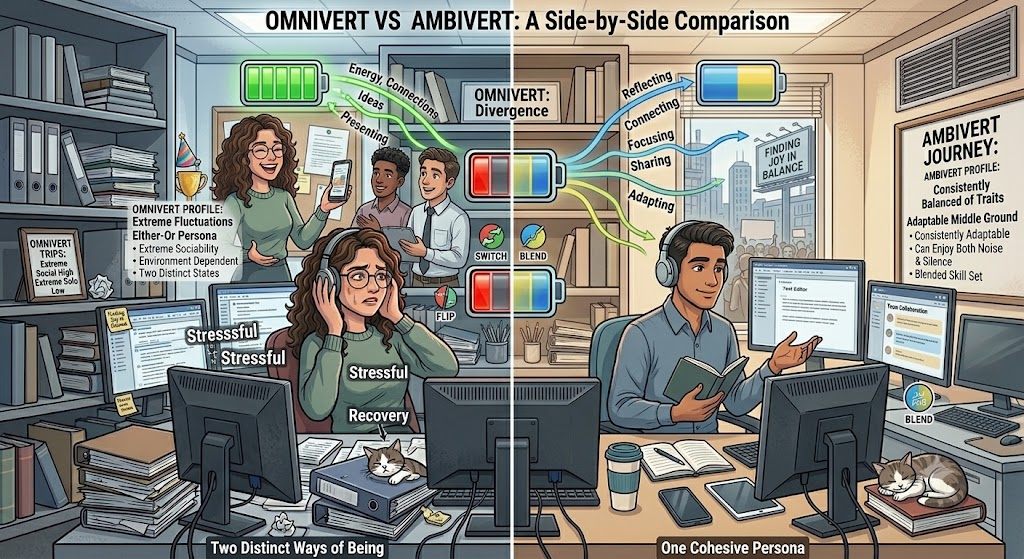
The omnivert vs ambivert debate matters more than it might seem, because getting this wrong means misreading your own energy patterns for years. Both types sit somewhere between introvert and extrovert on the personality spectrum, but they behave very differently — and the distinction has real consequences for how you structure your social life, your work, and your recovery time.
What Omnivert vs Ambivert Actually Means, Psychologically
An ambivert sits in the middle of the introvert-extrovert spectrum and stays there. They draw moderate energy from social situations and lose moderate energy from solitude. The experience is relatively consistent. They can work in open offices without shutting down, and they can spend a quiet weekend alone without going stir-crazy. Research by Adam Grant at Wharton found that ambiverts often outperform both introverts and extroverts in contexts requiring social flexibility, precisely because their baseline is already balanced.
An omnivert swings between the two extremes. They are fully introverted in some situations and fully extroverted in others — not a blend, but a shift. The trigger might be context, mood, stress levels, or who is in the room. When they’re in extrovert mode, they genuinely need social engagement. When they flip, they need deep solitude just as urgently. There is no comfortable middle ground for an omnivert. They feel things at either end of the dial.
The introvert-extrovert spectrum, as Carl Jung originally described it, was never a binary. But the omnivert vs ambivert distinction adds a second dimension: not just where you land on the spectrum, but how stable that position is.
Signs You Might Be One or the Other
Ambiverts often find social situations easy to read. They can move between a team meeting and an afternoon of solo work without a noticeable crash or surge. They rarely feel socially drained in a dramatic way, and they rarely feel desperate for company either. If someone asks whether you prefer people or solitude, you genuinely answer “depends” — and the depends is not extreme in either direction.
Omnivert patterns look different. You might go through a phase of accepting every invitation, being the loudest person in the room, then suddenly need two weeks of near-total isolation to feel like yourself again. The shift can feel involuntary. You might confuse people close to you because your social appetite seems completely inconsistent. It often shows up as others saying you seem like a different person depending on the day — and they are not wrong. You were socially energised last Thursday; today the thought of small talk is genuinely painful.
The key marker is variability. Ambiverts are consistent. Omniverts oscillate.
What Actually Helps Each Type
If you are an ambivert, your main challenge is not energy management — it is identity. Because you do not fit cleanly into the introvert or extrovert box, you may spend energy trying to figure out which one you “really” are. Stop. Accept that your natural state is the middle, and design your life accordingly. Roles that mix independent work with regular social contact tend to suit you well. You do not need to fix anything.
If you are an omnivert, the work is about pattern recognition. Start tracking when your extrovert phases tend to arrive — are they linked to low stress, certain environments, specific people? Knowing your triggers gives you some control. When a social shutdown is coming, do not treat it as a personal failure or try to push through with willpower. Schedule the recovery time before you need it.
When you are in an extrovert phase, use it — make the calls, attend the events, have the difficult conversations. When you shift, protect that time without over-explaining. You do not owe anyone a detailed account of why you are less available this week.
Both types benefit from understanding that neither end of the omnivert vs ambivert spectrum is a disorder. They are different architectures, not better or worse ones.
When to Get Support
If your swings between social craving and withdrawal feel completely uncontrollable, cause significant distress, or are accompanied by shifts in mood, sleep, or self-worth, it is worth speaking to a psychologist. Extreme variability in social energy can sometimes overlap with mood dysregulation that goes beyond personality type. A professional can help you distinguish between personality pattern and something that genuinely benefits from clinical attention.
A Few Questions Worth Answering
- Is omnivert a real personality type?
- It is not a formal clinical category, but the omnivert personality is a widely recognised pattern in personality psychology. It describes someone whose introvert or extrovert orientation shifts significantly depending on context and internal state, rather than sitting at a stable midpoint the way an ambivert does.
- What is the ambivert meaning in simple terms?
- An ambivert is someone whose social energy needs are moderate and consistent. They are neither strongly introverted nor strongly extroverted. The ambivert meaning centres on balance — not swinging between extremes, but sitting comfortably in the middle of the introvert-extrovert spectrum most of the time.
- Can an introvert become an omnivert?
- Personality traits are relatively stable across adulthood, according to Big Five research. However, life changes — a new city, a new career, recovery from burnout — can shift how your social energy expresses itself. What looks like becoming an omnivert may be a genuine shift in social comfort, or it may be context-dependent behaviour on top of an introverted baseline.
- How do I know if I am on the introvert-extrovert spectrum as an omnivert or ambivert?
- Track your energy, not your behaviour. Ambiverts feel relatively even across varied social situations. Omniverts feel genuine swings — real need for social engagement at some points, real need for isolation at others. If your internal experience shifts dramatically rather than staying moderate, omnivert is likely the closer fit.
Personality labels are only useful when they help you understand your actual experience more clearly. If the omnivert vs ambivert distinction gives you a more accurate map of how you function socially, use it. If neither fits perfectly, that is also fine — you are not obligated to find a word that contains you completely.