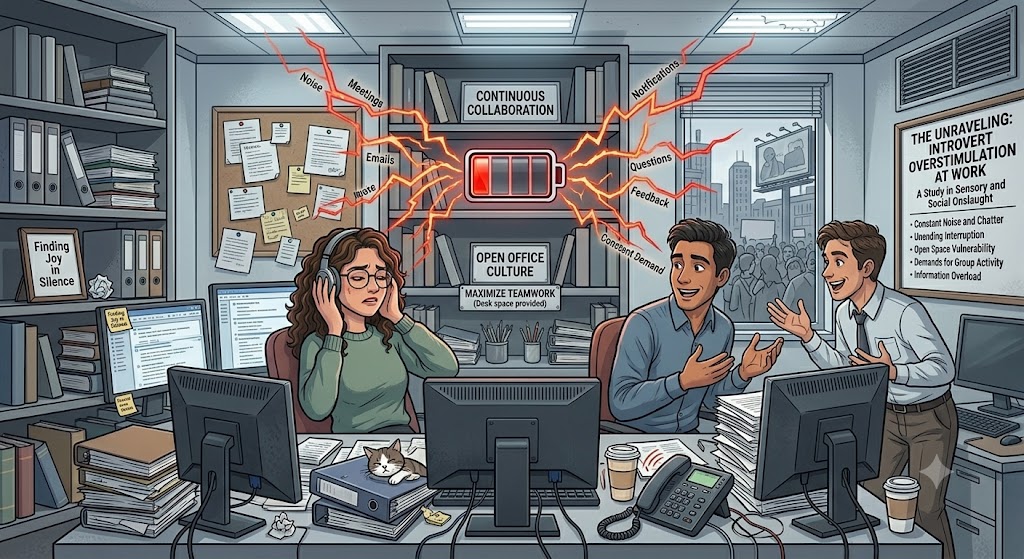
Introvert overstimulation at work is not about being shy or antisocial. It is a neurological reality — your brain processes incoming information more deeply than most, and open offices, back-to-back meetings, and constant digital noise push that system past its limit. By mid-afternoon, you are not tired because you worked hard. You are tired because your brain has been processing at full volume since 9am.
Why Introvert Overstimulation at Work Happens
The difference between introvert and extrovert brains is not a personality myth. Research into cortical arousal — much of it building on Hans Eysenck’s original work — suggests introverts reach their optimal stimulation threshold faster. Your nervous system is already running closer to its ceiling. Add fluorescent lighting, overlapping conversations, Slack notifications, and a hot-desk neighbour on a long phone call, and you hit that ceiling well before lunch.
Dopamine and acetylcholine also play a role. Extroverts tend to respond strongly to dopamine, the reward signal tied to external stimulation. Introverts lean more on acetylcholine pathways, which reward focused, internal thinking. The modern open-plan office is essentially a dopamine delivery machine — constant novelty, noise, and social cues. For introverts, it is less a reward and more a tax on every hour spent inside it.
This is not a flaw. It is simply a mismatch between how your brain works and how most workplaces are designed.
Signs You Are Overstimulated at Work
It often shows up as a specific kind of exhaustion — not the satisfying tiredness of deep work, but something flatter and more irritable. You might notice that small interruptions feel disproportionately disruptive. A colleague asking a quick question sends your train of thought off the rails for twenty minutes. You start making errors on straightforward tasks, not because the work is hard, but because your brain’s processing capacity is stretched thin.
Sensory overload for introverts at work can also feel physical. A dull headache that appears around midday. Sensitivity to sounds you can usually ignore. A strong pull toward any quiet corner — the stairwell, a bathroom cubicle, a five-minute walk outside. These are not signs of weakness. They are your nervous system flagging that it needs less input, not more.
Emotionally, you might feel withdrawn or flat after a morning of meetings, even if the meetings went well. The content was fine. The volume was not.
What Actually Helps With Introvert Energy Drain
The first practical step is protecting at least one uninterrupted block each day. Not two hours if one is all you can negotiate — just one. Block it in your calendar as a meeting with yourself. Label it something neutral like “focused work” if your workplace culture would question it. Use that time for your most demanding thinking, not email.
Noise-cancelling headphones are not antisocial. They are a tool. Wearing them signals to colleagues that you are in focus mode. Most people respect this if you are consistently responsive at other times. You do not need to explain yourself.
When you have a dense meeting schedule, build a ten-minute gap between sessions rather than stacking them. Even sitting quietly for ten minutes — not scrolling, not replying — allows your nervous system to partially reset. A short walk outside does this faster than sitting at your desk.
Learn to leave social situations at work without over-explaining. If a lunch gathering is draining you, eat quickly and go. A friendly nod and “I’ve got something to finish up” is enough. Lengthy apologies draw more attention than a clean exit.
Finally, track when your low-stimulation hours tend to occur — early morning, late afternoon, before others arrive. Protect those windows for your highest-stakes thinking. Match the work to your energy, not the other way around.
When to Get Support
Overstimulated at work occasionally is normal. If you are arriving home unable to speak, consistently sleeping through weekends to recover, or feeling dread on Sunday evenings that is growing stronger over months, that pattern is worth taking seriously. Chronic overstimulation can tip into burnout, which is harder to reverse. A therapist familiar with workplace stress, or a GP if physical symptoms persist, is a reasonable next step — not a dramatic one.
A Few Questions Worth Answering
What causes introvert overstimulation at work?
Introvert overstimulation at work comes from environment rather than workload: open plan noise, constant interruption and back-to-back meetings.
What does being overstimulated at work feel like?
Being overstimulated at work feels like fog by mid-afternoon, with simple decisions taking disproportionate effort.
Why is an open plan office introvert workers hardest?
An open plan office introvert workers occupy delivers unpredictable sound and movement all day, which is the most expensive combination.
How do you reduce work overstimulation?
Work overstimulation drops with headphones, a seat facing the wall and one protected block daily. Introvert overstimulation at work is largely an environment problem.
- Is introvert overstimulation at work the same as anxiety?
They can overlap but are not the same. Overstimulation is primarily about sensory and cognitive load. Anxiety involves a fear response that persists even in calm environments. If the feelings ease significantly when you have quiet time alone, overstimulation is likely the main factor. - Can introverts thrive in open-plan offices?
Yes, with the right strategies. Introverts who manage their sensory environment — headphones, early arrival, negotiated focus blocks — often perform well. The office design works against you, but it is not insurmountable if you actively protect your attention. - Why do I feel more drained after virtual meetings than email?
Video calls demand sustained eye contact, real-time facial processing, and constant social monitoring — all at once. Email lets you process at your own pace. For introverts, the cognitive load of a one-hour video call is genuinely higher than an equivalent written exchange. - How long does it take to recover from introvert energy drain?
It depends on how depleted you are. Mild overstimulation often resolves with a few hours of quiet. After a heavy week, some introverts need a full day of low-stimulus activity — reading, solo walks, limited screen time — before they feel restored. Pushing through without recovery extends the depletion.
The workplace was not built with introvert neurology in mind. That is a fact, not a complaint. Knowing exactly why you drain faster than your extrovert colleagues means you can make targeted changes rather than assuming something is wrong with you. Small adjustments to your environment and schedule make a measurable difference over time.