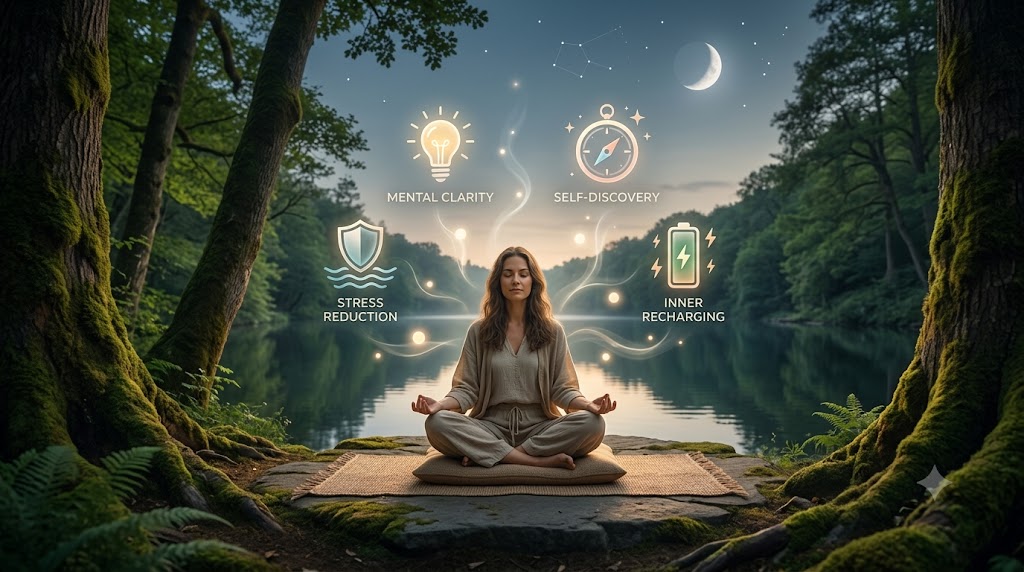
Meditation benefits for introverts go deeper than stress relief — they align with how the introvert brain is already wired. If social interaction drains you and solitude restores you, sitting quietly with your own mind is not a stretch. It is closer to your natural state than most wellness advice will admit. This is not about becoming more zen. It is about giving your nervous system something it genuinely needs.
Why Meditation Fits the Introvert Brain
Research in personality neuroscience suggests introverts have higher baseline arousal in the cortex — meaning the introvert brain is already processing more internal stimulation than an extrovert’s brain at rest. Psychologist Hans Eysenck proposed this in the 1960s, and later work on the neurotransmitter acetylcholine supports the idea: introverts tend to favour the longer, internal reward pathway that runs on acetylcholine rather than the faster, external dopamine hit that extroverts often seek.
What this means practically is that introverts are predisposed to internal reflection. Meditation does not ask you to do something foreign — it asks you to do something you are already inclined toward, but with more structure and intention. The stillness is not the hard part for most introverts. The hard part is letting go of the internal critic long enough to actually rest in that stillness.
Studies from institutions including Harvard Medical School have shown regular meditation reduces activity in the default mode network — the brain’s rumination circuit. For introverts prone to overthinking, this is one of the most concrete meditation benefits for introverts worth understanding. Less loop, more clarity.
Meditation Benefits for Introverts: Why Stillness Feels Like Coming Home
If you’re an introvert, you already know the exhaustion that comes from too much noise, too many people, too much everything. The world is loud. It demands performance. And by the end of most days, you’re running on empty.
Meditation doesn’t just help — it feels, for introverts especially, like finding a room you didn’t know existed inside yourself.
Here’s why.
Step 1: It Gives You Permission to Stop
Most of us spend our energy pretending we’re fine with the constant buzz of modern life. Meditation is the first practice that looks you in the eye and says: you don’t have to be.
Even five minutes of conscious stillness tells your nervous system it’s safe to exhale. For introverts who spend all day filtering stimulation, that exhale is everything.
What to do: Start with just 5 minutes in the morning before you check your phone. Sit. Breathe. Notice.
Step 2: It Recharges You Faster Than Sleep Alone
Sleep restores the body. Meditation restores your inner world — the one introverts guard so fiercely and deplete so quietly.
Studies consistently show that even brief meditation sessions reduce cortisol, lower heart rate, and return the mind to a baseline of calm. For introverts who run hotter internally than they ever show externally, this is nothing short of transformative.
What to do: Try a body scan meditation after work. Lie down, close your eyes, and slowly bring attention to each part of your body from feet to head. Ten minutes feels like two hours of rest.
Step 3: It Sharpens the Inner Voice You Already Rely On
Introverts live inside their heads. You think deeply, feel deeply, and process everything before you ever speak. The problem is that the world’s noise drowns out that inner clarity — and you end up second-guessing the very instincts you should trust.
Meditation quiets the interference. It doesn’t create your intuition. It clears the static so you can actually hear it.
What to do: After meditation, spend two minutes journaling whatever surfaces. Don’t edit. Don’t judge. Just write. You’ll be surprised how much you already knew.
Step 4: It Builds a Private Sanctuary No One Can Touch
Here’s something nobody tells you: meditation creates an internal space that belongs entirely to you. No small talk required. No social energy burned. It’s solitude without loneliness — depth without isolation.
For introverts, this is sacred. When the world demands too much, you’ll have somewhere real to go — and you won’t need a plane ticket to get there.
What to do: Develop a short ritual around your practice. Same spot, same time, same few deep breaths to begin. The consistency trains your mind to drop into stillness faster each time.
Step 5: It Makes Social Exhaustion Manageable
Meditation won’t make you love crowded rooms. But it will help you recover from them faster — and handle them with far more grace while you’re in them.
When you meditate regularly, your reactivity lowers. You stop being hijacked by the noise. You can be present in social situations without losing yourself in them, and when you finally get home and close the door, you come back to yourself in minutes instead of days.
What to do: If you know a draining social event is coming, meditate beforehand. Start from full, not from empty.
Signs That Meditation Might Be Exactly What You Need
You might notice that after a busy week — too many meetings, too many people, too many decisions — your mind does not quiet down even when the schedule does. You finally get time alone but your brain keeps replaying conversations, rehearsing things you should have said, or anticipating what comes next. That loop is exhausting in a way that sleep alone does not fix.
It often shows up as a kind of restless fatigue: tired but unable to switch off. Some introverts describe it as feeling overfull — like there is no more room to take in anything, but the mind keeps spinning anyway. Physical tension in the shoulders, jaw, or chest frequently accompanies it.
If solitude used to restore you but lately it feels insufficient — if you need more and more quiet time just to feel functional — that is worth paying attention to. Mindfulness for introverts is not about adding another thing to do. It is about making the alone time you already value actually restorative, rather than just time spent alone with a busy mind.
What Actually Helps: Specific Practices Worth Trying
Start with five minutes, not twenty. Sitting for twenty minutes when you are new to meditation is like starting a running habit with a half-marathon. Five minutes of genuine attention beats twenty minutes of fidgeting and self-criticism. Set a timer and commit to the five minutes fully.
Breath-focused meditation works well for introverts because it uses the internal focus you already have. Sit, close your eyes, and count each exhale up to ten. When you lose count — and you will — start again at one. No judgment. Just start again. The reset is the practice, not the failure.
Body scan meditation is particularly useful after social exhaustion. Lie down and move your attention slowly from your feet to the top of your head, noticing tension without trying to fix it. It takes about ten minutes and works better than scrolling through your phone for an hour.
Protect your meditation time the same way you protect your alone time. Tell people you are unavailable. Do not apologise for it. Close the door. The introvert-specific benefit of meditation compounds when it becomes a reliable anchor in your week — not an occasional experiment.
Skip guided meditations with heavy music or overly enthusiastic narration if they irritate you. A calm, neutral voice or silence works better for most introverts. Apps like Insight Timer let you filter by teacher style and length, which makes finding a fit much easier.
When to Get Support
Meditation is not a treatment for anxiety disorders, depression, or trauma — it can complement professional support, but it should not replace it. If your internal world feels consistently overwhelming, if intrusive thoughts are frequent or distressing, or if quiet time reliably brings up difficult emotions you cannot manage alone, speaking with a therapist is the appropriate step. Introverts sometimes assume they should be able to handle inner experience privately. That assumption is worth questioning.
A Few Questions Worth Answering
How long should meditation for introverts actually be?
Meditation for introverts does not need length to work. Ten minutes done daily beats forty minutes done occasionally, because the benefit comes from the habit of returning rather than the duration of any one sitting.
Does meditation for introverts work differently than for other people?
Meditation for introverts often clicks faster, because sustained internal attention is already the default. The difficulty is usually stillness of body, not stillness of mind.
What are the main meditation benefits introvert practitioners report?
The meditation benefits introvert practitioners describe most are shorter recovery after social contact and a slower slide into rumination.
Does meditation help introverts who already overthink?
Does meditation help introverts who overthink? Often yes, though not by stopping thought. Meditation for introverts works by changing your relationship to the loop rather than ending it.
- Do introverts meditate more easily than extroverts?
-
Often, yes — but not automatically. Introverts are comfortable with internal focus, which removes one barrier. The challenge for introverts tends to be overthinking during practice rather than discomfort with silence. The skill is learning to observe thoughts rather than follow them.
- How long before meditation shows real results?
-
Research generally points to eight weeks of consistent daily practice — even ten minutes a day — before measurable changes in stress response and attention appear. Introvert mental health benefits often feel noticeable sooner because the practice fits naturally into existing habits of solitude and reflection.
- Is mindfulness for introverts different from general mindfulness?
-
The technique is the same. What differs is the context. Introverts often find meditation most useful as a way to recover from social drain and quiet rumination — rather than as a general productivity tool. Framing it that way makes it easier to maintain as a practice.
- Can meditation make introversion worse — more withdrawn?
-
This is a fair concern. Meditation increases comfort with internal experience, which for introverts occasionally tips into avoidance. The practice itself is neutral. If you notice yourself using meditation as a reason to avoid necessary interaction, that is worth examining honestly — possibly with a therapist.
Introverts and meditation are a natural pairing not because introverts are already enlightened, but because the practice asks for exactly the kind of inward attention that comes most naturally to you. The real benefit is not calm for its own sake — it is the ability to actually rest inside your own mind, rather than just occupying it.