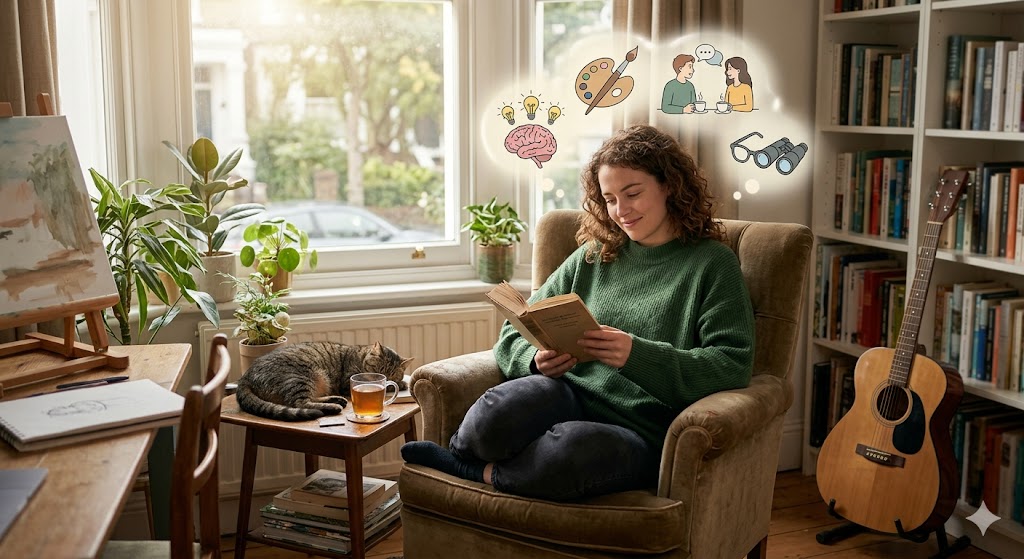
How introverts can embrace their personality? You don’t need to change your personality — you need to understand it clearly enough to stop fighting it. Introversion is not a flaw to manage or a phase to grow out of. If you’ve spent years feeling like you’re doing something wrong by needing quiet, preferring depth over breadth, or finding social exhaustion a real and predictable thing, this is worth reading carefully. Learning to embrace introvert personality can shift the way you experience your daily life.
What It Actually Means to Embrace Introvert Personality
The word ‘introvert’ was used by Carl Jung to describe people who turn inward for energy rather than outward. Decades of psychology research have confirmed that introversion is a stable personality trait — not a social disorder, not shyness (though they can overlap), and not something that responds to enough practice or willpower.
At a neurological level, introverts tend to have higher baseline arousal in the brain, which means external stimulation — loud rooms, group conversations, prolonged social contact — can tip quickly into overwhelm. This isn’t sensitivity as a weakness. It’s simply how your nervous system is calibrated. Acetylcholine, a neurotransmitter associated with calm focus and inward reflection, tends to be more active in introverted people. Extroverts run more heavily on dopamine, which drives reward-seeking through external experience.
Understanding this matters because it reframes the problem. When you leave a party early, cancel plans to recover, or prefer one meaningful conversation to a room full of small talk, you’re not being antisocial. You’re responding accurately to what your brain needs. To embrace your introvert personality is to stop interpreting those accurate responses as personal failures.
Signs That You Haven’t Fully Accepted Your Introvert Traits
It often shows up as constant apology. You apologise for needing to leave, for not calling back quickly enough, for being quiet in meetings. You frame your preferences as deficits — ‘I’m not very good at networking’ instead of ‘I find shallow networking draining and mostly useless.’
You might notice yourself pushing hard against your natural rhythm, saying yes to every invitation out of guilt, then arriving already depleted and leaving feeling worse. Or you mask so thoroughly in social situations that people are genuinely surprised when you describe yourself as an introvert — which leaves you feeling invisible in a different way.
Another pattern worth recognising: you measure your social life by extrovert standards. You count how many events you attended rather than how many conversations actually meant something. You worry that one close friend isn’t enough, even when that friendship gives you more than a wide social circle ever did. These comparisons don’t reflect what works for you — they reflect what a louder culture has said should work for you.
What Actually Helps When You’re Learning to Work With Your Personality
Start by auditing your language. When you catch yourself framing introvert traits as problems — ‘I’m too quiet,’ ‘I overthink everything,’ ‘I’m not good with people’ — pause and restate it factually. You’re not too quiet. You’re selective about when speaking adds something. That’s a different thing.
Build recovery time into your schedule before you need it, not after you’ve hit the wall. If you have a long social commitment on Saturday, protect Sunday. Not as a reward — as a structural reality. Treat it the way you’d treat a flight you can’t miss.
Stop explaining yourself in situations that don’t require explanation. When you leave a gathering, you don’t owe anyone a detailed account of why. A simple ‘I’m heading off — good to see you’ is complete. The need to justify your limits to people who didn’t ask is often a sign of internalised shame, not politeness.
Invest in fewer, slower relationships. One person you can talk to honestly is worth more than ten acquaintances you perform for. Being an introvert often means you build trust slowly and loyalty deeply — let your social choices reflect that, rather than fighting it.
Finally, find contexts where your introvert traits are assets. Research, writing, deep listening, independent problem-solving, sustained focus — these aren’t consolation prizes. Many fields and relationships actively benefit from exactly what you bring. Placing yourself in those contexts more often isn’t avoidance. It’s accuracy.
When to Get Support
Introversion and anxiety are not the same thing, but they can layer on top of each other in ways that make daily life harder than it needs to be. If social situations don’t just drain you but genuinely frighten you — if avoidance is limiting your work, relationships, or health — that’s worth exploring with a therapist. A good one won’t try to make you into an extrovert. They’ll help you separate what’s personality from what’s distress.
A Few Questions Worth Answering
What does embracing being an introvert actually mean?
Embracing being an introvert means designing around the trait rather than apologising for it. It is a planning decision, not an attitude adjustment.
How to accept being an introvert after years of being told to change
How to accept being an introvert usually starts with separating the trait from the criticism attached to it. The quietness was never the problem.
Is being proud of being an introvert overdoing it?
Being proud of being an introvert is unnecessary; being unapologetic is enough. Embracing being an introvert does not require treating it as an achievement.
Does embracing being an introvert mean avoiding people?
Embracing being an introvert means choosing your social load deliberately, not reducing it to zero.
- Is being an introvert a mental health condition?
-
No. Introversion is a normal personality trait, not a disorder. It sits on a spectrum and is well-documented in personality research including the Big Five model. It becomes a mental health concern only when it’s entangled with anxiety, depression, or avoidance that significantly limits functioning.
- Can introverts become more extroverted over time?
-
Research suggests core personality traits are relatively stable across a lifetime. You can develop social skills and become more comfortable in social settings, but that’s different from changing your underlying introversion. Trying to sustain an extroverted lifestyle long-term tends to cost introverts more than it gains them.
- Why do I feel guilty for needing alone time?
-
Because most cultural messaging — at work, in friendships, in families — treats sociability as the default good. Needing quiet gets framed as withdrawal or unfriendliness. That guilt is learned. It doesn’t reflect anything true about the value of solitude or about you as a person.
- How do I explain introversion to people who don’t get it?
-
Keep it simple and factual: social interaction costs you energy in a way it doesn’t cost everyone. You’re not avoiding people — you’re managing your capacity. Most people understand energy depletion when it’s framed that way. You don’t need to convince anyone; a brief, clear explanation is enough.
Choosing to embrace introvert personality doesn’t mean rejecting social life or retreating permanently. It means building a life that fits how you actually function rather than how you think you should function. That adjustment — small, practical, and honest — tends to be quieter than a revelation. But it tends to stick.