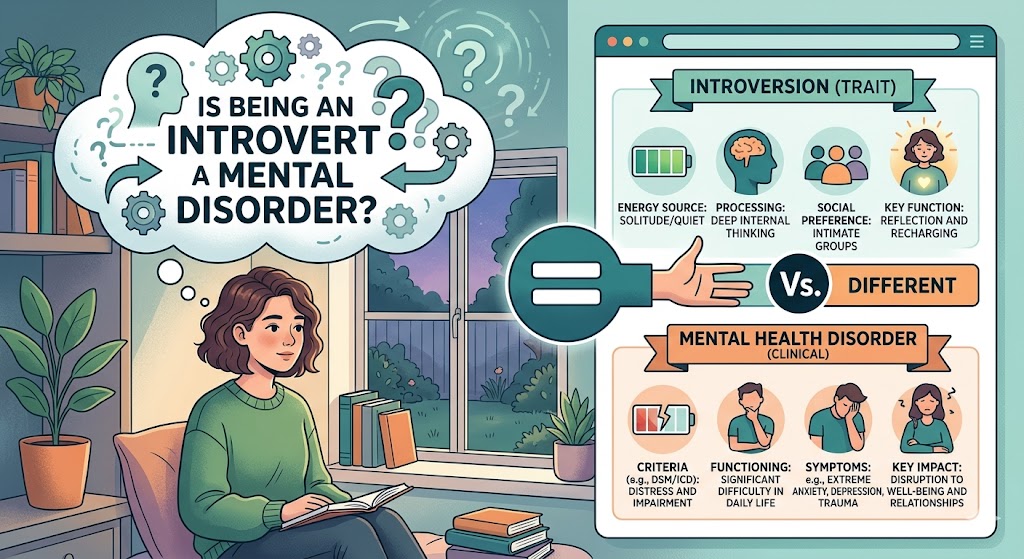
Someone in your life has probably made you feel like something is wrong with you. Maybe it was subtle — a coworker asking why you’re so quiet, a family member pushing you to “come out of your shell,” a date who said you seemed distant. After enough of that, it’s easy to start wondering it yourself. Am I broken? Is this actually a problem? It isn’t. Introversion is not an introvert mental disorder — it’s a well-documented personality trait. But let’s be honest about what’s really going on.
Is Introversion an Introvert Mental Disorder? What’s Actually Going On
Introversion is not a disorder, and it’s not an introvert mental disorder — it’s a personality trait — one of the most well-documented in psychology. In the Big Five personality model, it sits on a spectrum opposite extraversion. Neither end is healthier than the other. They’re just different ways of processing the world.
The difference comes down to how your brain responds to stimulation. Introverts tend to have a more reactive nervous system, meaning the same party that energizes an extravert can leave you feeling like you’ve run a marathon. Research suggests this connects to differences in dopamine sensitivity and how much acetylcholine — a neurotransmitter linked to calm focus and inner thought — your brain prefers to run on. Carl Jung, who first popularized the terms introvert and extravert in the early 1900s, described it as a preference for where you direct your energy: inward or outward.
None of that is dysfunction. It’s just neurology. The problem is that most social environments were designed by and for people who gain energy from being around others. When you don’t, you get labeled as the problem.
The Signs You Might Be Experiencing This
You might notice that after a full day of meetings, even a phone call from someone you love feels like too much. Not because you don’t care about them. Just because there’s nothing left.
It often looks like needing an unusual amount of time to recharge after social events — not hours, sometimes a full day. It looks like preferring one real conversation to a room full of small talk, and feeling vaguely hollow after the small talk anyway. It looks like being told you’re “too serious” or “hard to read” by people who’ve just met you, even though the people who know you well would describe you completely differently.
You might also notice that you think before you speak — really think — and that interrupting a conversation to jump in with a half-formed thought feels genuinely uncomfortable. That you do some of your best thinking alone. That being around people you don’t know well requires a kind of performance that leaves you tired in a specific way. The kind of tired where even texting back feels like too much.
These aren’t symptoms of something wrong. They’re just how you’re wired.
What This Actually Looks Like
Sam works in a busy open-plan office. She’s good at her job, liked by her colleagues, and still leaves every Friday feeling scraped out from the inside. On Saturday she cancels brunch. Not because she’s depressed. Because she needs the quiet more than she needs the eggs. Her friends think she’s flaky. Her old therapist once asked if she was “avoiding” things. She spent three years wondering if they were right, trying to push through it, ending up more exhausted than before. Eventually she stopped apologizing for Saturday mornings alone. The guilt didn’t vanish. But the exhaustion started to lift.
What Tends to Help
Stop scheduling back-to-back social commitments and calling the fallout laziness. Your brain needs transition time. Build it in like it’s a meeting, because for you, it basically is.
When you leave a gathering early, don’t explain yourself to death. A simple “I’m heading out” is a complete sentence. Over-explaining trains people to expect justification every time.
Find one or two people you can be genuinely quiet with. Not people you perform for. People you can sit next to while you’re both reading. That kind of connection doesn’t deplete you the same way.
Be honest with yourself about the difference between introversion and avoidance. Introversion is recharging alone after social effort. Avoidance is skipping things that matter to you because the anxiety of showing up feels too big. They can look similar from the outside. They feel different from the inside.
And stop letting other people’s comfort with noise become your measuring stick for mental health.
When to Get Some Support
If the quietness has started to feel less like preference and more like being trapped — if you’re skipping things you actually want to do, or the idea of other people has started to feel genuinely frightening rather than just draining — it might be worth talking to someone. Not because introversion is a problem, but because social anxiety and depression can sometimes wear introversion as a mask. A good therapist will know the difference. So will you, honestly, if you sit with it.
A Few Questions Worth Answering
Is being an introvert a mental disorder?
No. Is being an introvert a mental disorder is one of the most common searches in this area, and the answer is settled: introversion is a normal personality trait with no clinical status.
Is introversion a disorder in any diagnostic manual?
Is introversion a disorder anywhere in the DSM or ICD? It is not listed, because is being an introvert a mental disorder was never a clinical question.
Is being introverted normal?
Is being introverted normal is answered by prevalence alone: somewhere between a third and a half of people score on that side of the scale.
When should a quiet person seek help anyway?
Is being an introvert a mental disorder is the wrong question if solitude has stopped restoring you. That change, not the quietness, is what deserves attention.
- Is introversion the same as social anxiety?
-
No. Introversion is about energy — socializing costs you more than it costs an extravert. Social anxiety is about fear — the worry that you’ll be judged, rejected, or humiliated. You can be introverted without anxiety, and anxious without being introverted. They overlap sometimes, but they’re different things with different roots.
- Can introversion get worse over time?
-
The trait itself tends to stay stable across your life. But if you’ve spent years forcing yourself to act extraverted, the exhaustion can accumulate and make everything feel more intense. It’s not the introversion getting worse. It’s the cost of ignoring it finally showing up.
- Is being introverted linked to depression?
-
There’s no evidence that introversion causes depression. But introverts who feel constantly pressured to be someone else — louder, more social, more “on” — report higher stress and lower wellbeing. The problem isn’t the introversion. It’s the gap between who you are and who you’re expected to be.
- Should I tell people I’m an introvert?
-
Only if it’s useful. With close friends, it can explain a lot and save a lot of hurt feelings. In professional settings, you don’t owe anyone a personality debrief. “I work best with some heads-down time” lands better than a label, anyway.
You don’t need to be fixed. You need to be understood — starting with yourself. The world is loud and it rewards loudness, and that’s genuinely hard to move through when quiet is where you think best. But hard isn’t the same as wrong. You’ve always known that. You just needed someone to say it plainly.