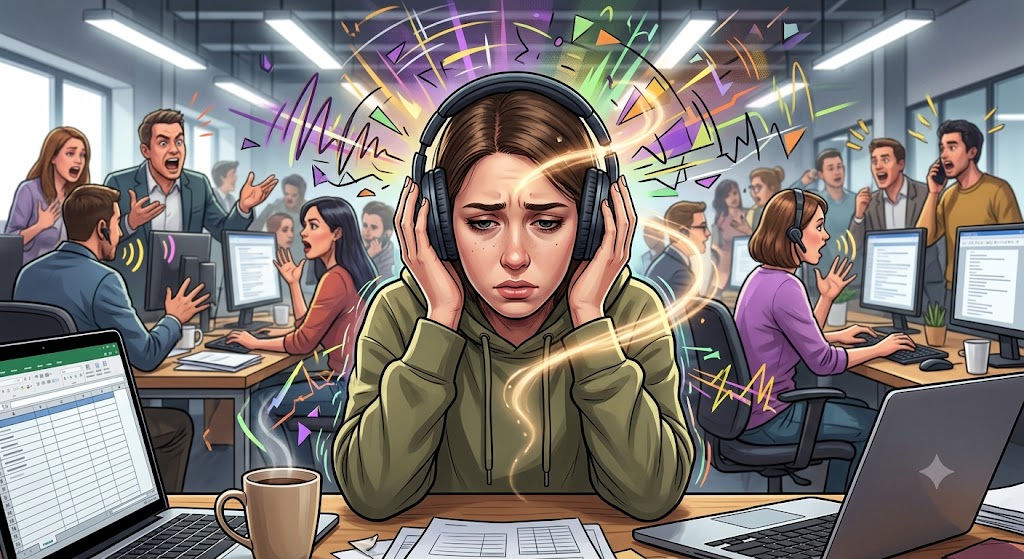
Loud environments drain introverts in a way that is physical, not just emotional. If you leave a concert, a packed restaurant, or an open-plan office feeling hollowed out while everyone else seems fine, that is not weakness or oversensitivity. There is a clear biological reason your nervous system responds differently to noise — and understanding it changes how you think about your own limits.
Why Loud Environments Drain Introverts at a Neurological Level
The most useful framework here comes from neuroscience, not personality theory. Introverts and extroverts differ in their baseline cortical arousal — introverts operate closer to their stimulation threshold even at rest. The psychologist Hans Eysenck proposed this in the 1960s, and subsequent research has broadly supported it. When noise enters the picture, introverts reach overstimulation faster because they were already running at a higher internal volume.
There is also a neurochemical dimension. Introverts tend to rely more heavily on acetylcholine as a reward neurotransmitter, which is associated with internal thought and focused attention. Extroverts lean toward dopamine pathways, which respond well to external novelty and stimulation — loud music, crowds, social buzz. For an introvert, that same external stimulation does not produce reward. It produces friction.
Noise also triggers the amygdala, the brain’s threat-detection centre. Sudden or sustained loud sound activates a low-level stress response — cortisol rises, attention narrows, cognitive resources get redirected toward managing the environment rather than engaging with it. For someone already closer to their arousal ceiling, this is not background noise. It is a drain on a finite resource.
Signs That Noise Is Costing You More Than You Think
Introvert sensory overload from noise does not always announce itself dramatically. It often shows up as a slow flatness — you stop contributing to a conversation not because you have nothing to say, but because forming words feels like too much effort. Your thinking becomes shallow. You find yourself watching the clock or mentally rehearsing your exit.
You might notice that your tolerance drops over the course of the day. A noisy lunch with colleagues might feel manageable at noon, but the same noise level at 4pm leaves you irritable and blank. That is not moodiness. That is accumulated stimulation with nowhere to discharge.
Physical signs are real too. Tight shoulders, a low headache behind the eyes, a slight nausea in very loud spaces — these are not imagined. The auditory system is directly connected to the vagus nerve, which regulates the body’s stress response. Sustained noise keeps that system activated. Introvert energy depletion from noise is as real as depletion from a long run. It just looks invisible from the outside.
What Actually Helps
The single most effective thing is giving yourself transition time after loud environments. Not just getting home and collapsing in front of a screen — that prolongs the stimulation — but ten to twenty minutes of genuine quiet. No podcasts, no background TV. Silence is not a reward. It is recovery.
If you cannot avoid noisy spaces regularly — open offices, loud commutes, busy households — invest in decent noise-cancelling headphones. This is not antisocial. It is a practical reduction in sensory load. Even wearing them without music signals your nervous system that the auditory threat has been managed.
Learn to leave before you are depleted rather than after. The tendency to push through and stay until exhaustion means you spend the next day recovering rather than functioning. When you feel the first signs of cognitive flatness or shoulder tension, that is your cue — not a suggestion to start winding down, but a signal to go.
When you are in a loud space and cannot leave, find the quietest corner available. Physical distance from noise sources matters. Even moving a few metres from speakers or a busy kitchen reduces decibels meaningfully and buys back some processing capacity.
Finally, stop explaining or apologising for needing quiet. When you leave a gathering, you do not owe anyone a justification. “I need to head off” is a complete sentence.
When to Get Support
Noise sensitivity that significantly limits your daily life — making it hard to work, socialise at all, or use public transport — may go beyond typical introversion. Conditions like misophonia, hyperacusis, or sensory processing sensitivity can sit alongside introversion and deserve proper attention. If loud environments are not just draining but genuinely distressing, a conversation with a psychologist or audiologist is worth having. That is not overreacting. It is being accurate about what you are dealing with.
A Few Questions Worth Answering
- Is noise sensitivity the same as being introverted?
- Not exactly. Introversion is about where you direct your energy and how you restore it. Noise sensitivity is about how your nervous system processes sensory input. Many introverts are also highly sensitive people, but they are separate traits that happen to overlap frequently.
- Why do I feel physically ill in very loud places?
- Sustained loud noise activates the body’s stress response through the vagus nerve and auditory pathways. For people with lower stimulation thresholds — common in introvert sensory overload — this can produce real physical symptoms: nausea, headache, and muscle tension are all documented stress responses to noise.
- Can introverts get used to noisy environments over time?
- Partial adaptation is possible, but it comes at a cost. Habituation to background noise exists, but introvert energy depletion from sustained loud environments tends to persist. You may function better in a noisy office over months, but the drain rarely disappears — it often just becomes normalised fatigue.
- What is the difference between introvert tiredness and burnout?
- Regular introvert tiredness from noise or social stimulation resolves with adequate quiet and rest — usually within hours or a day. Burnout is a sustained state where rest no longer restores you. If you are consistently exhausted despite getting quiet time, that pattern is worth taking seriously.
Knowing why loud environments drain introverts does not make the noise go away. But it does mean you stop blaming yourself for something that is simply how your nervous system is built. That shift — from “what is wrong with me” to “this is how I work” — is quiet, practical, and genuinely useful.