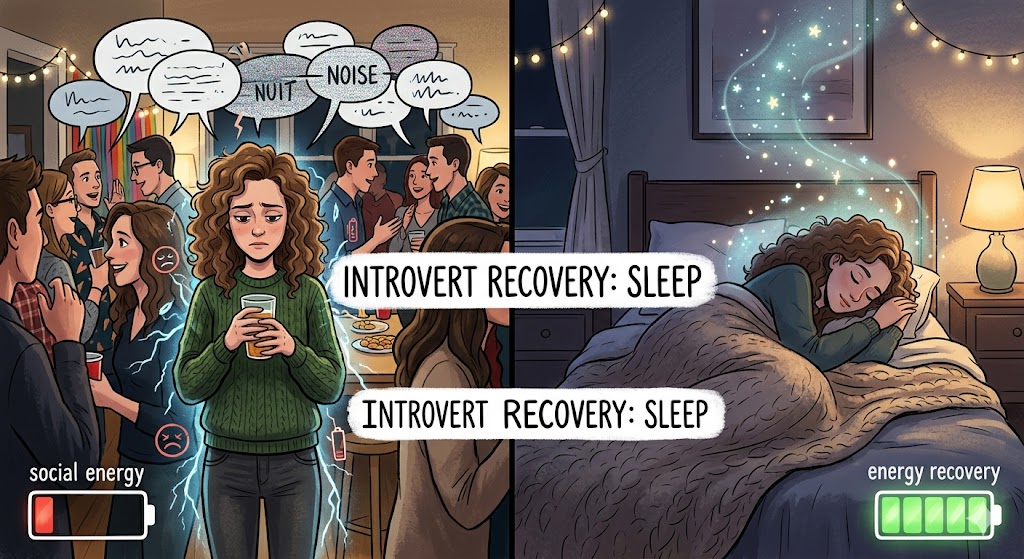
If you’ve ever collapsed onto your bed after a long day of meetings, small talk, and fluorescent lighting, only to feel like your body is buzzing even though you’re exhausted, you already understand something important about introvert sleep and energy recovery. For introverts, sleep isn’t just rest. It’s the nervous system’s primary repair mechanism after hours spent processing more stimulation than it was built to comfortably absorb. Understanding this connection changes how you think about your bedtime, your energy, and your entire relationship with rest.
Most conversations about sleep focus on duration and timing, how many hours you need, when you should go to bed. This is not that conversation. This is about the mechanism underneath the habit, the actual biological process that links a quiet, socially depleted brain to a good night’s rest, and why that process matters more for introverts than it does for people who recharge through interaction.
Why Introvert Sleep and Energy Recovery Are So Tightly Linked
Introverts are generally more sensitive to external stimulation. Research into temperament, going back to Jerome Kagan’s work on reactivity and continuing through more recent neuroscience, suggests that introverted nervous systems respond more intensely to noise, social contact, and sensory input. Every conversation, every open-plan office, every crowded grocery store run asks something of an introvert’s brain that it doesn’t ask of everyone equally. That “something” accumulates across the day as a kind of neural debt.
Sleep is where that debt gets paid down. During deep sleep stages, the brain’s glymphatic system becomes more active, clearing out metabolic byproducts that build up during waking hours of concentration and stimulation. For an introvert who has spent the day filtering conversations, managing eye contact, and consciously regulating their responses in social settings, this clearing process has more to do than it would for someone whose day required less constant self-monitoring. This is the biological heart of introvert sleep and energy recovery: rest isn’t optional recovery time, it’s the specific mechanism that resets an overworked filtering system.
The Nervous System Connection Behind Introvert Sleep and Energy Recovery
Think of your nervous system as having two main settings: an activated, outward-facing mode and a restorative, inward-facing mode. Social interaction, especially the kind that involves performance, small talk, or unfamiliar people, tends to keep the sympathetic nervous system engaged. This is the “go” system, useful in short bursts but costly when sustained. Introverts often stay in this activated state longer during and after social situations because their processing style is more deliberate and internally reflective.
Sleep, particularly the transition into slow-wave and REM stages, is one of the few reliable ways the body shifts fully into parasympathetic dominance, the “rest and digest” mode where cortisol drops, heart rate slows, and the brain can consolidate the day’s experiences without the pressure of ongoing input. For introverts, this shift matters enormously. Without it, the nervous system doesn’t get a genuine reset; it just gets quieter for a while before the next demanding interaction starts the cycle again. Poor sleep, in this light, isn’t simply tiredness. It’s an unfinished recovery cycle, and unfinished cycles compound.
How Burnout Enters the Picture
This is where burnout becomes relevant. Introvert burnout rarely looks like a dramatic collapse. It looks like irritability that seems disproportionate to the trigger, a sense of dread before ordinary social obligations, and a persistent, low-grade fatigue that a weekend doesn’t fully fix. When sleep quality declines, even slightly, the nervous system loses its main tool for offloading the sensory and social burden it’s been carrying. Each poorly recovered night stacks on top of the last, and what started as ordinary tiredness slowly becomes something closer to depletion.
This is why so many introverts describe a strange paradox: they feel tired constantly, yet also feel wired or unable to properly unwind at night. That combination, a body that wants to shut down and a brain still running background processes from the day, is a hallmark of interrupted energy recovery. It’s not a contradiction. It’s a nervous system that hasn’t been given a full opportunity to complete its restorative cycle, and the backlog is starting to show.
What the Research Says About Introvert Neuroscience and Rest
Studies on introvert neuroscience point to differences in dopamine sensitivity and arousal regulation that help explain why rest functions differently for introverts than for extroverts. Introverts tend to have a more reactive arousal system, meaning it takes less stimulation to reach a state of overload, and correspondingly, meaningful quiet and rest are needed to bring that arousal back down to baseline. Sleep is the deepest, most complete version of that quiet the body has access to.
This also explains why introverts often benefit from protecting the hour or two before bed as low-stimulation time. Winding the nervous system down before sleep isn’t a luxury habit, it’s preparation that allows the brain to enter restorative stages more efficiently once sleep begins. Skipping that transition and going straight from a stimulating evening into bed tends to produce lighter, more fragmented sleep, which undermines the very recovery process the body needs most.
Supporting the Connection Instead of Fighting It
Rather than treating sleep as a separate wellness task to check off, it helps to see it as the natural continuation of how you already manage your energy during the day. If you take breaks between social commitments, you’re already practicing a smaller version of what sleep does at a larger scale: giving your nervous system room to recover before the next demand arrives. Protecting sleep is simply extending that same instinct into the nighttime hours, where the recovery can go far deeper than any daytime break allows.
Small, consistent choices tend to matter more than dramatic overhauls. Dimming lights earlier, limiting draining conversations close to bedtime, and giving yourself permission to decline a late invitation when you’re already running on empty are not signs of antisocial behavior. They’re informed decisions that respect how your particular nervous system actually recovers.
Questions People Ask About Introvert Sleep and Energy Recovery
Does poor sleep affect introverts more than extroverts? Not necessarily more in every measurable way, but the impact often shows up differently. Because introverts rely heavily on sleep to offload accumulated social and sensory processing, sleep disruption can more quickly translate into feelings of overwhelm, irritability, or social withdrawal.
Can naps help with introvert energy recovery? Short naps can offer partial relief by briefly shifting the nervous system into a calmer state, but they rarely replace the deeper restorative stages achieved during a full night’s sleep. Naps are useful support, not a substitute for the main recovery process.
Why do I feel tired but wired after a social day, even in bed? This usually reflects a nervous system that hasn’t transitioned out of its activated state yet. The body may be physically fatigued while the brain is still processing the day’s stimulation, which can delay the onset of deep, restorative sleep stages.
Introvert sleep and energy recovery aren’t separate wellness topics loosely connected by good intentions. They describe one continuous biological process: a nervous system that absorbs more from social and sensory input during the day, and that depends on genuine, uninterrupted rest to reset. When you start treating sleep as the mechanism that repairs your capacity to engage with the world, rather than a passive habit to optimize, protecting it stops feeling indulgent and starts feeling like the most practical form of self-care available to you.