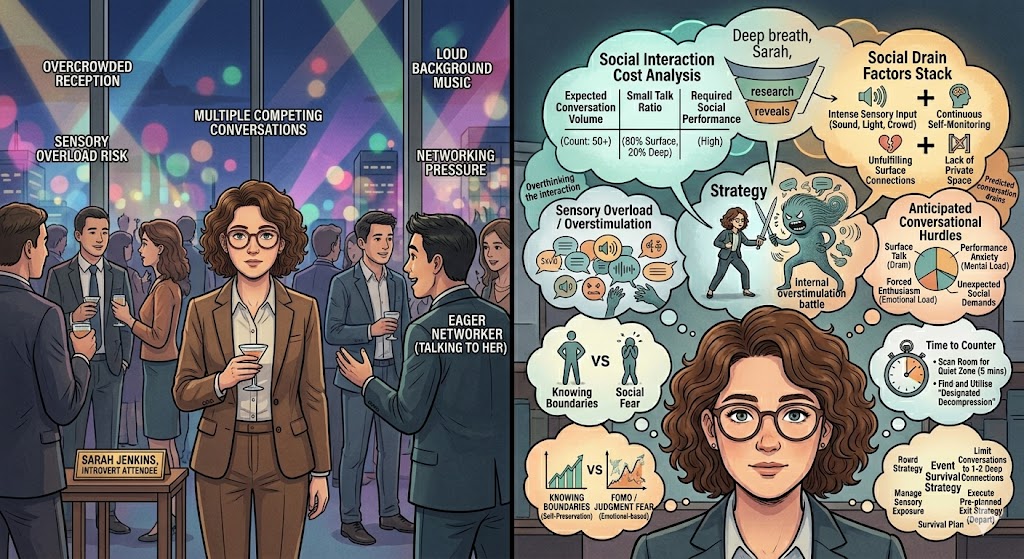
If you’ve ever canceled plans at the last minute, felt a wave of dread before a party, or quietly slipped out of a gathering early, you already know that introverts avoid social events for reasons that go far deeper than simple shyness. It isn’t that introverts dislike people or find conversation unpleasant. The truth is more physiological than emotional: social interaction costs introverts real, measurable energy, and that cost adds up faster than most extroverted friends and family members realize. Understanding why introverts avoid social events requires looking past the surface behavior and into the nervous system itself.
The Real Reason Introverts Avoid Social Events
Most people assume that avoiding a party or a crowded dinner means someone is antisocial, cold, or simply rude. But when introverts avoid social events, they are usually responding to an internal calculation about energy, not a judgment about the people involved. Extroverts tend to gain energy from external stimulation — noise, novelty, group conversation, unpredictable social dynamics. Introverts, by contrast, spend energy in those same environments. A two-hour party that leaves an extrovert feeling charged up can leave an introvert feeling like they’ve run a mental marathon.
This is why introverts avoid social events even when they genuinely like the people attending. Liking someone and having the energy reserves to interact with them in a stimulating environment are two entirely separate things. An introvert might adore their cousin’s wedding guests individually, one-on-one, over coffee, and still dread the reception because the format itself — loud music, dozens of simultaneous conversations, unpredictable small talk — is what drains them, not the people.
Anticipatory Dread Is Part of the Pattern
Long before the event even starts, many introverts experience a specific kind of dread that begins the moment an invitation appears. This anticipatory anxiety is one of the clearest signs that introverts avoid social events not out of laziness but out of genuine self-protection. The mind starts running simulations: Who will be there? Will I be expected to make small talk? How will I exit gracefully if I need to leave early? This mental rehearsal can consume energy for days before the actual event, which means the avoidance often isn’t really about the event itself — it’s about protecting the days leading up to it and the recovery time afterward.
This anticipatory pattern explains why some introverts seem to “flake” on plans that once excited them. It isn’t that they stopped caring. It’s that as the date approaches, the anticipated cost of the event starts to outweigh the anticipated reward, especially if the person is already running low on reserves from work, caregiving, or other daily stressors.
Overstimulation and Sensory Overload
Overstimulation plays a massive role in why introverts avoid social events, and it’s one of the most misunderstood parts of the introvert experience. Many introverts are highly sensitive to sensory input — bright lights, loud music, overlapping conversations, crowded rooms, and constant motion. In a social setting, all of these inputs hit at once, and the nervous system has to work overtime just to process the environment, let alone engage meaningfully in conversation. This is why a seemingly ordinary work happy hour can feel as taxing to an introvert as an entire day of physical labor.
Sensory overload doesn’t always look dramatic from the outside. Sometimes it shows up as an introvert going quiet in the corner of a room, checking their phone more than usual, or repeatedly glancing at the door. These aren’t signs of boredom or disinterest — they’re signs that the nervous system has reached its limit and is searching for relief. Recognizing overstimulation as a physical response, not a character flaw, is essential to understanding why introverts avoid social events in the first place.
How This Affects Relationships
Because introverts avoid social events, relationships can sometimes suffer from misunderstanding rather than any real lack of care. A partner, friend, or family member who doesn’t understand introversion may interpret repeated declines as rejection, disinterest, or even a lack of love. In reality, introverts often care just as deeply — they simply express and sustain that care differently, favoring smaller, quieter connections over large group gatherings.
Healthy relationships with introverts usually involve some negotiation: attending certain important events while skipping others, arriving late and leaving early, or trading a big party for a smaller one-on-one dinner beforehand. When both sides understand that introverts avoid social events because of genuine energy limits rather than a lack of affection, resentment tends to fade and compromise becomes much easier to reach.
Healthy Avoidance Versus Unhealthy Isolation
It’s worth distinguishing between healthy pacing and unhealthy withdrawal, because not all avoidance is the same. Healthy avoidance looks like an introvert choosing to skip a large networking event but still showing up for a close friend’s birthday dinner. It involves selectivity, awareness of one’s own limits, and intentional recovery time. Unhealthy isolation, on the other hand, looks like consistently avoiding all human contact, canceling plans out of anxiety rather than genuine energy management, and feeling increasingly lonely or disconnected as a result.
If avoidance starts to shrink someone’s world rather than protect it, that’s a signal worth paying attention to. The goal isn’t to eliminate all social events from an introvert’s life — it’s to help them choose the right ones, attend on their own terms, and build in enough recovery time that socializing remains sustainable rather than something to dread indefinitely.
Questions People Ask About Why Introverts Avoid Social Events
Does avoiding social events mean an introvert doesn’t like people? No. Most introverts enjoy meaningful connection; what they struggle with is the format and intensity of large group gatherings, not the individuals within them. Preferring a quiet dinner over a loud party is about energy management, not a dislike of company.
Why do introverts avoid social events even when they were looking forward to them? Anticipatory dread and shifting energy levels can change how appealing an event feels as the date approaches. Someone might be excited a week out but feel depleted by the actual day, especially after a demanding week.
Can introverts learn to enjoy social events more? Yes, with the right strategies. Setting a time limit, choosing smaller gatherings, arriving with a plan to recharge afterward, and being selective about which events truly matter can all make socializing feel far more manageable and even enjoyable.
Ultimately, understanding why introverts avoid social events comes down to recognizing that energy, sensory processing, and anticipatory stress work differently for every person. It isn’t a flaw to be fixed or a phase to outgrow — it’s a genuine pattern of how the introvert nervous system engages with the world. With awareness, communication, and a little compromise, introverts can stay connected to the people they love without sacrificing the quiet recovery time they need to feel like themselves again.