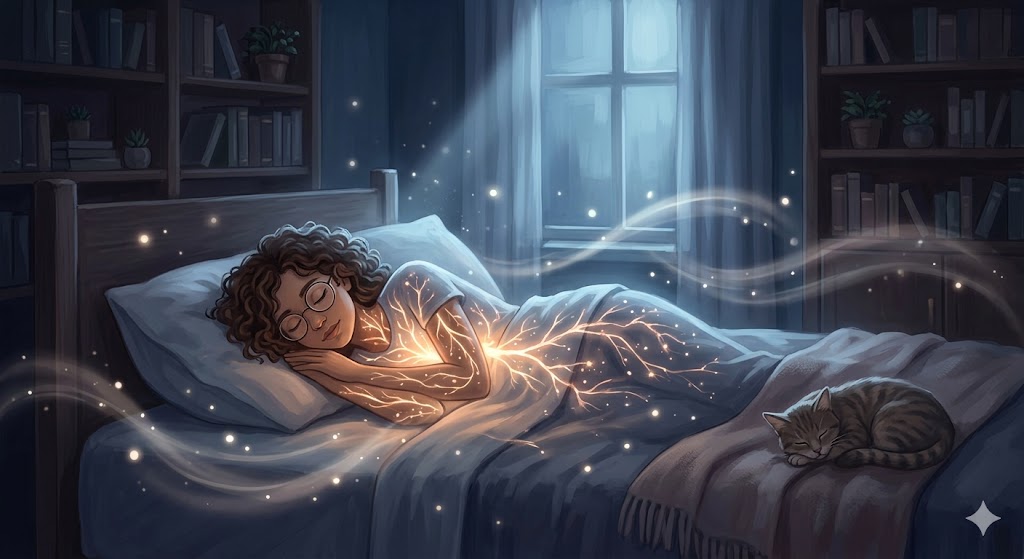
Sleep quality introvert energy connects far more directly than most people realise, and if a single poor night’s sleep seems to hit you socially far harder than it hits your more extroverted friends and colleagues, that’s not an exaggeration on your part. There’s a real physiological mechanism behind it, and understanding it explains why protecting sleep quality matters even more for an introvert’s actual functioning than general wellness advice usually acknowledges.
Why Sleep Quality Introvert Energy Levels Are So Closely Linked
Managing stimulation and social demand already asks a lot of an introvert’s nervous system on a good day, since the processing involved — filtering input, tracking social dynamics, regulating response to a busier environment — draws on cognitive resources that are considerably more taxed by poor sleep than by a full night’s rest. Poor sleep quality specifically reduces the exact cognitive control and emotional regulation capacity an introvert relies on to manage a socially demanding day without becoming overwhelmed, which is why one bad night can make an otherwise manageable day feel disproportionately draining.
This means sleep quality introvert energy isn’t simply about feeling generically tired — it’s about a specific reduction in the buffer an introvert nervous system needs to handle stimulation and social demand at all. With that buffer reduced, ordinary levels of social contact that would normally be manageable can suddenly feel overwhelming, not because anything about the day changed, but because the underlying capacity to handle it did.
The Nervous System Link Between Sleep and Introvert Energy
Poor sleep disrupts the prefrontal cortex functions responsible for impulse control, emotional regulation, and sustained attention — all of which an introvert draws on heavily to manage social interaction and filter sensory input throughout the day. When these functions are impaired by inadequate rest, the same social or sensory load that would normally be manageable can tip into genuine overstimulation far more easily, since the regulatory system doing the filtering is itself running below capacity.
This creates a compounding effect worth taking seriously: poor sleep doesn’t just make an introvert tired in the ordinary sense, it specifically reduces their capacity to manage the stimulation load that’s already a daily reality, producing a day that feels considerably harder than an equivalent day following good sleep would.
Protecting Sleep Quality as Part of Introvert Energy Management
Treat sleep as a core, non-negotiable part of energy management rather than a separate wellness category, especially before any day you know will be socially demanding. Introverts managing an important social commitment tend to benefit disproportionately from prioritising sleep the night before, since the resulting cognitive buffer directly affects how well the actual event goes the next day.
Build a consistent, protected wind-down routine, since sleep quality often matters as much as raw sleep duration for this specific effect. A calm, low-stimulation period before bed — dim lighting, no screens, quiet activity — tends to improve sleep quality meaningfully, which in turn protects the exact regulatory capacity an introvert needs the next day.
Notice the pattern directly in your own life rather than assuming general tiredness explains a harder-than-usual social day. If a demanding day follows a poor night’s sleep, recognising that connection explicitly helps you plan recovery accordingly, rather than assuming something is wrong with your general resilience.
Questions People Ask About Sleep and Introvert Energy
How does sleep quality introvert energy depend on each other?
Sleep quality introvert energy tracks closely, and one poor night hits social capacity harder than it hits physical capacity.
What is the link between sleep and social battery?
Sleep and social battery are related but separate systems. Sleep quality introvert energy suffers first in the social column.
Why does poor sleep introvert readers report feel worse?
Poor sleep introvert readers report feels worse because filtering capacity drops, so ordinary input becomes overwhelming.
What does sleep deprivation introvert experience look like?
Sleep deprivation introvert experience shows as reduced tolerance for noise and people long before it shows as tiredness.
Does caffeine make up for the specific deficit poor sleep quality creates?
Caffeine can mask general tiredness temporarily but doesn’t restore the specific regulatory capacity poor sleep quality depletes, so it tends to help far less with actual overstimulation management than genuine rest does.
Why does one bad night of sleep affect me more than it seems to affect extroverted friends?
Poor sleep reduces the exact cognitive regulation capacity introverts rely on more heavily day to day to manage stimulation and social demand, so the effect tends to be more noticeable for this temperament specifically.
Should I prioritise sleep before a big social event more than usual?
Yes — protecting sleep quality the night before a demanding social commitment directly supports the regulatory capacity you’ll need the next day, making the event considerably more manageable.
Can naps make up for poor overnight sleep quality?
Somewhat, though they’re a partial fix rather than a full substitute — a nap can restore some capacity, but consistently poor overnight sleep quality tends to compound over multiple days if left unaddressed.
Is it worth tracking sleep quality alongside social energy levels?
Often yes — noticing the direct relationship between a poor night’s sleep and a harder-than-usual social day can help you plan recovery time and pace commitments more accurately going forward.
Does this mean introverts need more total sleep than extroverts?
Not necessarily more hours, but sleep quality specifically matters more for introverts given how directly it affects the regulatory capacity used to manage stimulation, so protecting quality may be even more valuable than simply extending duration.
What’s the fastest way to improve sleep quality before a demanding social day?
A consistent wind-down routine the night before — dim lighting, no screens, a calm low-stimulation activity — tends to produce a meaningfully better night’s sleep than trying to force extra hours alone without addressing quality.
Sleep quality introvert energy connects through a real, specific mechanism, not just general tiredness — protecting sleep deliberately is one of the most effective, underrated tools available for managing an introvert’s day-to-day capacity to handle stimulation well, especially heading into a demanding week, or any stretch of days that will ask more of you than usual.