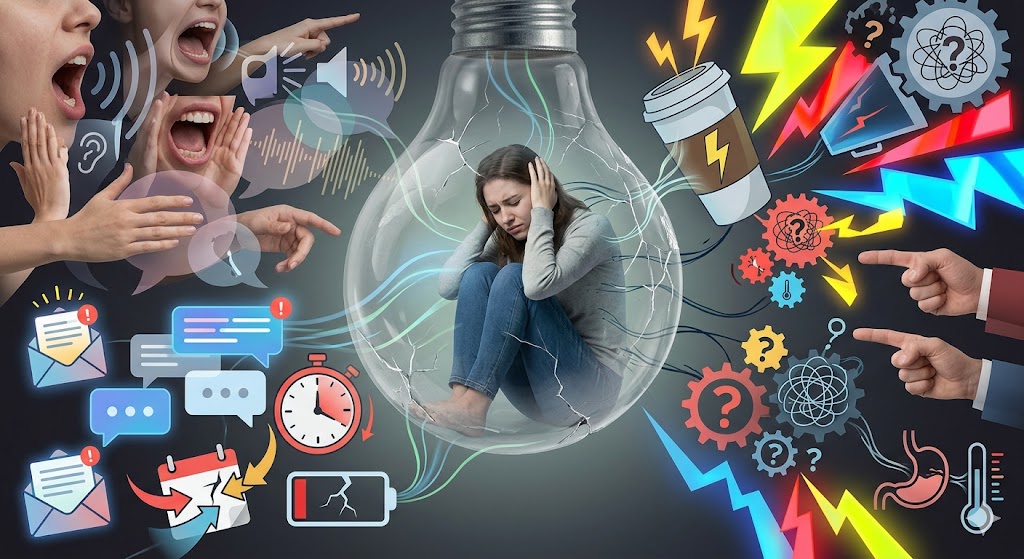
There’s a specific moment many quiet people know all too well: the party is fine, the conversation is fine, and then suddenly it isn’t. Your ears feel too full, your thoughts scatter, and you just want to leave. This is the moment when introverts get overstimulated, and it isn’t a mood swing or a character flaw. It’s a measurable shift in brain arousal that happens once incoming stimulation crosses a specific threshold. Understanding where that threshold sits, and what happens physiologically once you cross it, explains a huge amount about introvert life that willpower alone never could.
The Arousal Threshold: Why Introverts Get Overstimulated Sooner
Psychologist Hans Eysenck proposed decades ago that introversion and extraversion track with baseline levels of cortical arousal, the background hum of activity in the brain’s reticular activating system. His theory, since refined by later researchers, suggests introverts tend to run at a higher baseline arousal level than extraverts. That sounds counterintuitive, since introverts often look calm from the outside. But a higher starting point on the arousal dial means less room is needed to tip into overstimulation. Extraverts, starting from a lower baseline, can absorb more noise, more people, and more novelty before they hit the same ceiling. This is the core reason introverts get overstimulated in situations extraverts barely register as intense: the threshold for “too much” simply sits closer to normal, everyday input.
What the Brain Is Actually Doing at the Tipping Point
Crossing the threshold isn’t a single switch flipping. It’s a cascade. As stimulation builds, the brain’s alerting and attention networks work harder to filter what matters from what doesn’t. Once demand outpaces filtering capacity, sensory information starts arriving faster than it can be sorted and prioritized. That backlog is what people describe as their brain “getting full” or feeling static-y. Physiologically, this is often accompanied by a mild stress response: elevated cortisol, a faster heartbeat, and a tightening sense of urgency to reduce input. It is at this exact tipping point that introverts get overstimulated, and the experience is not imagined. It’s the nervous system doing exactly what an overloaded system does, prioritizing withdrawal over further processing.
The Crash: Life After the Threshold Is Crossed
What follows overstimulation is rarely instant recovery. Many introverts describe a “crash,” a period of flat affect, irritability, or exhaustion that can last anywhere from twenty minutes to an entire evening. This crash reflects the cost of sustained high arousal. The body has been running a stress response, however mild, for an extended period, and coming down from that state takes real physiological time, not just a change of scenery. Trying to push through a crash by staying in a stimulating environment tends to backfire, deepening fatigue rather than resolving it. This is a distinct pattern from simply preferring quiet; it is a recovery curve with its own shape, and recognizing that curve is often the first step toward managing it well.
Why This Differs From Simply Disliking Noise
It’s tempting to reduce this whole phenomenon to sound sensitivity, but arousal threshold theory is broader than any one sense. Bright lighting, unpredictable conversation, multitasking, and even emotionally charged social dynamics all add to the same cumulative load. The threshold isn’t sense-specific; it’s a general capacity limit on the nervous system’s arousal regulation. This is part of why introverts get overstimulated in situations that contain no obvious sensory assault at all, like a long one-on-one conversation with a close friend that still leaves them wrung out. The stimulation was social and cognitive rather than loud, but it counted toward the same total.
Working With the Threshold Instead of Against It
Because the arousal threshold is a stable trait rather than a flaw to fix, the most effective strategies work with it rather than trying to override it. Building in recovery breaks before arousal peaks, rather than after, keeps the nervous system from reaching the tipping point at all. Spacing out demanding events, choosing smaller gatherings, and giving yourself permission to leave a room for five minutes are not avoidance behaviors; they are threshold management. Over time, many introverts learn to read their own early warning signs, a certain restlessness, a narrowing of attention, a wish for silence, and treat those signs as useful data rather than something to push past. That shift alone changes overstimulation from a crisis to something anticipated and handled with far less distress.
Questions People Ask About Why Introverts Get Overstimulated
Why do introverts get overstimulated so quickly?
Why do introverts get overstimulated comes down to threshold. The same input arrives at higher intensity, so the ceiling is reached sooner.
What does introvert overstimulation science actually show?
Introvert overstimulation science points to differences in baseline arousal and stimulation tolerance rather than to any deficit.
Can overstimulation explained simply?
Overstimulation explained simply: your system is processing more per unit of input, and eventually it cannot keep up. Why do introverts get overstimulated is a capacity question, not a willingness one.
Does knowing why do introverts get overstimulated help?
Why do introverts get overstimulated matters practically, because it moves the fix from trying harder to changing the environment.
Is overstimulation the same thing as social anxiety?
No. Social anxiety involves fear of judgment or negative evaluation, while overstimulation is a nervous system arousal response that can happen even in comfortable, low-pressure settings with people you trust. The two can coexist, but they are distinct mechanisms with different roots.
Can the overstimulation threshold change over time?
The baseline tendency toward higher cortical arousal appears fairly stable, but the practical threshold can shift with sleep, stress, and health. Poor sleep or a demanding week lowers the amount of stimulation someone can handle before crossing into overload, which is why the same environment can feel manageable one day and unbearable the next.
What are the first physical signs that the threshold has been crossed?
Common early signs include difficulty following conversation, a strong pull toward silence, restlessness, a headache-like pressure, or a sudden drop in patience. Learning to notice these signals early, before full overload, makes recovery faster and less disruptive to the rest of the day.
The science behind why introverts get overstimulated isn’t a diagnosis or an excuse; it’s a description of how a particular nervous system is wired to regulate arousal. Once you can name the threshold, notice the early signs, and expect the crash that follows, overstimulation stops feeling like a personal failing and starts looking like information. That reframe, more than any single trick or hack, is often what makes the difference between dreading your own sensitivity and learning to work alongside it.