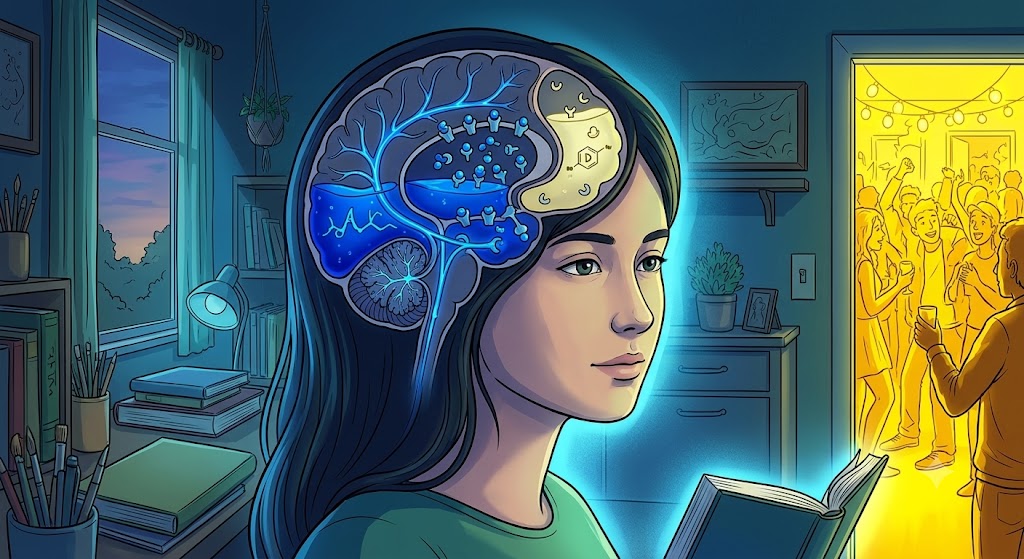
If you’ve ever wondered why a crowded party leaves you wiped out while it seems to energize your extroverted friends, the answer isn’t just personality quirks — it’s biology. Researchers have spent decades poking around inside the introverted brain trying to understand what’s actually going on beneath the surface, and what they’ve found is genuinely fascinating: introvert brain chemistry appears to work differently from extrovert brain chemistry in several measurable ways. No single theory tells the whole story. Instead, scientists have identified a handful of overlapping factors — from neurotransmitter sensitivity to structural differences in brain regions to baseline arousal levels — that together paint a picture of why introverts experience the world the way they do. This post is meant as a starting point, a broad map of the territory, so you can see how all these pieces fit together before diving deeper into any one of them.
Why Introvert Brain Chemistry Is a Multi-Factor Story
It’s tempting to want one tidy explanation — “introverts just have less of X chemical” — but the reality is messier and more interesting. Introvert brain chemistry involves at least four areas of ongoing research: how the brain responds to the neurotransmitter acetylcholine, how sensitive the dopamine reward system is to external stimulation, how active the prefrontal cortex tends to be, and how the brain regulates its own baseline level of arousal. Each of these has its own body of research, and each one is a rabbit hole in its own right. Rather than trying to explain all four in full depth here, think of this as an orientation guide — enough detail to understand the shape of the science, with pointers toward the deeper dives worth exploring next.
The Acetylcholine Thread
One of the most talked-about theories in introvert psychology centers on acetylcholine, a neurotransmitter linked to focus, memory, and the kind of calm, inward-facing pleasure you get from reading a good book or working through a puzzle. Some researchers, most notably Marti Olsen Laney, have proposed that introverts’ brains lean more heavily on acetylcholine pathways than dopamine pathways, which would help explain why quiet, low-stimulation activities feel rewarding rather than boring. This is a rich area of study on its own, and if it interests you, it deserves its own deep dive — for now, just know it’s one thread in the larger fabric of introvert brain chemistry.
Dopamine Sensitivity and Stimulation
The flip side of the acetylcholine story is dopamine, the neurotransmitter most associated with reward, novelty, and the buzz of external stimulation. A commonly cited body of research suggests introverts may have a more reactive dopamine system, meaning they reach a satisfying — or overwhelming — level of stimulation with less external input than extroverts need. This doesn’t mean introverts have “less” dopamine; it may be more about sensitivity and threshold than raw quantity. Again, this is a topic substantial enough to merit its own detailed exploration, and it’s one of the more heavily researched pieces of introvert brain chemistry.
Prefrontal Cortex Activity
Beyond neurotransmitters, there’s a structural angle to consider: brain imaging studies have found differences in blood flow and activity in the prefrontal cortex, the region involved in planning, reflection, and internal processing. Some studies suggest introverts show relatively higher activity here, which may relate to their tendency toward deliberate, reflective thinking rather than quick, reactive responses. This is still an evolving area of neuroscience, and it’s worth being honest that brain imaging research on personality traits is notoriously difficult to replicate cleanly — so treat this as a promising thread rather than settled fact.
Cortical Arousal and the Reticular Activating System
Perhaps the oldest and most foundational theory in this space comes from psychologist Hans Eysenck, who proposed that introverts have naturally higher baseline cortical arousal than extroverts. In simple terms, introverts’ brains may already be running closer to their optimal stimulation level at rest, which means additional input — noise, social interaction, bright lights — pushes them past a comfortable threshold faster. Extroverts, by this theory, start from a lower baseline and need more external stimulation to feel alert and engaged. This arousal-regulation idea has influenced much of the later research into introversion, including the acetylcholine and dopamine theories described above, and it’s a useful lens for understanding why the same environment can feel just-right to one person and overwhelming to another.
What This Means for Everyday Life
None of these theories are meant to put introverts in a box or suggest that biology is destiny. Understanding the basics of introvert brain chemistry can simply be a relief — a reminder that needing quiet time, feeling drained after socializing, or preferring one-on-one conversations over group settings isn’t a character flaw or something to “fix.” It’s a reflection of how your nervous system is wired to process the world. That knowledge can be freeing: it gives you permission to structure your life, work, and relationships in ways that actually fit your brain instead of fighting against it.
Questions People Ask About Introvert Brain Chemistry
Is introvert brain chemistry scientifically proven, or is it still theoretical? Some pieces are better supported than others. The idea that introverts and extroverts differ in baseline arousal has decades of research behind it, while the specific acetylcholine-versus-dopamine framing is more of a working hypothesis that hasn’t been fully settled by large-scale studies. It’s fair to say the field is real and active, but not every detail is locked down.
Can introvert brain chemistry change over time? Personality traits, including introversion, do show some flexibility across a person’s life, and brains are more adaptable than we once assumed. That said, most researchers believe the underlying tendencies — how your brain regulates arousal and responds to stimulation — stay fairly stable, even if your behavior and coping strategies evolve.
Does understanding introvert brain chemistry actually help introverts in daily life? Many introverts report that learning about the biology behind their preferences helps them stop second-guessing themselves. Instead of forcing yourself into high-stimulation environments because you think you “should” enjoy them, you can plan your day around what your brain actually needs — and that shift in self-understanding often reduces stress significantly.
Introvert brain chemistry is still an unfolding area of science, and no single neurotransmitter or brain region tells the whole story on its own. What the research does make clear is that introversion isn’t a preference pulled out of thin air — it’s rooted in real, measurable differences in how the brain processes stimulation, reward, and reflection. If any one of these threads caught your attention, whether it’s acetylcholine, dopamine sensitivity, or the deeper science of cortical arousal, treat this overview as your starting point and follow the thread that resonates most. Understanding the “why” behind your introversion is often the first step toward living more comfortably with it.