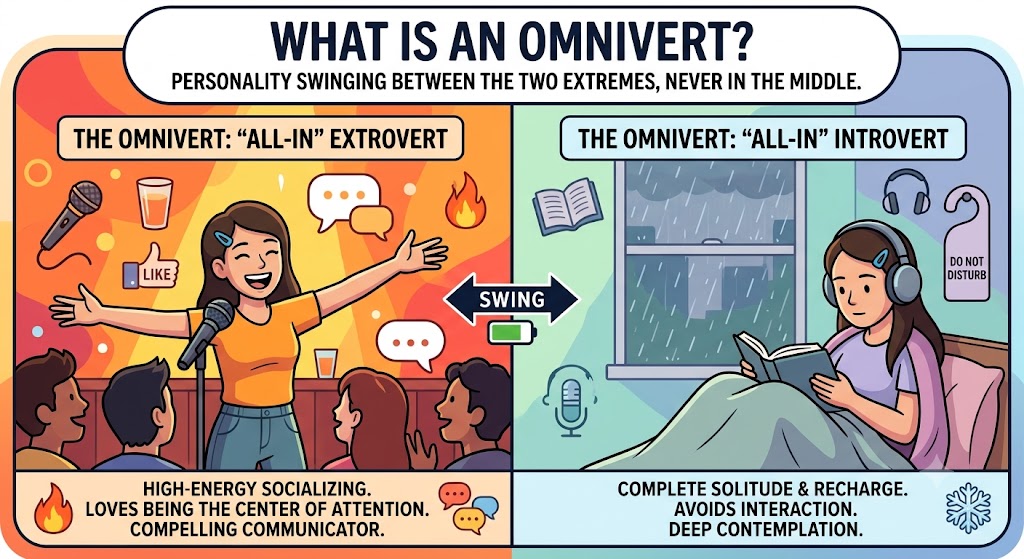
An omnivert is someone who swings between full introversion and full extroversion — not a blend of both, but each one completely, depending on the situation. If you have days where you genuinely crave a loud room full of people, followed by days where a single text message feels like too much, this might describe you more accurately than any other personality label you have tried on.
What an Omnivert Actually Is
The omnivert concept sits close to — but is distinct from — the ambivert. An ambivert typically sits in the middle of the introvert-extrovert spectrum at all times, moderately social, moderately private. An omnivert does not live in the middle. They occupy both ends, moving between them based on context, mood, stress levels, or who they are with.
Psychologically, this connects to how the brain uses two competing neurotransmitter pathways. Dopamine drives the reward response associated with external stimulation — socialising, novelty, action. Acetylcholine governs the quieter internal reward system that introverts tend to rely on. Most people lean toward one. An omnivert appears to access both, though not simultaneously — more like switching between two distinct operating modes.
This is not a formally recognised clinical category. It is a descriptive term, useful precisely because the introvert-extrovert binary does not account for everyone. Carl Jung himself described introversion and extroversion as tendencies, not fixed states. The omnivert simply makes that variability more visible and more extreme.
Signs You Might Be an Omnivert
You might notice that you are genuinely the loudest person in the room one evening and completely unreachable the next morning. It is not a mood disorder. It is more like a tide — predictable once you understand your own patterns, but confusing to people who expect you to be consistent.
It often shows up as contradictory social feedback. Friends who know you in one context think of you as outgoing. People who know you in another see you as reserved. Both are right. You are not performing either version — they are both real.
Another sign is that your energy source shifts. Sometimes being around people fills you up. Other times identical social contact drains you completely. The difference is rarely about the people involved. It has more to do with where you are internally before the interaction begins. When you are in an extroverted phase, stimulation feeds you. When you are in an introverted phase, the same stimulation costs you.
You may also find labels frustrating. “Introvert” feels right sometimes. “Extrovert” fits other times. “Ambivert” feels too lukewarm for what you actually experience. If that resonates, omnivert may be the more honest description of your personality type.
What Actually Helps When You Are an Omnivert
The most useful thing is learning to recognise which mode you are in before committing to social plans. A brief honest check — not a lengthy journaling session, just a genuine sense of where your energy is — can prevent a lot of regret. Saying yes to dinner when you are in an introverted phase and then white-knuckling through it helps no one.
Give people in your life a simple framework. You do not need to explain omniversion at length. Something like “I go through phases where I need more space” is enough. It removes the guesswork for them and the guilt for you.
Stop treating your extroverted days as the baseline you should maintain. Many omniverts feel vaguely broken on their introverted days, as though they have regressed or failed somehow. They have not. Both states are functional. Neither is the real you hiding behind the other.
When you leave a social gathering early because you have hit your limit, do not apologise or over-explain. A simple “I am heading off now” is a complete sentence. The guilt that follows an honest exit costs more energy than the exit itself ever should.
Track your patterns if you are genuinely uncertain about what triggers each mode. Sleep, stress, work pressure, and even the season can all influence whether you are running on dopamine or acetylcholine on a given day. That information is more useful than any personality quiz.
When to Get Support
Swinging between social states is not inherently a problem. But if the shifts feel extreme, rapid, or outside your control — particularly if low periods bring persistent low mood, withdrawal from things you usually value, or a sense of not recognising yourself — it is worth talking to a therapist or GP. Personality variability and mood disorders can overlap, and a professional is better placed than a personality framework to help you tell the difference.
A Few Questions Worth Answering
- What is the difference between an omnivert and an ambivert?
-
An ambivert sits consistently in the middle of the introvert-extrovert spectrum. An omnivert moves between the two extremes depending on the situation or internal state. The experience is less of a permanent middle ground and more of an alternating current between two distinct personality modes.
- Is being an omnivert the same as being inconsistent or unpredictable?
-
Not quite. Omniverts follow real patterns — the shifts are responsive to context and internal state, not random. Once you understand your own triggers, the behaviour is actually quite consistent. The confusion usually comes from others comparing two different versions of you across different situations.
- Can an introvert become an omnivert over time?
-
Personality traits shift gradually across a lifetime, particularly in response to major life changes. Some people who identified strongly as introverts find their social needs change. Whether that becomes an omnivert pattern or simply a softer introvert vs extrovert position depends on the person and how pronounced the shifts are.
- Is omnivert a real psychological term?
-
It is not a formal clinical or academic term in the way introversion is defined within Big Five personality research. It is a descriptive label that many people find more accurate than the standard binary or the ambivert middle ground. Its value is practical, not diagnostic.
If the word omnivert finally makes your social patterns make sense, that is reason enough to use it. Labels are only useful when they reflect something real. What matters more is understanding your own rhythms well enough to stop apologising for them.