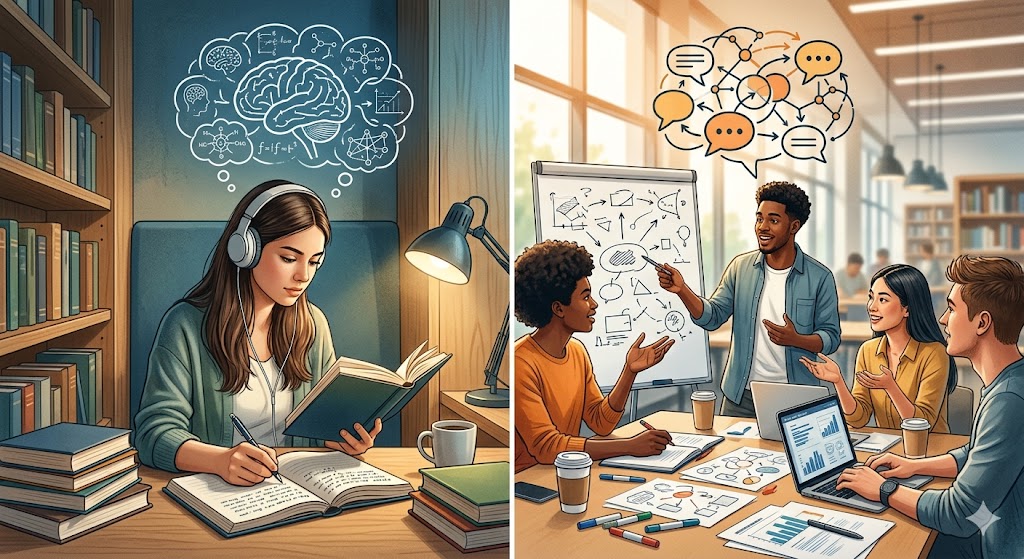
How you learn best is not just a preference — it is wired into how your brain processes stimulation. Understanding introvert vs extrovert learning styles starts here: the difference between introvert vs extrovert learning styles is real, measurable, and worth understanding. If you have ever felt drained by group projects, unable to think clearly in noisy classrooms, or at your sharpest when studying alone, that is not a quirk. It is your neurology.
The Science Behind Introvert vs Extrovert Learning Styles
The foundational explanation comes from Hans Eysenck’s arousal theory, later supported by research on neurotransmitter sensitivity. Introverts have a lower threshold for external stimulation. Their brains reach an optimal level of arousal faster than extroverts do. This means that the same classroom environment — background noise, group discussion, fast-paced back-and-forth — that energises an extrovert can tip an introvert into overload before they have had a chance to think clearly.
The neurochemistry matters here. Research suggests introverts are more sensitive to dopamine and rely more heavily on a longer neural pathway involving acetylcholine, the neurotransmitter associated with inward focus and reflection. This is why introverts often do their best thinking slowly, privately, and in conditions of relative quiet. It is not about being shy or antisocial. It is about where the brain’s processing power goes.
Extroverts, by contrast, need more stimulation to reach that same optimal state. Group learning, debate, and talking through problems out loud tend to help them consolidate information. They are often energised by thinking aloud. Neither approach is superior — they are simply different operating systems.
Recognisable Signs That You Learn Like an Introvert
You might notice that you retain information far better after reading alone than after a group discussion covering the same material. The discussion felt scattered; the solitary reading felt solid. That gap is telling you something about how introvert learning styles work in practice.
It often shows up as a need to sit with new information before you can respond to it usefully. When a teacher calls on you without warning, your mind may go blank — not because you do not know the answer, but because you have not had time to process. Given a written question and five minutes, the same answer comes easily.
You may also find that open-plan study spaces, study groups, or collaborative workshops leave you exhausted rather than informed. You absorb less when there is too much going on around you. Noise-cancelling headphones, a library corner, or a closed door are not antisocial choices — they are tools that let your brain do its actual job. Many introverts also find they learn well through writing, reading, and one-on-one conversation, rather than large-group formats.
What Actually Helps Introverts Learn Better
Control your environment before anything else. Identify the specific conditions under which you retain the most — time of day, level of ambient noise, whether music helps or hinders. Then protect those conditions. Studying at 10pm in silence because that is genuinely when your brain is quiet is a legitimate strategy, not a bad habit.
When you have to participate in group learning, prepare beforehand. Read the material, form your thoughts, and write down two or three points you want to make. Walking into a discussion with something already formed in your mind reduces the pressure of real-time processing significantly.
Use writing as a thinking tool, not just a recording tool. Before a test, exam, or important meeting, write out what you know from memory. This works with how introverts process — it externalises internal thought without the noise of another person in the room.
If you are in a course or workplace that defaults to group work, ask for options. Request written briefs in advance. Ask to submit thoughts in writing rather than speaking off the cuff. Many educators and managers will accommodate this when asked plainly, without apology.
Finally, build in recovery time after intensive learning sessions. Two focused hours followed by a genuine break will produce more than five hours of overstimulated half-attention.
When to Get Support
If your learning difficulties go beyond preferring quiet — if anxiety makes it genuinely impossible to participate in any group setting, or if avoidance is affecting your career or studies — that is worth talking to someone about. A therapist familiar with social anxiety can help distinguish between introversion and something that is actively limiting you. The two can overlap, and untangling them is useful work.
A Few Questions Worth Answering
What are the main introvert vs extrovert learning styles differences?
Introvert vs extrovert learning styles differ in processing: one prefers to absorb then discuss, the other to discuss in order to absorb.
How introverts learn best in a classroom
How introverts learn best is by reading ahead and writing afterwards, which is why participation-heavy formats undersell them.
What introvert study habits actually work?
The introvert study habits that work involve long uninterrupted blocks and written output rather than group revision.
Is learning style personality dependent?
Learning style personality claims are often overstated, but introvert vs extrovert learning styles differ reliably in tolerance for group formats.
- Do introverts actually learn differently than extroverts?
-
Yes, in measurable ways. Research on cortical arousal and neurotransmitter pathways shows introverts reach cognitive overload faster in high-stimulation environments. This affects how they absorb and retain information, making quieter, self-directed study formats more effective for most introverts.
- Why do introverts struggle with group learning?
-
Group settings create competing stimuli — other voices, social dynamics, rapid topic shifts. For introverts, managing that stimulation uses cognitive resources that would otherwise go toward understanding the material. The struggle is neurological, not a lack of social willingness.
- What are the best introvert study habits for retaining information?
-
Studying alone in a low-stimulation environment, using writing to consolidate thinking, preparing questions before discussions, and spacing sessions with real rest in between. These introvert study habits align with how the introverted brain processes and stores information most efficiently.
- Can introverts do well in schools or workplaces built for extroverts?
-
Yes, with deliberate adaptation. Understanding your learning and personality type lets you build compensating habits — preparing in advance, requesting written formats, choosing when and where to engage. The system rarely changes; knowing yourself means you can work within it without running on empty.
The point is not to avoid every collaborative setting or to label yourself as someone who cannot adapt. It is to stop interpreting your brain’s natural preferences as failures. When you study in a way that fits how you actually process information, the results speak for themselves.