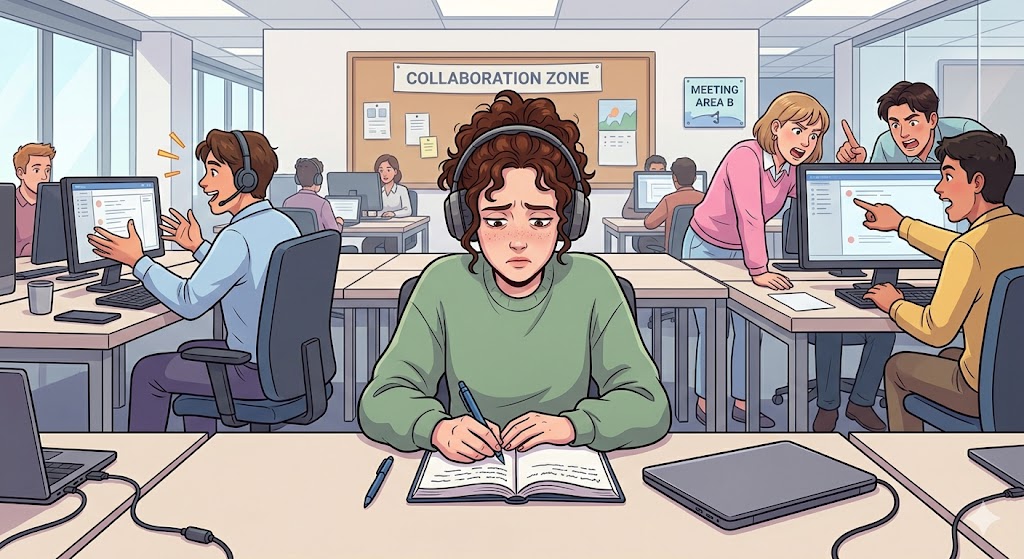
Open offices introverts have to work in were designed around a theory of collaboration that mostly benefited the people who designed them, not the significant share of employees whose actual best work happens in focused, low-stimulation conditions. If you’ve felt measurably less productive and considerably more drained since your company switched to an open floor plan, that’s not a personal shortcoming — it’s a well-documented mismatch between the environment and how a large portion of the workforce actually functions.
Why Open Offices Introverts Work In Cause Real Problems
Open floor plans were sold on the promise of spontaneous collaboration and easier communication, but the research on actual outcomes is considerably less flattering — several major studies have found that face-to-face interaction actually decreases in open offices, as people retreat to messaging and headphones to cope with the constant ambient noise and visibility. For introverts specifically, the format adds a continuous, low-grade sensory and social demand throughout the entire workday: ambient conversation, visual movement, the general awareness of being observable at all times, none of which ever fully switches off the way a private or semi-private space would allow.
This constant background stimulation draws steadily on the same limited attention and energy an introvert needs for focused, high-quality work, meaning the cost isn’t just discomfort — it’s a genuine, measurable productivity tax that compounds across an entire working day, every single day, without any of the natural recovery breaks a more private setup would provide.
The Career Cost of an Environment That Wasn’t Designed for You
Beyond daily productivity, open offices introverts navigate can create a subtler career cost: the visible, constant collaboration the format is designed to showcase often gets read by management as engagement and initiative, while an introvert’s genuinely productive focused work — happening quietly, without much visible activity — can be undervalued simply because it doesn’t look like the busy, interactive behaviour the space seems to reward. This isn’t a fair measure of actual contribution, but it’s a real dynamic worth being aware of and actively managing rather than just enduring silently.
Practical Strategies for Surviving and Advocating in an Open Office
Use noise-cancelling headphones deliberately and visibly, not just for music but as a genuine focus tool — many open offices have informally adopted headphones as a signal for “please don’t interrupt,” and using them consistently tends to reduce casual interruptions considerably over time as colleagues learn the pattern.
Book any available private or semi-private space — a phone booth, an unused meeting room, even a quiet corner — for your most demanding focused work, rather than trying to power through it at your open desk. Treating this as a legitimate, scheduled part of your workday, not a special favour, tends to normalise the practice for both you and your colleagues.
Advocate directly for flexibility where possible, whether that’s remote work days, flexible hours that let you work during quieter periods, or a request for a quieter desk location away from high-traffic areas. Framing this in terms of concrete output — “I produce my best work with fewer interruptions” — tends to land better with management than framing it purely as a personal preference.
Time-box your most demanding cognitive work for whatever window in the day tends to be naturally quieter in your specific office, whether that’s early morning before most colleagues arrive or a different lull you’ve noticed in your particular workplace’s rhythm.
Questions People Ask About Introverts in Open Offices
Why are open offices introverts work in so difficult?
Open offices introverts work in deliver unpredictable noise and movement continuously, which is the most expensive sensory combination.
What are the main open plan office problems?
The open plan office problems best documented are reduced face-to-face collaboration, more email, and measurable drops in concentration.
Why open offices dont work as intended
Why open offices dont work is now well evidenced: the collaboration they promised largely did not materialise, while the cost to focused work did.
How do you handle introvert office noise?
Introvert office noise is managed with noise-cancelling headphones, a seat away from walkways and one booked quiet room daily.
Is it reasonable to ask for a quieter desk or private space at work?
Yes, especially when framed around concrete productivity outcomes rather than just personal comfort — many employers are increasingly aware of the research on open-office drawbacks and receptive to reasonable accommodation requests.
Do noise-cancelling headphones actually help in an open office?
Considerably, both by reducing the actual ambient noise and by signalling to colleagues that you’re in focused work mode, which tends to reduce casual interruptions over time as the pattern becomes recognised.
Why do I feel more exhausted at the end of the day since switching to an open office?
The constant, low-grade sensory and social stimulation of an open floor plan draws continuously on attention and energy throughout the day, producing a real cumulative fatigue that a private or semi-private workspace wouldn’t generate to the same degree.
Should I push for full remote work instead of trying to adapt to the open office?
If it’s available and suits your role, it’s worth genuinely considering — but even partial flexibility, like a few remote days or access to quiet space during the workweek, can meaningfully reduce the cumulative cost open offices introverts otherwise absorb silently.
Are companies actually moving away from open floor plans given the research?
Some are, particularly toward hybrid layouts with a mix of open collaborative space and quiet private zones, though full reversal is slow — advocating for these hybrid options where available is often more realistic than requesting a complete return to private offices.
Open offices introverts work in weren’t designed with this temperament’s actual productivity needs in mind, but understanding the real mechanism behind the drain — and advocating concretely for the specific adjustments that address it — tends to work far better than simply enduring it and assuming the exhaustion is a personal failing you need to just push through quietly, day after day, without ever naming clearly what’s actually happening underneath it.