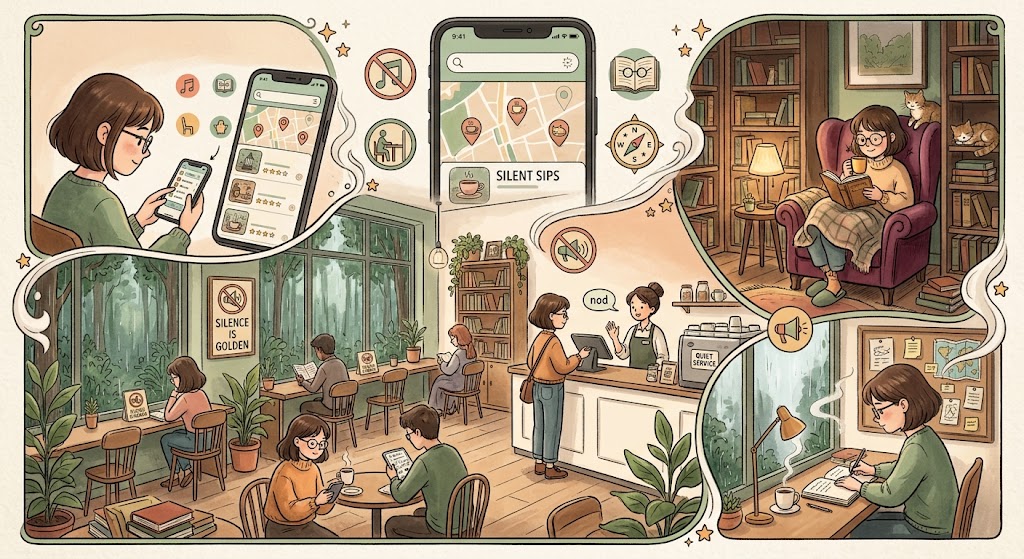
Quiet cafes for introverts solve a problem most people never quite name out loud: the need to be around other people without needing to interact with them. If working from home feels isolating but a busy open-plan office or a loud coffee shop leaves you fried within the hour, the answer isn’t forcing yourself to tolerate more stimulation. It’s finding the specific kind of low-key public space that gives you presence without performance.
Why Quiet Cafes for Introverts Work Better Than Either Extreme
Total isolation and loud, crowded environments fail introverts for opposite reasons. Working entirely alone at home removes stimulation but often removes the ambient sense of being around life too, which can tip into a flat, understimulated kind of loneliness over time. A loud, busy café floods the system with exactly the kind of unpredictable noise and social density an introvert nervous system struggles to filter out, making focus or genuine relaxation almost impossible. Quiet cafes for introverts sit in the narrow, valuable middle: enough ambient human presence to feel connected to the world, with none of the demand to actually engage with any of it.
This matches a specific introvert need for what’s sometimes called parallel presence — being near other people without direct interaction, similar to how a quiet library or a park bench near light foot traffic can feel calming rather than draining. The right café hits this register precisely, offering company without requiring performance.
What to Actually Look for in an Introvert Recharge Environment
Background noise level matters more than most people initially think to check for. A space with soft ambient chatter and no music, or quiet instrumental music at a low volume, sits in a genuinely different category from one playing loud upbeat playlists meant to energise a crowd. Testing a new café at an off-peak hour first — mid-morning on a weekday rather than a Saturday afternoon — often reveals its true baseline noise level more accurately than visiting during a busier stretch would.
Seating layout matters just as much as volume. Look for cafés with varied seating — a few tables tucked away from the main flow of foot traffic, seats facing a wall or window rather than the open room, corners that naturally discourage the kind of casual conversation-starting that a communal table invites. These small layout choices do more for how restorative a space actually feels than the coffee quality or the aesthetic ever will.
Consistency is worth prioritising once you’ve found a spot that works. Returning to the same quiet café repeatedly, rather than constantly testing new venues, lets the environment become genuinely familiar and therefore even less demanding on your attention — a known space requires far less vigilance to feel safe in than a new one, even one that’s objectively just as quiet.
Making the Most of Low Stimulation Spaces Beyond Just Cafés
The same principle extends well beyond coffee shops. Quiet corners of libraries, off-peak museum galleries, even a specific bench in a park at a predictable time of day can serve the same function: low stimulation spaces that offer company without demand. Building a small personal list of two or three reliable low-stimulation spots, rather than relying on a single café, gives you options across different moods and times of day without needing to search for a new environment every time.
Questions People Ask About Quiet Cafes for Introverts
Why do quiet cafes for introverts work so well?
Quiet cafes for introverts solve a specific need: being around people without interacting with any of them.
What makes the best cafes for introverts?
The best cafes for introverts have soft surfaces, spaced tables and no music competing with conversation.
Is working from a cafe introvert friendly?
Working from a cafe introvert style works when the ambient noise is steady rather than variable. Quiet cafes for introverts beat silent rooms for many people.
What should you look for in a coffee shop introvert visitors like?
A coffee shop introvert visitors return to has a corner seat, no queue pressure and staff who do not attempt conversation.
Is it strange to go to a café alone regularly rather than to socialise?
Not at all — using a quiet café as a personal recharge or work environment is a completely legitimate reason to be there, and most cafés welcome regular solo customers just as warmly as social groups.
How do I find quiet cafes near me without visiting every option in person?
Review sites and photos often reveal seating layout and general atmosphere before you visit, and searching specifically for terms like “quiet,” “good for working,” or “laptop-friendly” in reviews tends to surface the right kind of venue faster than browsing blind.
What if my favourite quiet café gets busier or louder over time?
It happens, and it’s worth having a backup or two in rotation rather than depending entirely on one venue staying exactly the same indefinitely as its popularity or ownership changes.
Can a noisy café ever work for an introvert with the right adjustments?
Sometimes, with noise-cancelling headphones and a corner seat away from the busiest area, though this is usually a workaround rather than a genuine substitute for a venue that’s naturally quiet to begin with.
Is it worth paying more for a quieter café over a cheaper, louder chain?
Often yes, if the space genuinely functions as a recovery or focus environment for you — the value of a reliably restorative spot tends to outweigh a modest price difference once you factor in how much more gets done, or how much better you feel, during and after the visit.
Quiet cafes for introverts aren’t a small preference to apologise for — they’re a legitimate, well-understood need for company without demand, and worth the deliberate searching it takes to find the two or three spots that actually deliver it consistently, session after session, year after year, long after the initial search itself is forgotten and the routine simply feels like an ordinary, comfortable part of the week, rain or shine, busy season or quiet one, year in and year out.