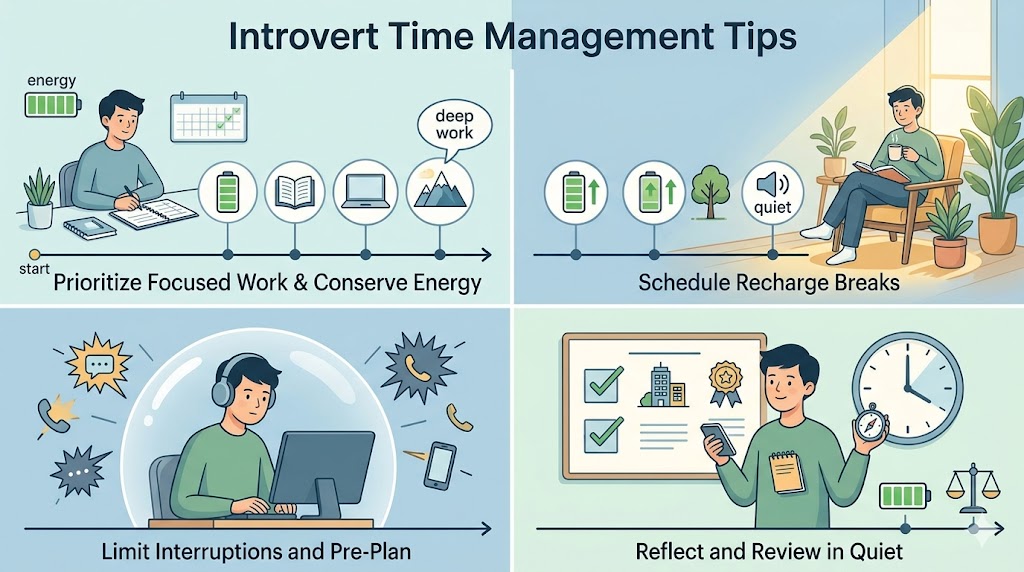
Most productivity advice assumes everyone runs on the same fuel: a fixed number of hours, refilled by coffee and willpower. If you’re an introvert, you already know that’s not quite true. Your energy doesn’t move in a straight line through the day — it dips and spikes depending on how much social or sensory input you’ve absorbed. That’s exactly why generic scheduling hacks so often fail you, and why real introvert time management tips have to start with energy, not just with the clock.
This isn’t another article about building a weekly planner or picking the perfect morning routine. Those things have their place, but they’re templates — swap in your own tasks and hope for the best. What follows instead are the underlying principles that make time management actually work for an introverted nervous system: how to structure your day around energy rather than hours, how to batch tasks so your brain isn’t constantly switching gears, and how to protect the deep work that lets you do your best thinking without burning out.
Why Standard Time Management Fails Introverts
Most time management systems were built around an implicit assumption: that a person’s capacity for focus and social interaction is roughly constant throughout the day, limited mainly by sleep and meals. Introverts don’t work that way. Social interaction, open-plan noise, video calls, and even crowded group chats draw down a separate reserve of energy that has nothing to do with how many hours you’ve slept. Ignore that reserve and you’ll find yourself productive on paper — every slot in the calendar filled — while feeling completely drained and behind by 3 p.m.
The fix isn’t to work harder inside a flawed system. It’s to redesign the system itself. That’s the core idea behind every one of the introvert time management tips in this article: treat energy as the primary resource you’re budgeting, and let the clock play a supporting role.
Energy-Based Time Blocking, Not Just Calendar Blocking
Calendar-based time blocking asks a simple question: what time is it? Energy-based time blocking asks a better one: what state am I in right now? For most introverts, energy is highest in a window of relative solitude — often early morning or late evening, before or after the social demands of the day have had a chance to accumulate. That window is when your brain is least cluttered by other people’s input, and it’s the single best place to protect for your hardest, most cognitively demanding work.
Map your own pattern for a week. Jot down, hour by hour, whether you feel sharp, neutral, or foggy. You’ll likely notice a shape: a strong stretch early on, a dip after any meeting-heavy block, and a smaller second wind later. Once you can see that shape, stop assigning tasks to time slots and start assigning them to energy states instead. High-energy windows get your hardest problem-solving. Neutral windows get routine execution. Foggy windows get the low-stakes, low-decision tasks that don’t require much of you at all — filing, replying to easy emails, tidying files.
Batching: The Antidote to Constant Context-Switching
Every time you jump between an unrelated task — from writing to answering a Slack message to reviewing a spreadsheet and back — your brain pays a switching cost. For introverts, that cost is compounded, because many of those interruptions also carry a social or sensory component: a notification, a quick call, a hallway conversation. Each one isn’t just a task switch, it’s a small withdrawal from your energy reserve.
Batching solves this by grouping similar tasks so your brain stays in one mode for longer stretches. Answer all your messages in two set windows instead of as they arrive. Handle every phone call for the day back to back rather than scattering them. Group all your creative work into one block and all your administrative work into another. The goal isn’t rigidity for its own sake — it’s reducing the number of times per day your brain has to reorient itself, which is one of the most underrated introvert time management tips because it saves energy you didn’t realize you were spending.
Protecting Deep Work Without Guilt
Deep work — the kind of focused, uninterrupted thinking that produces your best writing, strategy, or problem-solving — depends on exactly the conditions introverts are naturally good at creating: quiet, minimal interruption, and sustained attention on one thing. The trouble is that many workplaces and even personal routines treat availability as a virtue, which quietly punishes anyone who tries to close the door and disappear for ninety minutes.
Reframe deep work as a scheduled commitment, not a stolen luxury. Put it on the calendar the same way you’d put in a meeting, and treat interruptions during that block the way you’d treat someone walking into an actual meeting uninvited. If your environment makes closed-door blocks impossible, use smaller signals — headphones, a status message, a specific chair — to create the same psychological boundary. Deep work sessions don’t need to be long to be valuable; even a protected forty-five minutes, done consistently, will outproduce a scattered eight-hour day.
Building in Recovery to Prevent Burnout
Burnout among introverts rarely comes from working too many hours in the abstract sense. It comes from too many hours spent in states that drain rather than restore — back-to-back meetings, open offices, constant availability. A time management system that never accounts for recovery is a system that’s quietly setting you up to crash.
Treat recovery blocks as non-negotiable line items, not optional nice-to-haves you’ll get to if there’s time left over. A short walk alone between tasks, a lunch eaten without a screen or a conversation, ten minutes of silence between a call and the next task — these aren’t indulgences, they’re what let the next work block actually be productive. Without them, every subsequent task gets a little more effortful, and by late afternoon you’re running on fumes rather than genuine focus.
Questions People Ask About Introvert Time Management Tips
Do introvert time management tips actually differ from general productivity advice? Yes, in one key respect: they treat energy, not just hours, as the resource being managed. The tactics — blocking time, batching tasks, protecting focus — sound similar to general advice, but the trigger for when you use them is your energy state rather than the clock alone.
How many hours of deep work should an introvert aim for each day? There’s no universal number, but most people find that one to three genuinely focused hours produce more usable output than a full day of scattered attention. Start with one solid block and build from there once you see how it changes your output.
Is batching tasks realistic in a job full of interruptions? Even partial batching helps. If you can’t control your whole day, batch what you can — set two windows for messages instead of checking constantly, or group your calls into one stretch. Small batches still reduce the switching cost that drains introverted energy.
None of this requires a total overhaul of your job or your calendar overnight. Start with one principle — energy-based blocking, batching, protected deep work, or built-in recovery — and apply it for a week before adding the next. The point of these introvert time management tips isn’t to turn you into someone who works differently than you naturally do; it’s to build a system that finally matches the energy you already have, so the hours you spend working actually count.