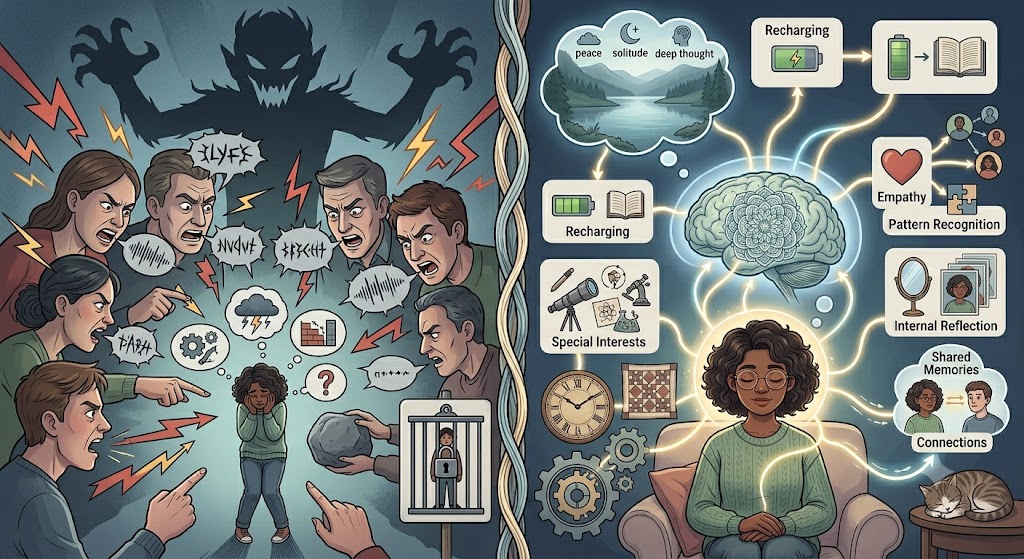
Mental health stigma for introverts often takes a specific, easy-to-miss shape — not outright dismissal, but a quieter tendency to read genuine symptoms as “just how introverts are,” which can delay recognizing when something has moved past personality and into an actual mental health concern.
How Mental Health Stigma for Introverts Shows Up Differently
Where extroverted people showing withdrawal or low energy are more likely to prompt concern and questions, an introvert showing the same signs is often assumed to simply be acting like themselves. This creates a specific form of mental health stigma for introverts: real symptoms of anxiety, depression, or burnout get absorbed into an existing personality narrative rather than recognized as something that might need attention.
The introvert’s own self-assessment can be affected by the same bias. Because solitude and low social energy are normal and healthy parts of being an introvert, distinguishing that baseline from an actual decline can be genuinely difficult — the line between “recharging” and “withdrawing due to depression” isn’t always obvious from the inside, especially without a clear point of comparison.
Why This Matters for Getting Real Support
This stigma has practical consequences. Friends, family, and even clinicians unfamiliar with typical introvert behavior patterns may take longer to recognize a genuine problem, since the outward presentation looks similar to ordinary introvert functioning. Delayed recognition often means delayed support, at exactly the point when earlier intervention would have been most useful.
It can also make introverts more hesitant to seek help themselves, worried that a real concern will be dismissed as “just needing some alone time” rather than taken seriously as something worth addressing directly.
Distinguishing Normal Introversion From a Genuine Concern
A few markers tend to separate ordinary introvert functioning from something that warrants more attention: a noticeable change from your own typical baseline, rather than a fixed trait; withdrawal that doesn’t resolve with normal rest and recharge time; and a loss of interest in activities that would normally still feel appealing even at lower energy.
Tracking your own patterns over time — noticing what a “normal” recharge period looks like for you specifically — makes it much easier to recognize when something has shifted meaningfully rather than second-guessing every quiet stretch.
Pushing Back on the Stigma
Naming the distinction explicitly, both to yourself and to people close to you, helps: solitude by choice is different from withdrawal driven by something that needs addressing. Being specific about which one you’re experiencing, rather than letting others assume, makes it easier for real concerns to actually get heard.
How This Stigma Shows Up in Clinical Settings Specifically
Mental health stigma for introverts doesn’t only come from friends and family — it can show up in clinical assessments too. A quiet, reserved presentation during a therapy intake or psychiatric evaluation can be read as personality rather than as a possible symptom pattern, especially in a single short appointment where a clinician doesn’t yet know a person’s actual baseline.
Choosing a clinician who explicitly welcomes this kind of context, and asks about baseline behavior rather than assuming it, can meaningfully reduce this specific risk over time.
This is part of why bringing specific, concrete detail into an appointment matters so much — describing exactly how current functioning differs from your normal pattern, rather than describing symptoms in general terms, gives a clinician the comparison point they need to see past a naturally quiet presentation to what’s actually changed.
It can also help to bring a trusted person’s outside observation into the conversation, since they may notice a shift you’re too close to see clearly yourself.
If a first appointment doesn’t feel like it captured the real picture, following up with more specific written detail, or seeking a second opinion, is a reasonable next step rather than assuming the initial read was necessarily accurate.
Helping Others Understand the Difference
For people close to an introvert, learning to ask specific rather than general questions helps cut through this stigma directly. “Is this different from your normal quiet time, or does it feel like something more?” invites a more accurate answer than a general “are you okay?”, which an introvert experiencing real symptoms might reflexively answer with a reassuring but inaccurate “I’m fine.”
This kind of specific question also signals that the person asking already understands ordinary introvert behavior isn’t itself a concern, which tends to make an honest answer feel safer and less likely to be dismissed as overreacting to normal quietness.
Questions People Ask About Mental Health Stigma and Introverts
What does introvert mental health stigma look like?
Introvert mental health stigma is quiet rather than hostile: real symptoms get read as just how they are, and nobody follows up.
How does mental health stigma work differently here?
Mental health stigma for quiet people rarely takes the form of dismissal. It takes the form of a plausible explanation that stops the conversation.
Why do introvert symptoms dismissed so often go unchecked?
Introvert symptoms dismissed as temperament delay help by months. Introvert mental health stigma is dangerous precisely because it sounds reasonable.
What breaks the pattern?
Introvert mental health stigma breaks when the question changes from are you withdrawn to has your recovery stopped working.
How do I know if I’m just recharging or actually depressed?
Look at whether rest restores your energy and interest as usual — if it doesn’t, or if the withdrawal persists well beyond what normally helps, it’s worth taking seriously rather than assuming it’s simply introversion.
Why do clinicians sometimes miss mental health issues in introverted clients?
Some may attribute quiet, reserved presentation to personality rather than symptoms, which is why being explicit about changes from your own baseline during an appointment matters.
Is it stigma if a friend assumes I’m fine because I seem calm?
It can be a mild version of it — a well-meaning assumption that still means a real concern might go unnoticed unless you communicate it directly.
Recognizing mental health stigma for introverts as a real, specific pattern — not just personality misunderstanding — makes it easier to take your own symptoms seriously and to communicate clearly when something genuinely needs more than rest to resolve.