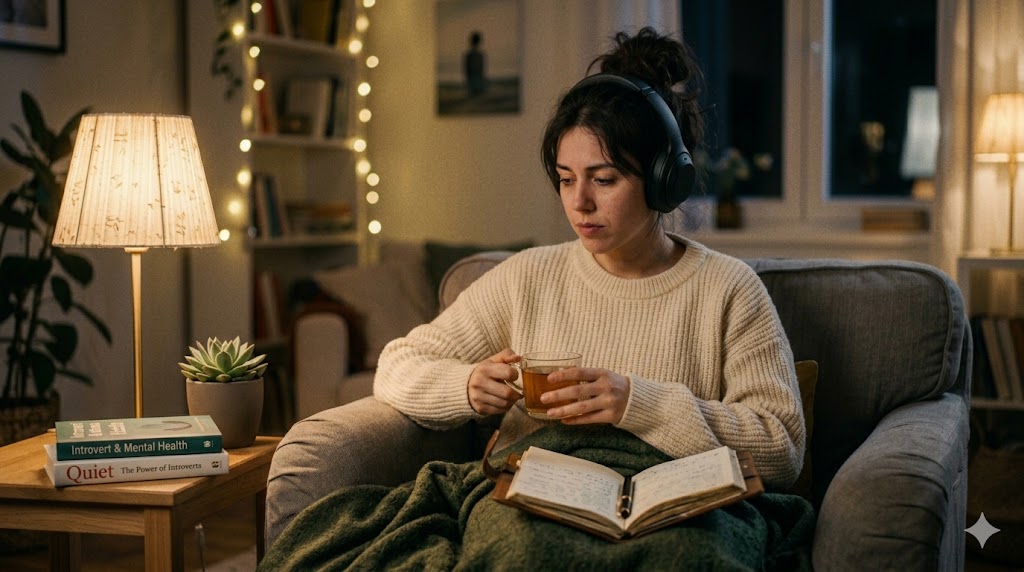
The link between being an introvert and mental health is often misunderstood: introverts aren’t inherently more prone to mental health issues, but they do face distinct challenges that others might not understand. The constant pressure to be socially ‘on’, the misinterpretation of quiet reflection as depression, and the exhaustion from living in an extrovert-oriented world can genuinely impact wellbeing. Understanding these patterns helps you protect your mental health while honouring your natural temperament.
The Science Behind This
Carl Jung first distinguished introverts from extroverts in the 1920s, noting that introverts direct their energy inward and recharge through solitude. Modern neuroscience has shown this isn’t just preference—it’s biology. Research by Dr. Debra Johnson found that introverts have higher baseline cortical arousal, meaning their brains are already quite stimulated at rest. This explains why additional social stimulation feels overwhelming rather than energizing.
The neurotransmitter acetylcholine plays a starring role here. Introverts’ brains respond more strongly to acetylcholine, which activates during quiet, contemplative activities like reading or thinking. Meanwhile, extroverts get more dopamine hits from external stimulation like socialising and novelty-seeking. Neither system is better—they’re simply different reward pathways. Problems arise when introverts force themselves into constant extroverted behaviours, depleting their mental resources and triggering what psychologists call ‘introvert burnout’.
Importantly, introversion itself isn’t a mental health condition. However, studies show introverts may be more susceptible to anxiety disorders and depression—not because of introversion, but because society often misunderstands or pathologises their need for solitude. The constant message that being quiet or needing alone time is ‘wrong’ creates real psychological stress.
Introvert and Mental Health: Signs and What It Looks Like
Healthy introversion looks like someone who enjoys deep conversations, needs regular alone time to recharge, and feels content with a smaller social circle. They’re thoughtful, observe before acting, and can engage socially when needed—they just need recovery time afterwards. This is normal and adaptive.
Mental health struggles in introverts often manifest differently than in extroverts. Watch for excessive isolation beyond normal alone time—cancelling plans repeatedly, avoiding even one-on-one interactions with close friends, or feeling paralysed by the thought of any social contact. Physical symptoms matter too: disrupted sleep, changes in appetite, persistent fatigue even after rest, or unexplained aches and pains.
Another warning sign is when the internal world becomes overwhelming. Introverts naturally spend time in their heads, but rumination—replaying conversations obsessively, catastrophising future scenarios, or getting trapped in negative thought loops—signals something beyond healthy reflection. Similarly, if solitude stops feeling restorative and starts feeling like escape or hiding, that’s worth examining. The key distinction is whether your introversion energises you or whether you’re using it to avoid dealing with deeper issues.
A Real-Life Example
Jordan, a 32-year-old graphic designer, always knew she was introverted. She loved her solo work time and preferred quiet evenings with a book over crowded bars. But during a particularly demanding project requiring constant client meetings, she noticed something shift. She stopped returning texts from close friends, began dreading even video calls with her sister, and felt anxious just thinking about leaving her flat. What started as normal introvert recharge time became isolation tinged with panic.
After her partner gently pointed out she hadn’t seen anyone in three weeks, Jordan recognised the difference. Her introversion hadn’t changed, but she’d slipped into social anxiety. With a therapist, she learned to distinguish between ‘I need time to recharge’ and ‘I’m avoiding interaction because I’m afraid.’ Understanding this difference was the first step toward addressing the anxiety while respecting her introverted nature.
What You Can Do About It
Start by establishing clear boundaries around your energy. Track how different activities affect you over two weeks. Notice which interactions leave you pleasantly tired versus completely drained, and which solitary activities genuinely restore you. This data helps you make informed choices rather than reacting to external pressure. Build ‘buffer time’ into your schedule—at least 30 minutes of quiet alone time before and after social events.
Create a ‘social budget’ that honours both your introversion and your connection needs. Humans are social creatures, even introverts, so complete isolation rarely serves mental health. Schedule one-on-one meetups with close friends rather than group events. These deeper connections often feel more meaningful and less draining than surface-level socialising. Quality over quantity protects your energy while maintaining important bonds.
Develop a regular mindfulness practice to distinguish healthy reflection from harmful rumination. Apps like Headspace or Calm work well, or simply try five minutes of focused breathing daily. When you notice thought loops starting, ask yourself: ‘Is this thought helping me solve something, or am I just spinning?’ This awareness helps you redirect mental energy more productively.
Finally, educate the people closest to you about what introversion actually means. Share articles, explain that declining an invitation isn’t personal rejection, and help them understand that your need for solitude is about self-care, not avoidance. When your support network understands your temperament, they’re less likely to misinterpret your behaviour or add pressure that damages your mental health.
When to Seek Help
Understanding the connection between introvert and mental health can help you know when it’s time to reach out. Consider professional support if you’re experiencing persistent low mood lasting more than two weeks, panic attacks, intrusive thoughts that interfere with daily functioning, or if your isolation feels compulsive rather than restorative. Also seek help if you’re using alcohol or other substances to cope with social anxiety, or if people you trust express genuine concern about changes in your behaviour. A therapist familiar with personality differences can help you address mental health challenges while respecting your introverted nature. Cognitive behavioural therapy and acceptance and commitment therapy have strong evidence for treating anxiety and depression in introverts.
Frequently Asked Questions
Are introverts more likely to be depressed?
Research shows a slight correlation, but introversion doesn’t cause depression. Instead, introverts may face more social pressure and misunderstanding, which can contribute to mental health struggles. The key factor isn’t introversion itself but how well you can honour your temperament while meeting connection needs. Introverts who accept themselves and set appropriate boundaries show no higher depression rates than extroverts.
How much alone time is too much?
This varies individually, but watch for these signs: alone time stops feeling restorative, you’re avoiding interactions you’d normally enjoy, or you’re isolating due to fear rather than preference. Healthy introverts still maintain close relationships and engage socially—they just need recovery time. If you’re going weeks without meaningful human contact or feeling relief rather than loneliness when plans cancel, that’s worth examining.
Can therapy help introverts, or will it just try to make me more extroverted?
Good therapy absolutely helps introverts without trying to change your temperament. A skilled therapist distinguishes between personality traits and mental health symptoms. They’ll help you address anxiety or depression while respecting your need for solitude and deep processing. If a therapist suggests your introversion itself is a problem, find a different therapist who understands personality psychology.
Is social anxiety the same as introversion?
No, they’re completely different. Introversion is a personality trait involving how you gain energy—you prefer less stimulation and recharge alone. Social anxiety is a mental health condition involving fear of judgment or negative evaluation in social situations. Introverts can be perfectly comfortable socially but need recovery time afterwards. Social anxiety causes distress before, during, and after interactions regardless of personality type.
Your introversion is a strength, not a flaw requiring fixing. The challenge lies in navigating a world that doesn’t always understand or accommodate quieter temperaments. By recognising the difference between healthy introversion and mental health struggles, setting protective boundaries, and seeking support when needed, you can thrive exactly as you are. Your depth, thoughtfulness, and capacity for meaningful connection are valuable—protect them by protecting your mental health.
Questions People Ask
What should you know about introvert mental health?
Introvert mental health is mostly ordinary mental health with one complication: the symptoms of withdrawal look identical to the temperament.
How do introversion and depression get confused?
Introversion and depression get confused because both reduce social activity. The difference is whether solitude still restores you.
Is introvert anxiety a distinct thing?
Introvert anxiety is not a separate condition, though the pressure to perform sociability is a real and specific stressor. Introvert mental health suffers most from that mismatch.
What does good mental health for introverts look like?
Mental health for introverts looks like enough solitude to recover and enough contact to stay connected — and noticing quickly when either one stops working.