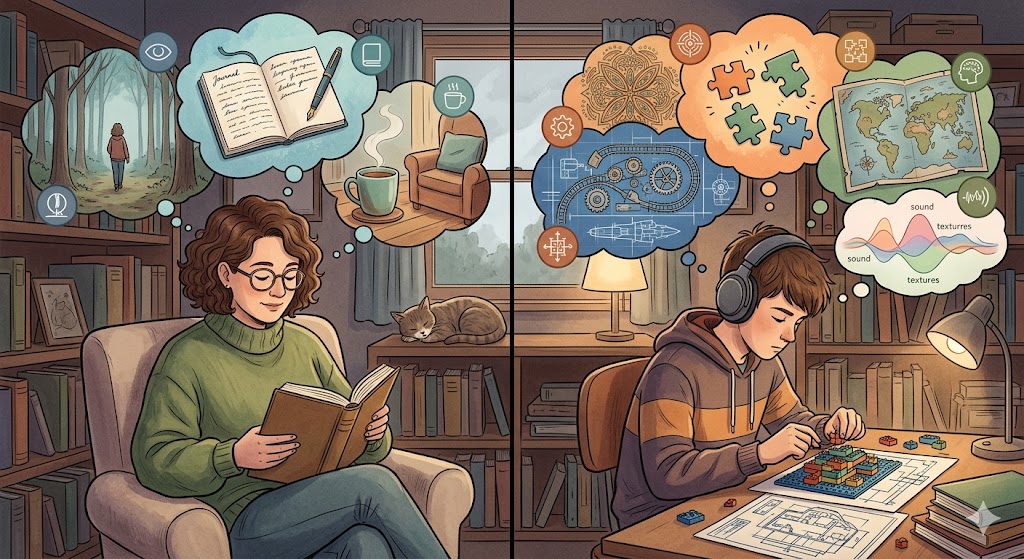
If you have ever felt drained after a party, preferred a quiet night with a book over a crowded bar, and then wondered whether your need for solitude might mean something more clinical, you are not alone. The relationship between introvert and autism traits is one of the most searched, and most misunderstood, topics in mental health conversations today. This confusion is understandable: both introverts and autistic people can find socializing exhausting, both may prefer smaller gatherings, and both are sometimes labeled “shy” by people who do not take the time to understand them. But introversion and autism are not the same thing, and treating them as interchangeable can do a disservice to both introverts and autistic individuals. This article walks through what the science and lived experience actually tell us about introvert and autism overlap, where the two diverge, and how to think clearly about your own traits without jumping to conclusions.
What Introversion Actually Is
Introversion is a personality trait, not a diagnosis. In psychological research, it sits on a spectrum with extroversion, describing where a person draws and spends their mental energy. Introverts tend to feel replenished by quiet, low-stimulation time alone or with one or two close people, while socializing, especially in large groups, tends to cost them energy rather than generate it. This does not mean introverts dislike people. Many introverts have deep, meaningful friendships and genuinely enjoy conversation; they simply need more recovery time afterward than an extrovert might. Introversion also comes with common traits such as a preference for listening over speaking first, a tendency to think before responding, sensitivity to overstimulating environments, and a rich inner world of reflection. None of these traits, on their own, indicate a developmental or neurological condition. They describe a normal, healthy variation in human temperament that shows up in roughly a third to a half of the population, depending on how it is measured.
What Autism Actually Is
Autism, by contrast, is a neurodevelopmental profile that affects how a person processes sensory information, communicates, and interacts with the social world from early childhood onward. Autistic people may experience differences in social communication, such as interpreting language very literally, finding unspoken social rules confusing, or communicating in ways that do not follow typical back-and-forth conversational patterns. Many autistic people also experience sensory sensitivities to light, sound, texture, or touch, alongside a strong preference for routine and predictability, and often develop deep, focused interests in specific topics. Autism is diagnosed through a comprehensive clinical evaluation, not a personality quiz, because it involves a distinct developmental and neurological pattern that goes well beyond simply enjoying quiet time. Autism exists on a spectrum too, meaning it looks different from person to person, but the underlying thread is a different way of processing and engaging with the world, present from an early age.
Where Introvert and Autism Traits Genuinely Overlap
The confusion between introvert and autism traits is not baseless. Several surface behaviors really can look similar from the outside. Both introverts and many autistic people may prefer solitary or low-key activities over large social events. Both groups can appear quiet in group settings, need recovery time after socializing, and feel overwhelmed in loud, crowded, or unpredictable environments. Both may be perceived by others as reserved, aloof, or hard to read, even when they are simply processing internally rather than expressing outwardly. Because of these visible similarities, it is entirely possible, and common, for someone to be both introverted and autistic. Being on the autism spectrum does not cancel out having a personality, and autistic people show the full range of introvert and extrovert temperaments just like anyone else. Recognizing this overlap in introvert and autism traits can actually be validating: it explains why some experiences feel familiar across both communities, without requiring one label to fully explain the other.
Key Differences Between an Introvert and Autism
The clearest distinctions between an introvert and autism traits show up in the “why” behind the behavior, not just the behavior itself. An introvert avoids a loud party primarily because it is tiring, not because the social rules of the party are confusing or distressing. An introvert can typically read facial expressions, tone of voice, and unspoken cues without much difficulty, even if they choose not to engage extensively. Autistic individuals, on the other hand, may find those same social cues genuinely hard to interpret, regardless of their energy level that day. Sensory sensitivities also tend to be more intense and more consistently present in autism, sometimes to the point of causing physical discomfort from certain sounds, lights, or fabrics, whereas an introvert’s sensitivity to stimulation is usually more about energy management than sensory pain. Autism also involves developmental patterns that are typically noticeable in childhood, while introversion is simply a stable personality trait observed across the entire lifespan without a “before and after.” Understanding these differences matters because mislabeling either experience can lead to missed support or unnecessary worry.
Mental Health Considerations
Mental health context matters a great deal here. Anxiety, depression, and social exhaustion can make introverted tendencies look more pronounced, just as they can intensify autistic traits, which sometimes muddies self-assessment further. If you are wondering whether your traits point toward autism rather than introversion, that curiosity is worth taking seriously, especially if unspoken social rules feel consistently confusing, if sensory experiences feel overwhelming in ways that go beyond simple tiredness, or if you have noticed these patterns since early childhood. A brief, honest note: self-reflection and online information, including this article, can help you understand yourself better, but they cannot replace a proper autism evaluation from a qualified psychologist or specialist. If the question feels persistent and personally significant, reaching out for a professional assessment is a reasonable, grounded next step, not an overreaction.
Questions People Ask About Introvert and Autism
Can you be an introvert without being autistic? Yes, absolutely. Most introverts are not autistic. Introversion is an extremely common personality trait found across roughly a third to half of the general population, while autism is a distinct neurodevelopmental profile affecting a much smaller percentage of people. Preferring quiet time and small groups, on its own, is simply a personality style.
Can an autistic person also be an extrovert? Yes. Autism affects social communication and sensory processing, but it does not erase personality. Autistic people can be introverted, extroverted, or anywhere in between, and many autistic extroverts genuinely enjoy socializing even while navigating social communication differences or sensory challenges along the way.
Is it possible to be both introverted and autistic? Yes, and it is fairly common. Being autistic does not prevent someone from also having an introverted temperament, and many autistic people describe themselves this way. In these cases, the person experiences both the energy-management patterns of introversion and the distinct social-communication and sensory patterns of autism together.
Ultimately, the introvert and autism conversation is less about drawing a hard line and more about understanding two genuinely different, sometimes overlapping, human experiences with clarity and compassion. Introversion describes how you recharge; autism describes a broader neurodevelopmental way of processing the world. You do not need a diagnosis to honor your need for quiet, and you do not need to dismiss real autistic traits out of fear of over-labeling yourself. If you recognize pieces of both descriptions in your own life, that is worth exploring gently, ideally with support from a professional who can offer real answers rather than internet speculation. Either way, understanding your own mind, whether it turns out to be simply introverted, autistic, or both, is a worthwhile and validating pursuit.