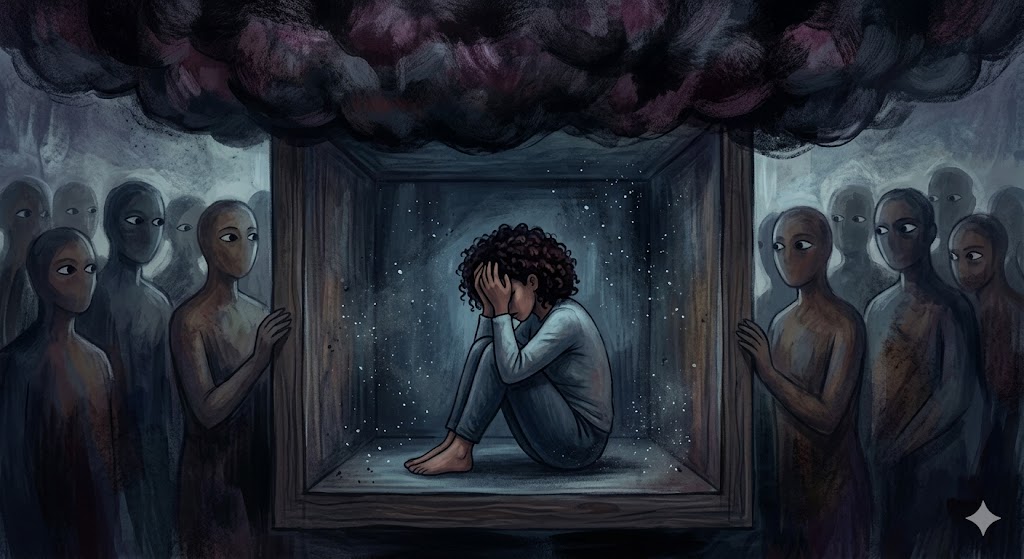
There is a particular kind of ache that comes from apologizing for who you are before anyone has even asked you to explain yourself. If you have ever left a party early and felt the need to invent a reason, or sat quietly in a meeting while your stomach twisted with the sense that your silence was a failure, you already know what introvert shame feels like from the inside. It is not simply preferring solitude. It is the belief, absorbed slowly over years, that preferring solitude makes you less than the people around you. Introvert shame is so common that most quiet people carry it without ever naming it, mistaking it for a personal flaw rather than a learned response to a world that rewards constant talking.
This feeling rarely arrives all at once. It builds in small moments: a teacher’s comment on a report card about needing to “participate more,” a relative teasing you for being the quiet one at family gatherings, a manager praising the loudest voice in the room while your careful, well-considered idea goes unnoticed. None of these moments seem large on their own. Stacked together over a childhood and into adulthood, they form a quiet, persistent message that being quiet is something to fix.
Where Introvert Shame Actually Comes From
Much of introvert shame is inherited rather than invented from scratch. Western culture in particular has spent the last century building institutions around an extroverted ideal. Classrooms reward students who raise their hands quickly and speak up often, even when a quieter student has spent longer actually thinking through the answer. Open-plan offices assume that collaboration only happens out loud, at volume, in real time. Media and marketing lionize the charismatic leader, the life of the party, the person who “commands a room,” while rarely celebrating the person who listens carefully and speaks only when it matters.
Add to this the well-meaning but damaging phrase so many quiet children hear growing up: come out of your shell. It sounds gentle, even encouraging, but it carries a hidden assumption that there is something wrong with the shell itself, something to be escaped rather than understood. Children who hear this enough times start to believe that their natural way of engaging with the world is a stage to grow out of rather than a legitimate and permanent part of their introvert identity. That belief does not disappear at eighteen. It follows people into job interviews, first dates, and family dinners, quietly whispering that their normal reactions are somehow wrong.
The Difference Between Introvert Shame and Introvert Guilt
It helps to separate two feelings that often get tangled together. Introvert guilt tends to be situational: you feel bad about a specific choice, like skipping a friend’s gathering or needing to cancel plans to recharge. Guilt says, “I did something that disappointed someone.” Introvert shame runs deeper and is far less specific. It says, “There is something wrong with me as a person.” Guilt can often be resolved with an honest conversation or a small repair. Shame is harder to resolve because it is not really about the specific event at all — it is about a core belief regarding your own worth and normalcy.
Recognizing which one you are experiencing in a given moment is genuinely useful. If you can name a feeling as introvert guilt over one particular choice, you can address that choice directly. If what you are feeling is introvert shame, the work is different: it requires examining the belief itself, not just the behavior that triggered it.
How Being Quiet Gets Mistaken for a Problem
One of the cruelest parts of introvert shame is how often it gets triggered by completely neutral behavior. Being quiet in a group is not evidence of boredom, unfriendliness, or social failure — it is often evidence of active listening, careful thought, or simple energy conservation. Yet quiet people are routinely asked, “Are you okay?” or “Why are you so quiet?” as though silence itself requires a medical explanation. Over time, this repeated questioning teaches introverts to perform engagement they don’t feel, just to avoid the discomfort of being noticed for something as ordinary as not talking.
This mismatch between how introverts actually function and how their behavior is interpreted by others is at the root of a great deal of unnecessary suffering. The problem was never the quietness. The problem is a cultural lens that reads quietness as a deficit rather than as one legitimate way among many of moving through the world.
Building a Steadier Introvert Identity
Untangling introvert shame is less about becoming louder and more about becoming more accurately informed about yourself. A stronger introvert identity starts with learning the actual research on temperament: introversion is a well-documented, biologically influenced trait related to how a person’s nervous system responds to stimulation, not a character defect or a phase of shyness to outgrow. Understanding this reframes years of self-criticism. You were never broken. You were operating exactly as your nervous system was designed to, in a culture that mostly built its institutions for a different kind of person.
From there, small practical shifts help. Notice when you’re translating a neutral preference — leaving early, needing quiet after a long day, preferring one-on-one conversations to group settings — into evidence of some deeper flaw. Practice describing your needs plainly instead of apologizing for them: “I do my best thinking alone” carries very different weight than “sorry, I’m just weird about this.” Surrounding yourself, even gradually, with people who don’t require you to perform extroversion to be valued also does enormous quiet work over time.
Questions People Ask About Introvert Shame
Is introvert shame the same as social anxiety?
No, though they can overlap and reinforce each other. Social anxiety involves fear of judgment or negative evaluation in social situations, often with physical symptoms like a racing heart. Introvert shame is a belief that your natural preference for lower-stimulation environments is inherently wrong or inferior. You can feel introvert shame without any anxiety at all, simply from years of cultural messaging that quiet people need fixing.
Can introvert shame develop even with a supportive family?
Yes. While a critical household can certainly deepen it, introvert shame is often absorbed from schools, workplaces, media, and broader social norms that prize extroversion, not just from direct family criticism. Even people raised in warm, accepting homes can pick up the message elsewhere that being quiet is a problem to solve.
What is the first step toward letting go of introvert shame?
Start by simply noticing the internal script. Many people carry an automatic inner voice that criticizes their quietness before they’ve even had a chance to evaluate whether anything actually went wrong. Naming that voice as a product of cultural conditioning, rather than an accurate reflection of reality, is often the first real crack in the shame.
Letting go of introvert shame is slow, unglamorous work, and it rarely happens through a single realization. It happens in small repeated moments: choosing not to apologize for leaving early, describing your needs plainly instead of shrinking them, noticing when you’ve quietly excelled precisely because you took the time to think before speaking. None of this requires becoming someone louder or more outgoing. It only requires believing, a little more each day, that the quiet way you move through the world was never something to be ashamed of in the first place.