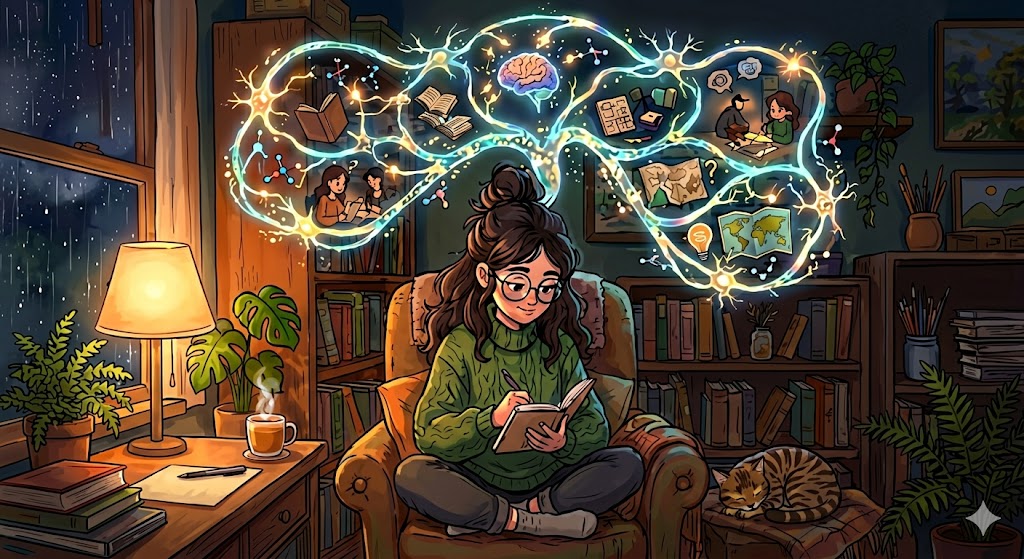
If you have ever left a party early not because you disliked the people but because your body was quietly begging you to go sit somewhere quiet with a book, you may have brushed up against one of the more fascinating threads in brain chemistry: the acetylcholine introvert theory. It is not a diagnosis and it is not a settled scientific fact carved into stone, but it is a genuinely useful lens for understanding why some of us feel most alive in low-key, internally focused moments while others feel most alive chasing novelty and noise. This article walks through the theory in plain language, what the research actually suggests, and why it matters for how you think about your own wiring.
What Acetylcholine Actually Does in the Brain
Acetylcholine is one of the brain’s oldest and busiest chemical messengers. It plays a role in muscle movement, memory formation, learning, and something researchers call “calm alertness” — a state where you are relaxed but mentally sharp, absorbed in a task rather than scanning the room for stimulation. Unlike dopamine, which is closely tied to seeking out rewards, novelty, and external excitement, acetylcholine seems to reward something quieter: sustained attention, reflection, and deep engagement with a single idea or activity. When you lose track of time while reading, journaling, or working through a puzzle, that absorbed, satisfied feeling is thought to be partly acetylcholine at work.
The Acetylcholine Introvert Theory, Explained Simply
The acetylcholine introvert theory, popularized in part by physiologist Marti Olsen Laney’s writing on introversion, proposes that introverts’ brains may lean more heavily on the acetylcholine pathway for their sense of reward and pleasure, while extroverts’ brains may lean more heavily on the dopamine pathway. In practice, this could mean that an introvert’s nervous system finds a quiet afternoon of focused, low-stimulation activity genuinely rewarding at a chemical level, not just as a preference but as something closer to a felt need. Extroverts, by contrast, may need more external stimulation, social novelty, and dopamine-driven excitement to feel that same sense of satisfaction. It is important to say clearly: this is a theory, not an established biological fact. Brain chemistry is dazzlingly complex, and no single neurotransmitter fully explains a personality trait as broad as introversion. But as a working model, the acetylcholine introvert framework does a remarkably good job of matching lived experience to plausible biology.
Why This Theory Resonates With So Many Introverts
Ask any introvert why they feel drained after a long stretch of socializing, even when they enjoyed it, and you will often hear some version of “it’s not that I don’t like people, I just run out of something.” The acetylcholine introvert idea offers a chemical explanation for that “something.” If your reward system is tuned toward internal focus and calm alertness, then environments demanding constant external processing — crowded rooms, rapid-fire conversation, sensory overload — are not just tiring, they are working against your brain’s preferred mode of operating. That is a very different story from the old, unhelpful narrative that introverts are simply shy, antisocial, or afraid of people. Understanding introvert psychology through this lens reframes quiet, solitary preferences as a legitimate neurological orientation rather than a social deficiency.
How the Dopamine and Acetylcholine Systems Might Differ
Dopamine is often described as the brain’s “seeking” chemical. It drives us toward new experiences, unpredictable rewards, and stimulation, which is part of why extroverted behavior — meeting new people, trying new places, chasing excitement — can feel so naturally reinforcing for some individuals. Acetylcholine, on the other hand, seems to be more closely tied to sustained focus, memory consolidation, and internal reflection. Researchers studying introversion and brain blood flow, including work referenced in Laney’s book “The Introvert Advantage,” have found that introverts sometimes show more activity in brain pathways associated with internal processing, planning, and problem-solving, while extroverts show more activity in pathways tied to sensory processing and immediate reward. None of this means one system is better than the other. They simply appear to be optimized for different kinds of experience, and understanding this difference in brain chemistry can help explain why the same party can feel exhilarating to one person and exhausting to another.
What the Acetylcholine Introvert Theory Does Not Claim
It is worth being precise here, because oversimplified science tends to travel faster than nuanced science. The acetylcholine introvert theory does not claim that introverts have “more” acetylcholine than extroverts, or that extroverts lack acetylcholine altogether. Both neurotransmitters are present and active in every brain, doing essential work regardless of personality type. The theory is really about relative sensitivity and reward pathways — which chemical system seems to produce the strongest sense of satisfaction and ease for a given person. It also does not mean introversion is purely biological and unchangeable. Environment, upbringing, culture, and personal habits all shape how introverted or extroverted someone becomes over a lifetime. Brain chemistry offers a partial explanation, not the whole picture.
Practical Takeaways for Understanding Your Own Wiring
Whether or not you find the neuroscience compelling, the acetylcholine introvert framework offers a genuinely practical takeaway: pay attention to what actually restores your energy. If quiet, focused, low-stimulation activities leave you feeling refreshed and capable, honor that instead of forcing yourself into constant social stimulation because it looks more “normal.” Building a life that includes regular pockets of calm alertness — reading, deep work, solitary walks, creative projects — is not self-indulgence for an introvert. It may genuinely be feeding a reward system that operates differently from an extrovert’s. That is a powerful piece of self-knowledge, and it removes a lot of the guilt that introverts often carry about needing time alone to recharge.
Questions People Ask About Acetylcholine and Introverts
Is the acetylcholine introvert theory scientifically proven? Not in the sense of being a fully settled, universally accepted fact. It is a well-regarded theory supported by some neuroscience research and brain imaging studies, but introversion is a complex trait shaped by many factors, and no single neurotransmitter fully accounts for it.
Can I increase my acetylcholine levels naturally? Some research suggests that activities like reading, meditation, deep focus work, and even certain nutrients (such as choline-rich foods like eggs) may support healthy acetylcholine activity, though this should not be treated as medical advice, and individual brain chemistry varies widely.
Does this mean extroverts can never enjoy quiet activities? Not at all. Extroverts absolutely can and do enjoy solitude and focus; the theory simply suggests a difference in which reward pathway tends to feel most naturally satisfying on average, not a rigid rule that applies identically to every individual.
Ultimately, the acetylcholine introvert theory is less about labeling yourself with a chemical formula and more about giving language to something many introverts have always sensed intuitively: that calm, internally focused moments are not a lesser version of a good time, but a genuinely rewarding state in their own right. Brain chemistry is still being mapped, and introvert psychology will keep evolving as research continues, but for now, this theory offers a compassionate, science-informed way to understand why your quiet corner of the world feels so good to come home to.