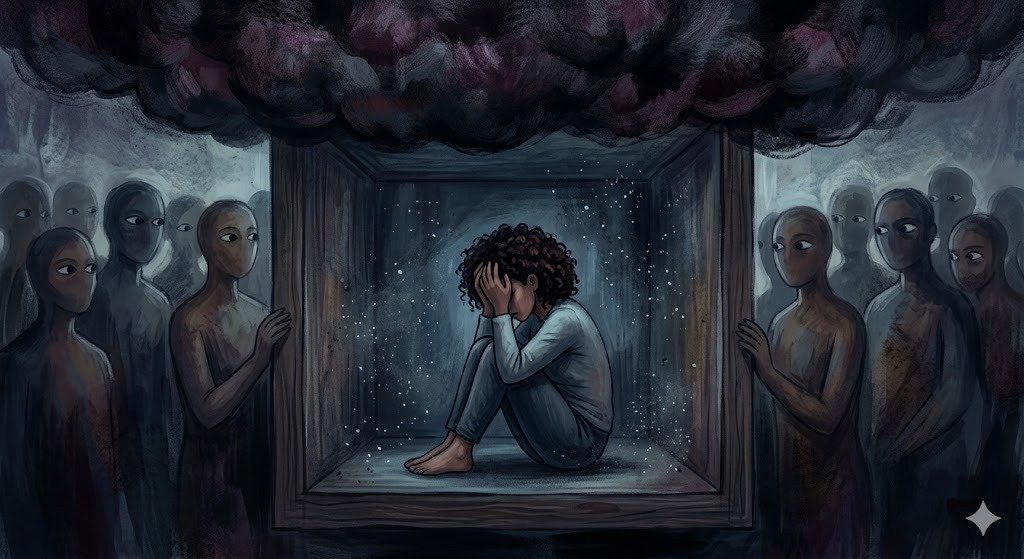
Introvert shame is the quiet, persistent belief that something is wrong with you because you need solitude, go quiet in groups, or simply do not find socialising energising. It does not usually announce itself. It shows up as apologising for leaving a party early, pretending to be more talkative than you are at work, or feeling a low-grade guilt every Sunday when you choose a book over a social plan. Many introverts carry this for years without naming it.
Why Introvert Shame Takes Root: The Psychology Behind the Guilt
Introversion is not shyness, avoidance, or a lack of social skill — it is a neurological orientation. Research into CNS arousal levels consistently shows that introverted brains operate closer to their optimal arousal threshold than extroverted brains do. This means that the same social environment that feels stimulating to an extrovert can tip an introvert into overload. The neurotransmitter acetylcholine plays a role here too: introverts tend to rely more heavily on the acetylcholine reward pathway, which activates during focused, internal thought rather than external stimulation. There is nothing broken about this. It is simply a different operating system.
The shame enters from outside. Western culture — particularly in workplaces, schools, and social norms built around extroverted ideals — consistently signals that the louder, more visible, more sociable person is the more valuable one. When a child is repeatedly told to “speak up,” “come out of their shell,” or “stop being so shy,” they do not conclude that the adult is wrong. They conclude that they are. That belief, absorbed before the frontal cortex was fully developed, becomes the template for how they relate to their own quietness for decades.
In personality psychology, introversion sits at one end of the Big Five Extraversion scale — a continuous, normally distributed trait. Being introverted is as statistically ordinary as being extroverted. But statistical ordinariness does not protect you from cultural messaging that says otherwise. Introvert shame is not a personality flaw; it is the predictable result of being a certain kind of person in a world designed for a different kind.
Signs the Shame Is Active in Your Life
Introvert guilt does not always feel like guilt. It often masquerades as over-apologising — saying sorry for needing to leave, for not having much to say, for wanting to spend the weekend alone. You might notice a compulsion to justify your quietness to people who did not ask for an explanation. It shows up as performing extroversion at work — being louder, more enthusiastic, more available than you actually have energy for — and then feeling hollow afterward, unsure whether anyone actually knows you at all.
Feeling bad about being introverted can also look like chronic comparison. You watch someone who moves easily through crowds and you do not think “different wiring” — you think “better person.” It shows up in the language you use about yourself: “I’m just bad at socialising,” “I’m not really a people person,” “I’m kind of boring.” These are not neutral self-descriptions. They are shame talking. Quiet person shame also tends to intensify after social events — not because the event went badly, but because the relief you feel when it ends makes you wonder what is wrong with you.
What Actually Helps: Moving Through Introvert Shame
Naming it is the starting point, but naming alone does not dissolve shame that has been building since childhood. The following steps move in a deliberate sequence — from understanding to identity to behaviour — because that is the order in which lasting change actually happens.
- Separate trait from deficit. Write down three things your introversion has given you — depth of focus, the ability to listen well, creative solitude, meaningful one-on-one connection. Not to make yourself feel better, but to build an accurate picture. Shame thrives on a partial account of who you are.
- Trace the shame to its source. Whose voice told you being quiet was a problem? A parent, a teacher, a workplace culture? Naming the origin does not erase the belief, but it externalises it. The message came from somewhere specific. It is not objective truth.
- Stop performing extroversion as a default. Each time you perform extroversion to avoid judgment, you reinforce the belief that your real self is not acceptable. Pick one low-stakes context — a casual social event, a team meeting — and allow yourself to be genuinely quiet when you have nothing to add. Notice that the consequences are almost never as bad as the shame predicts.
- Rebuild your nervous system after social events intentionally. After any demanding social event, block 60 to 90 minutes before returning to your phone or inbox. Your cortisol levels are elevated, your CNS is in recovery mode, and the guilt-spiral is most likely to hit in this window. A walk, deliberate silence, or a familiar activity interrupts the loop before it builds.
- Curate your social environment over time. Introvert guilt often intensifies in environments built entirely around extroverted norms. This does not mean avoiding all demanding situations — it means actively building relationships and spaces where your quietness is not a problem to be solved. Environments that fit you reduce the daily shame load significantly.
- Use language that is factual, not apologetic. Replace “sorry, I’m just not very chatty” with “I tend to listen more than I talk.” The first frames your introversion as a failure. The second describes a reality. This is not a trick — it is a slow rewiring of how you narrate yourself to yourself and others.
How Much Introvert Shame Are You Carrying?
Answer five honest questions. Your result stays on this page — nothing is stored or shared.
1. When you leave a social event early, how do you feel?
2. How often do you describe yourself as “bad at socialising” or “boring”?
3. When you choose a quiet evening alone over a social plan, how do you feel?
4. At work or in groups, how often do you perform being more outgoing than you are?
5. When you see outgoing, sociable people, your instinctive thought is:
Please answer all five questions before continuing.
When to Pay Attention to How Much This Is Affecting You
Introvert shame is normal in a culture that misunderstands introversion — but when the guilt is constant, when it is shaping major life decisions (turning down opportunities, avoiding relationships, shrinking your world), or when it is tangled up with persistent low mood or anxiety, that is worth taking seriously. A therapist who works with identity and personality — not to change your introversion but to uncouple it from shame — can make a significant difference.
Questions People Ask About Introvert Shame
Is feeling bad about being introverted the same as social anxiety?
Not exactly. Social anxiety involves fear of judgment or negative evaluation in social situations, often accompanied by physical symptoms like a racing heart. Introvert guilt is more of a chronic low-level belief that your quietness is a personal failing. They can overlap — someone with social anxiety may also carry introvert shame — but they have different roots and different approaches to address them.
Why do some introverts feel guilty for enjoying solitude?
Because culturally, choosing to be alone is often read as loneliness, antisocial behaviour, or depression. When those messages are absorbed early, solitude starts to feel like something that needs to be justified rather than something that is simply restorative. Quiet person shame specifically around solitude tends to ease when you spend more time in communities where alone-time is understood rather than pathologised.
Can introvert guilt cause burnout?
Yes. When you spend sustained energy performing extroversion — being louder, more available, more visibly engaged than your nervous system can sustain — your cortisol output stays elevated and recovery windows shrink. Over time, this produces a pattern that looks a lot like burnout: emotional flatness, reduced capacity for the things you normally enjoy, irritability, and a growing need for isolation. It is not introversion causing the burnout; it is the exhaustion of fighting it.
How do I stop apologising for being quiet?
Start by noticing when you apologise without having done anything that warrants an apology. "Sorry, I'm just not very talkative" is an apology for existing as you are. Replace it with a neutral description: "I tend to be more of a listener." This is not about confidence performance — it is about gradually withdrawing the admission of guilt that shame requires to stay in place.
Does introvert shame get better with age?
For many people, yes — gradually. Partly because life experience accumulates evidence that your introversion is not actually causing the catastrophic social consequences shame predicts. Partly because many introverts, in their thirties and beyond, actively research their own personality and find language that explains rather than pathologises them. That said, age alone does not dissolve shame that has deep roots. Active, intentional work moves it faster than time does.
Introvert shame is not a character flaw or a sign that you have failed at being yourself. It is what happens when a particular kind of brain grows up in an environment that consistently misreads it. Naming the shame does not make it vanish immediately — but it does change your relationship to it. You stop treating the discomfort as proof that something is wrong with you and start treating it as information about what you absorbed, not what you are.