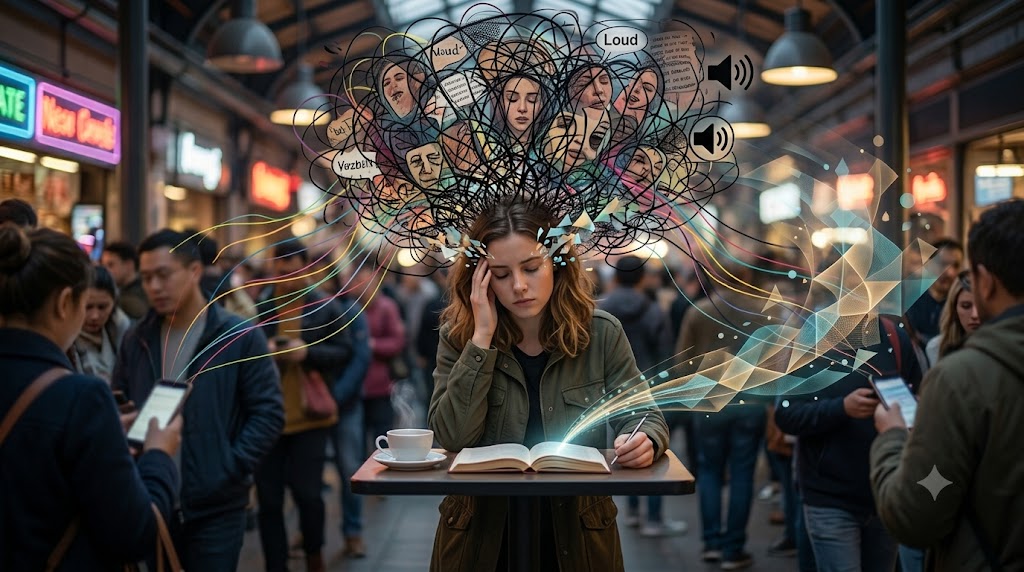
Feeling like an introvert overwhelmed in crowds is not weakness or social anxiety — it is your nervous system doing exactly what it is built to do. The noise, the movement, the unpredictability of strangers in close proximity — all of it costs you energy that other people barely spend. The problem is not you. The problem is that nobody tells you how to manage it practically, so you end up either avoiding everything or paying for it for days afterward.
Why an Introvert Overwhelmed in Crowds Feels So Drained
The introvert brain processes stimulation more deeply than the extrovert brain. This is not a metaphor. Research suggests introverts have higher baseline cortical arousal, meaning they reach their stimulation threshold faster. Where an extrovert walks through a busy market and feels energised, your brain is simultaneously processing every conversation, every face, every unexpected sound. It is doing more work, continuously.
The neurotransmitter picture matters here too. Introverts are thought to rely more on acetylcholine-driven reward pathways — these are quieter, internal, focused. Extroverts lean on dopamine, which spikes with external stimulation. A crowd is a dopamine delivery system. For an introvert, it is just noise without a payoff.
When you are an introvert overwhelmed in crowds, you are also often dealing with sensory overload — tight spaces, competing sounds, people moving unpredictably. The brain flags this as something to monitor closely. Over time, that vigilance becomes exhaustion. It is not imaginary. It is physiological.
Signs the Crowd Is Getting to You
It often shows up before you consciously register it. You might notice your shoulders tightening, your jaw clenching slightly, or a growing irritability that seems to come from nowhere. Small things start to bother you more than they should — a stranger standing too close, a conversation happening loudly nearby, the wait at a counter that seems to stretch forever.
Mentally, you may find it hard to hold a thought. A kind of blankness sets in, or alternatively, a low hum of anxiety. Decisions feel harder than they are. You stop wanting to talk, even to people you like. This is sensory overload introvert territory — your processing capacity is full and your brain is rationing resources.
Afterward, the signs continue. You might need hours of quiet to feel like yourself again. Sleep can be disrupted. Some people describe feeling faintly hollow or irritable the day after a heavy crowd experience. This is introvert energy drain doing its work. Recognising the pattern is the first step toward managing it with some intention.
What Actually Helps
Before you enter a crowded situation, eat something and rest beforehand if you can. Your threshold for overwhelm drops sharply when you are tired or hungry. This is not a small thing — arriving depleted means you have less to work with from the start.
Give yourself a physical anchor in the space. This means finding where the quieter edges are — the side of the room, a seat facing outward, the far end of a queue. Crowd anxiety in introverts often worsens when you feel surrounded on all sides with no clear exit. A wall behind you, or a clear line of sight to a door, reduces the low-level vigilance your brain otherwise maintains constantly.
Build in deliberate breaks before you need them. Do not wait until you are already overwhelmed. Step outside for three minutes, find a bathroom, sit in your car briefly. Leaving before your energy is fully gone means you recover faster. This is not antisocial — it is maintenance.
When you leave, resist the urge to immediately recap the event on your phone or jump into another social interaction. The return to quiet is itself the recovery. Let it work. Even twenty minutes of silence without screens makes a measurable difference in how you feel two hours later.
Finally, stop explaining your exits. You do not owe anyone a detailed account of why you are stepping away. A simple “I’m going to get some air” is enough. The habit of over-explaining or apologising for needing space adds a layer of social performance on top of the energy you are already spending.
When to Get Support
There is a difference between introvert energy drain from crowds and crowd anxiety that significantly limits your life. If you are avoiding situations you genuinely want to attend, if the anticipatory anxiety starts days before an event, or if the aftermath involves persistent low mood rather than just tiredness, it is worth speaking to a therapist. Cognitive behavioural therapy and somatic approaches both have solid evidence for this kind of difficulty. Introversion is not a disorder — but anxiety layered on top of it is worth addressing directly.
A Few Questions Worth Answering
What happens to an introvert overwhelmed in crowds?
An introvert overwhelmed in crowds is dealing with unpredictable movement, noise and proximity at once, which exceeds the filtering capacity quickly.
Why are introvert crowds so much worse than groups?
Introvert crowds are worse than groups because nothing is predictable. A dinner with eight people costs less than a station at rush hour.
Is crowd anxiety introvert readers feel the same as agoraphobia?
Crowd anxiety introvert readers describe is usually sensory rather than phobic, though the two can coexist.
Why do crowds drain me even when nothing happens?
Why do crowds drain me is answered by continuous low-level processing. An introvert overwhelmed in crowds has been working the whole time.
- Is being overwhelmed in crowds a sign of social anxiety?
-
Not necessarily. Introverts experience crowd overwhelm as an energy and sensory issue, not always a fear-based one. Social anxiety involves significant dread and avoidance driven by fear of judgement. Some introverts have both, but many simply find crowds draining without any anxiety attached to them. The distinction matters for how you address it.
- How long does introvert energy drain from crowds last?
-
It varies by person and by the intensity of the event. A busy two-hour gathering might need a quiet evening to recover from. A full-day event with no breaks can leave some introverts needing a full day of solitude afterward. Tracking your own patterns over a few weeks gives you more accurate data than any general rule.
- Can introverts get better at handling crowds over time?
-
You can build strategies that reduce the cost — timing, positioning, planned breaks, recovery routines. But you are not going to rewire your nervous system through exposure alone. The goal is not to stop being affected by crowds. The goal is to stop being surprised by it and to manage your energy more deliberately.
- What is the fastest way to recover from sensory overload as an introvert?
-
Quiet and low stimulation, specifically. Dim lighting, no background noise, no screens if possible. Some people find a short walk outside helpful because natural environments produce less unpredictable stimulation than indoor social spaces. Physical stillness — lying down, slow breathing — also signals to your nervous system that the monitoring can stop.
Being an introvert overwhelmed in crowds is not a flaw to fix. It is a pattern to understand. The more clearly you see how your energy works — where it goes, how fast it depletes, what actually restores it — the less crowded situations have to cost you. That knowledge is genuinely useful, and it compounds over time.