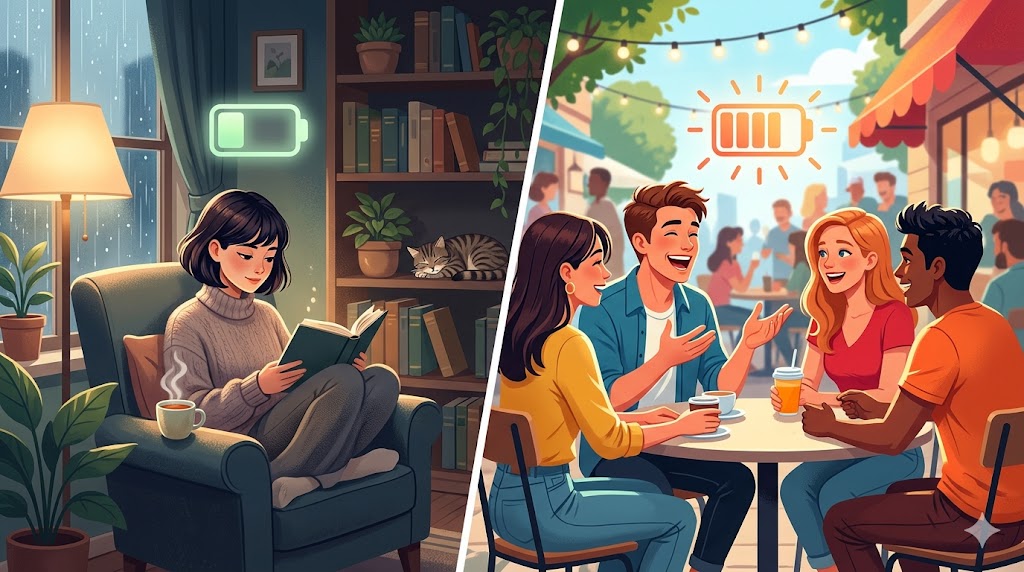
Introvert vs extrovert energy doesn’t just differ in degree — it runs in opposite directions entirely. While an extrovert leaves a dinner party feeling recharged and alive, an introvert leaves the same party needing to recover. Same event. Opposite outcome. This isn’t attitude or preference. It’s biology, and understanding it changes how you see yourself.
Why Introvert vs Extrovert Energy Actually Runs in Reverse
The clearest explanation comes from neuroscience. Introverts and extroverts respond differently to dopamine, the brain’s reward chemical. Research by psychologist Marvin Zuckerman and later work building on Hans Eysenck’s arousal theory both point to the same finding: extroverts have a higher threshold for stimulation. They need more external input — noise, people, activity — to feel good. Introverts are already closer to their stimulation ceiling, so the same social environment that feels energising to an extrovert tips them into overload.
There’s also a neurochemical difference in which pathway the brain prefers. Extroverts tend to rely more heavily on the dopamine reward pathway, which responds to external stimulation. Introverts tend to use the acetylcholine pathway more, which is activated by internal thought, focus, and quieter pleasures. This isn’t a flaw in either direction. It’s simply two different operating systems running on different fuel.
Carl Jung, who introduced the introvert-extrovert distinction in the early twentieth century, described it in terms of where psychic energy flows — outward toward the world, or inward toward thought and reflection. Modern neuroscience has given that observation a biological foundation. The difference is real, measurable, and not something either type can simply think their way out of.
Signs You’re Experiencing the Introvert Energy Drain
Introvert energy drain doesn’t always hit during an event. It often arrives an hour after you get home, or the next morning. You might notice a kind of mental fog — the sensation that thinking clearly requires effort that wasn’t there before. Conversations that felt manageable at the time suddenly seem exhausting in retrospect.
It often shows up as a strong pull toward silence. Not sadness, not antisocial feeling — just an almost physical need for a room without anyone in it. Some introverts describe it as a low battery indicator that only resets with solitude, sleep, or a deeply absorbing solo activity.
For extroverts, the pattern flips. Extended isolation produces something resembling that same drained feeling. Extroverts who work from home alone often describe losing focus, motivation, and mood — not because the work is hard, but because the social fuel has run out. They recharge socially the way introverts recharge alone. Neither experience is wrong. They’re just mirrors of each other.
What Actually Helps You Manage Your Energy Type
The most practical thing an introvert can do is treat recovery time as non-negotiable, not a reward for surviving enough socialising. Schedule it before and after high-stimulation events, not just after. A quiet hour before a party matters as much as the quiet hour after it.
Stop treating the need for solitude as something to explain or apologise for. You don’t owe anyone a detailed reason for leaving a gathering. You can simply leave. Saying “I have an early morning” is fine. Saying nothing except a warm goodbye is also fine.
Learn your personal stimulation threshold rather than relying on general advice. Some introverts can handle a three-hour dinner easily but collapse after twenty minutes in a loud bar. Others find one-on-one conversations energising but group settings depleting. The category of introvert tells you the direction of your energy; your own patterns tell you the specific shape of it.
For managing introvert brain chemistry day-to-day, activities that engage deep focus — reading, solo walks, creative work — don’t just feel good. They are literally replenishing the neurochemical resources social interaction depletes. Treat them accordingly.
If you work in a social environment, find micro-recovery moments. Eating lunch alone twice a week, taking a short walk without headphones, closing your office door for fifteen minutes. Small and consistent does more than one long weekend of retreat.
When to Get Support
If social situations don’t just drain you but genuinely frighten you — producing physical symptoms like a racing heart, avoidance that limits your life, or persistent dread — that may be social anxiety rather than introversion, and the two are different things. A therapist familiar with both can help you tell them apart. Introversion explains your energy. It shouldn’t be a source of ongoing distress.
A Few Questions Worth Answering
Why does introvert vs extrovert energy run in opposite directions?
Introvert vs extrovert energy runs opposite because the same stimulation that tops one person up draws the other down. Same event, opposite outcome.
How does the social battery introvert extrovert difference work?
The social battery introvert extrovert difference is about direction rather than size. One fills at a party; the other empties.
Why do introverts get drained by things they enjoy?
Why do introverts get drained by enjoyable events is the question that confuses people most. Enjoyment and energy cost are unrelated.
Is introvert vs extrovert energy fixed?
Introvert vs extrovert energy is broadly stable across life, though the amount of recovery needed changes with age and circumstance.
- Can an introvert become an extrovert over time?
-
Not fundamentally. The underlying brain wiring doesn’t rewire itself through effort. What can change is your skill in social situations and your comfort with them. Many introverts become highly capable in social settings without ever stopping being introverts. The energy equation stays the same.
- Why do some introverts enjoy parties but still feel drained after?
-
Enjoyment and energy cost are separate things. You can genuinely like an experience and still pay a neurological price for it. Introverts often do enjoy social events — the depletion comes after, not during. This is one reason the introvert-shy confusion persists. Shyness is fear. Introversion is an energy budget.
- Is introvert energy drain the same as being an empath?
-
No. Introvert energy drain is linked to stimulation thresholds and brain chemistry. “Empath” is not a scientific category. Some introverts are highly sensitive — a real trait called sensory processing sensitivity — but that’s a separate dimension from introversion itself, even if the two sometimes overlap.
- Do extroverts ever need alone time?
-
Yes. Extroverts are not immune to fatigue or overstimulation. The difference is that solitude is their cost, not their recovery method. An extrovert can handle — and even enjoy — alone time, but prolonged isolation will eventually deplete them in the same way prolonged socialising depletes an introvert.
Understanding introvert vs extrovert energy as a biological fact rather than a personality quirk gives you something genuinely useful: permission to stop fighting your own wiring. You’re not broken for needing quiet. You’re running on a different system. Work with it, and things get considerably easier.