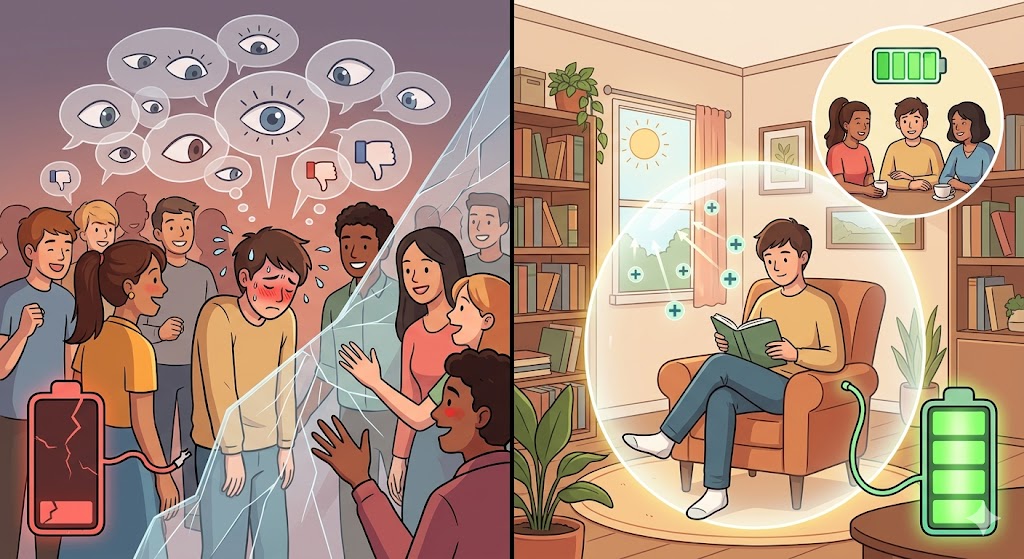
You like being alone, but sometimes being around people doesn’t just drain you — it scares you. And you’ve never been quite sure which part is just you, and which part is something harder to name. That confusion is exhausting in its own quiet way. Because if you can’t tell the difference, you can’t figure out what you actually need.
What’s Actually Going On
Introversion is a personality trait. It describes where you get your energy from. After a party, a long meeting, or even a good conversation, you need time alone to feel like yourself again. That’s not a flaw. Carl Jung described introverts as people who turn inward to recharge — and decades of personality research have backed this up. It’s wired into you.
Social anxiety is different. It’s not about energy — it’s about fear. Specifically, it’s the fear of being judged, embarrassed, or rejected in social situations. Where introversion makes you prefer quiet, social anxiety makes you dread noise. It often shows up as a tight chest before a phone call you haven’t made yet, replaying a comment you made three days ago at 2am, or canceling plans because the anticipation felt worse than the disappointment.
The tricky part is that they can exist at the same time. You can be an introvert and have social anxiety. But they have different roots — and different paths forward.
The Signs You Might Be Experiencing This
You might notice that you don’t just prefer to skip the party — you feel genuine relief when it gets canceled, like something dangerous was avoided. It often looks like rehearsing what you’ll say before a casual conversation, then replaying it afterward anyway.
It might show up as avoiding phone calls even when texting would be totally acceptable, because something about real-time interaction feels like a test you haven’t studied for. Or turning down opportunities you actually want — a job, a date, a creative project — because the social pieces attached to them feel impossible.
Introversion, by contrast, tends to feel more neutral. Preferring to stay home on a Friday feels like choosing something good, not escaping something bad. The difference is subtle but it matters: introversion is a preference, social anxiety is a pressure. One feels like peace. The other feels like avoidance dressed up as peace.
What This Actually Looks Like
Sam has a work event on Thursday. It’s optional. Sam tells themselves it’s fine to skip — they’re just introverted. But by Tuesday, they’ve thought about it eleven times. They’ve imagined walking in alone, not knowing where to stand, saying something weird to a colleague. They draft a reason to cancel that sounds legitimate. When Thursday comes and they stay home, the relief is immediate and enormous — but it’s followed by a low, familiar feeling of having missed something, of having let the fear win again. That’s not introversion. That’s anxiety wearing introversion’s coat.
What Tends to Help
First, get honest about whether you’re choosing solitude or hiding in it. Introversion feels restorative. If being alone mostly feels like hiding, that’s worth paying attention to.
When you do go to social events, give yourself a specific exit plan before you arrive. Not an excuse — a plan. “I’ll stay for an hour, then leave.” Knowing the door is unlocked makes it easier to walk through it in the first place.
Stop apologizing for leaving. Seriously. When you leave a gathering, just leave. A simple “good to see you” is enough. Every apology you make trains your brain to believe there was something wrong with going.
For the 2am replay spiral — write it down instead of looping it. One sentence. “I said that thing at lunch.” Then close the notebook. You’re not solving anything at 2am. You’re just suffering.
And if social situations consistently trigger physical symptoms — racing heart, shallow breathing, the urge to disappear into a wall — that’s your nervous system asking for more than a quiet weekend. Therapy that includes exposure work can genuinely change this, not just help you manage it.
When to Get Some Support
If avoiding social situations is costing you things you actually want — connection, career opportunities, relationships — it’s worth talking to someone. Not because something is deeply wrong with you, but because anxiety responds really well to the right kind of help. Cognitive behavioral therapy, in particular, has strong evidence behind it for social anxiety. You don’t need to be in crisis to deserve support. Feeling stuck for long enough is reason enough.
A Few Questions Worth Answering
What separates social anxiety vs introversion?
Social anxiety vs introversion separates on fear. Introversion is a cost; social anxiety is a threat response, and only one of the two responds to treatment.
Am i introverted or socially anxious?
Am i introverted or socially anxious is answered by what you want. Introverts decline invitations they do not want; socially anxious people decline invitations they do want.
Can you have introversion or social anxiety at the same time?
Introversion or social anxiety is a false choice for many people, who have both. Social anxiety vs introversion still matters, because the anxious part is the treatable one.
Does social anxiety vs introversion change what help you need?
Social anxiety vs introversion determines the route: one needs accommodation, the other responds to graded exposure and, often, therapy.
Can you be both introverted and have social anxiety?
Yes, and it’s actually pretty common. Being introverted means social situations cost you energy. Having social anxiety means they also frighten you. One is a personality trait, the other is a pattern your nervous system learned. You can be one, both, or neither — they’re not the same dial.
How do I know if I’m avoiding or just recharging?
Ask yourself how you feel before the situation, not after. Introversion makes the aftermath feel heavy. Anxiety makes the anticipation feel heavy. If you’re dreading something days before it happens and flooded with relief when it disappears, that’s anxiety doing the work, not introversion.
Is social anxiety something I can fix on my own?
Partially. Understanding it helps. Gently facing situations instead of always avoiding them helps. But if it’s been years and it’s still running your decisions, working with a therapist who specializes in anxiety will move things faster than going it alone. You don’t have to white-knuckle this.
Why does everyone just assume I’m shy?
Because “shy,” “introverted,” and “anxious” all look similar from the outside — quiet, reserved, not always jumping into conversations. But shyness is discomfort, introversion is preference, and anxiety is fear. They feel completely different from the inside. Most people just don’t have the language for the distinctions.
Knowing the difference between who you are and what you’re afraid of won’t fix everything overnight. But it might change what you ask of yourself — and what you decide you no longer have to apologize for. That’s a quiet, real kind of shift. And it starts exactly where you are right now.