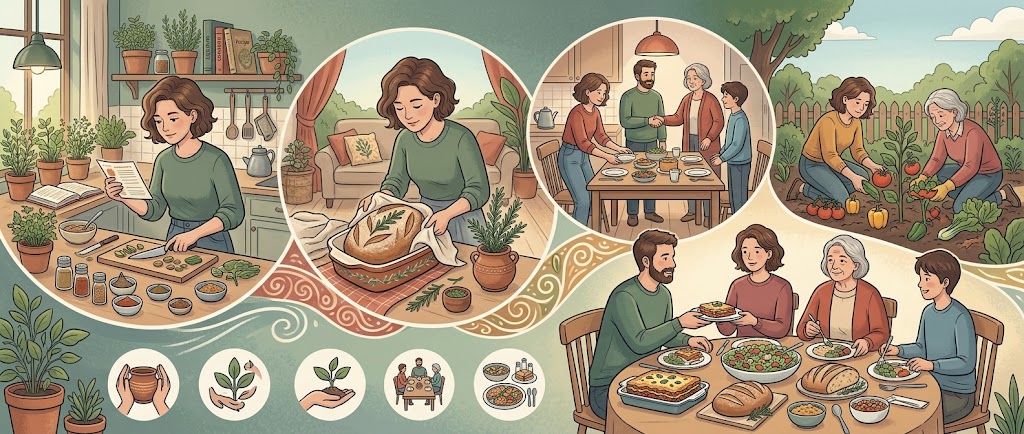
Introverts cook for others in a way that says everything words often don’t get around to saying at all. If you’ve noticed that you’d rather quietly make someone a full meal than tell them how much you care out loud, that instinct isn’t a workaround for being bad at feelings — it’s a genuinely complete way of expressing them, one that happens to fit an introvert’s communication style better than a long verbal declaration ever could.
Why Introverts Cook for Others Instead of Saying It Out Loud
Verbal affection asks for something introverts often find genuinely hard to produce on demand: an immediate, live, emotionally exposed statement, delivered in real time with someone watching your face for the reaction. Cooking sidesteps almost all of that. The care gets built quietly, alone, over the time it takes to plan and prepare something, and by the time it’s served, the emotional labour is already complete — there’s no improvised vulnerability required in the moment of delivery, just a plate that speaks for itself.
This is why introverts cook for others so consistently as a default response to caring about someone, whether that’s a partner having a hard week, a friend going through something difficult, or simply an ordinary Tuesday when showing up mattered more than saying anything. The meal isn’t a substitute for saying “I love you” or “I’m here for you” — for a lot of introverts, it’s a more accurate, more sustainable version of saying exactly that.
Cooking as an Introvert Love Language Worth Recognising
Love language frameworks tend to focus on acts of service or gifts as generic categories, but cooking specifically deserves its own recognition for introverts, because it combines several things this temperament does well at once: solitary preparation, careful attention to someone’s actual preferences remembered over time, and a tangible result that doesn’t require narrating the effort behind it to be appreciated. Remembering that someone doesn’t eat cilantro, or always wants the crust cut off, or mentioned liking a specific dish once months ago — and quietly building a meal around those details — is introvert affection operating at full strength, even without a single word of explanation attached.
The risk worth naming honestly is that this kind of care can go unrecognised if the other person doesn’t know to look for it, especially a partner or friend who processes love more verbally and expects to hear affection stated directly. It’s worth occasionally naming the gesture out loud — “I made this because I was thinking about you” — so the intention behind the meal doesn’t stay entirely implicit and risk being read as just dinner rather than the deliberate act of care it actually was.
Letting This Strength Show Up More Often
If cooking is genuinely how you express care best, there’s no need to force yourself into more verbally demonstrative habits to compensate — it’s worth instead building more deliberate opportunities for it into your relationships. Cooking for someone during a hard week, showing up with a meal instead of just words of sympathy, or making someone’s specific favourite dish on an ordinary day without a special occasion attached are all ways of using an existing strength more intentionally, rather than waiting for a birthday or holiday to justify the effort.
Questions People Ask About Introverts Who Cook for Others
Why do introverts cooking for others count as affection?
Introverts cooking for others is affection expressed in a medium that requires no speech and cannot be misread as effort-free.
Is cooking as love language a real thing?
Cooking as love language sits inside acts of service, and it is one of the clearest examples. Introverts cooking for others say a great deal with it.
What is behind feeding people love?
Feeding people love works because it is unambiguous. Time, attention and planning are visible on the plate.
Are introvert acts of service undervalued?
Introvert acts of service are frequently undervalued precisely because they are quiet. Introverts cooking for others rarely announce what it cost.
Is cooking really a legitimate way to show love, or just avoiding saying it directly?
It’s legitimate on its own terms — the planning, attention, and effort involved constitute real emotional labour, not a substitute for feeling something. Pairing it with an occasional verbal acknowledgment covers both bases without asking you to abandon what already works.
Why do I feel closer to people after cooking for them than after a long conversation?
Because the care gets expressed in a form that doesn’t require real-time emotional performance, letting the connection register more fully rather than being partly spent on managing the discomfort of saying something vulnerable out loud.
How do I get my partner to understand this is how I show love?
Name it plainly at least once — explain that a home-cooked meal on a hard day is your version of “I’m here,” and ask them to read it that way going forward, since the gesture communicates far more clearly once they know what it’s actually meant to say.
Should I learn to say things out loud more, even if cooking works well for me?
A little goes a long way — you don’t need to abandon a language that already works, just add occasional verbal confirmation so people who need to hear it explicitly aren’t left guessing at what the meal was actually meant to communicate.
What if the person I’m cooking for doesn’t seem to notice the effort at all?
It’s worth mentioning once, gently, rather than assuming they’ll eventually pick up on it — some people genuinely need the connection spelled out before they start reading a home-cooked meal as the deliberate act of care it actually was.
Introverts cook for others because it’s often the most honest, most complete version of care this temperament has to offer — not a smaller gesture standing in for words, but frequently the fuller one, quietly saying everything a conversation would have taken far longer to say. That fuller version deserves to be recognised on its own terms, not measured against a louder love language it was never trying to imitate.