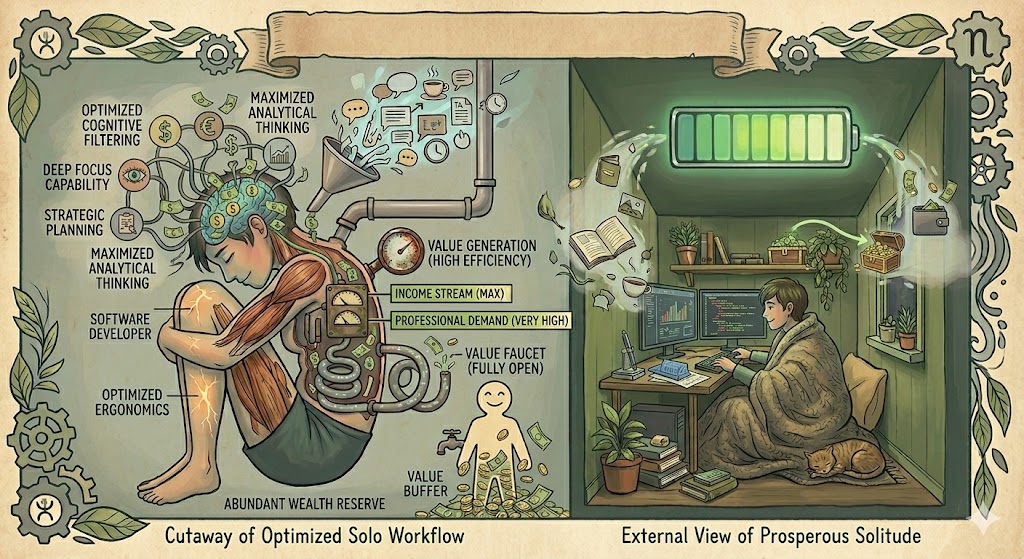
You’ve spent years watching the loudest person in the room get promoted. You do the deep work, solve the hard problems, and somehow the career advice you find still tells you to “speak up more in meetings.” The good news — and it’s real, not the motivational-poster kind — is that some of the highest-paying work in the world is built for exactly the way your brain operates. This guide breaks down the highest paying jobs for introverts, and why they suit the way you think rather than the way you perform.
What’s Actually Going On
Introversion isn’t shyness, and it isn’t a flaw in need of fixing. Psychologist Carl Jung first described it as a preference for where you draw your energy — inward, from ideas and solitude, rather than from external stimulation and crowds. In neurological terms, introverts tend to be more sensitive to dopamine and rely more heavily on acetylcholine, a neurotransmitter that rewards careful thinking and focused attention. That’s not a disadvantage. That’s a specification.
The careers that pay the most — and keep paying — tend to reward exactly what acetylcholine-dominant brains do well: sustained concentration, pattern recognition, precision, and the ability to sit with a complex problem until it actually makes sense. Not performing confidence. Not working a room. Just thinking, deeply, for a long time.
The mismatch has never been between introverts and ambition. It’s been between introverts and the wrong rooms.
The Signs You Might Be Experiencing This
You might notice that you do your best work before 9am, when the office is empty, or after 6pm when the Slack notifications finally go quiet. It often looks like finishing a project you’re proud of, then dreading the all-hands presentation more than the project itself.
You might notice that open-plan offices feel physically exhausting to you — not just annoying, but genuinely draining in a way that’s hard to explain to someone who thrives in them. The kind of tired where even texting back feels like too much by the time you get home.
It often looks like being the person everyone comes to when something is actually broken and needs fixing, but somehow still being passed over for the roles that come with a title bump. You get tapped for the hard thinking, not the visibility. And visibility, in most traditional workplaces, is what gets rewarded.
What you’re experiencing isn’t a lack of ambition. It’s a career structure that wasn’t designed with you in mind.
What This Actually Looks Like
Sam is a 34-year-old actuary. On a Tuesday, she reviews mortality data models before her first meeting, catches an error that would have cost the firm six figures, and fixes it quietly before anyone else notices. She eats lunch at her desk with headphones in — not because she’s antisocial, but because that hour is the only guaranteed silence she gets. By 5pm she’s done more meaningful work than most people accomplish in a week. She makes $130,000 a year. She has never once had to “network” at a happy hour to keep her job. The work speaks clearly enough.
Finding the Highest Paying Jobs for Introverts
When you’re looking at career paths, filter for depth over breadth. Jobs that reward specialization — where becoming the expert matters more than knowing everyone — tend to favor how you work naturally.
Look at roles where output is measurable. Software engineering, data science, financial analysis, medical writing, UX research — these pay well because the result is concrete. You don’t need to charm anyone. You need to be right.
Consider the actual structure of the work, not just the job title. A “marketing manager” role at one company might mean running solo analytics and writing campaign briefs. At another, it means being on camera every day. Read the job description like you’re looking for evidence, not inspiration.
If you’re in a role that fits but the environment doesn’t, remote work isn’t a consolation prize — it’s a legitimate performance upgrade. Researchers have found that introverts often show significant productivity gains when working independently. That’s worth negotiating for explicitly.
And when you leave a gathering — a meeting, a team lunch, a work event — you don’t owe anyone an apology or an excuse. Just leave. The energy you protect is the energy you bring to the work that actually matters to you.
When to Get Some Support
If your job is making you feel anxious most days — not just drained, but genuinely dreading going in — that’s worth paying attention to. Introversion explains a lot, but it doesn’t explain everything. A therapist who understands neurodiversity and workplace stress can help you figure out what’s introversion, what’s burnout, and what’s an environment that’s genuinely not okay. Those are three different things, and they have different solutions.
A Few Questions Worth Answering
What are the highest paying jobs for introverts?
The highest paying jobs for introverts cluster in technical and analytical work — data, engineering, actuarial, specialist medicine and quantitative finance.
Which high paying introvert careers are most accessible?
The high paying introvert careers most accessible without a decade of training are in data analysis, technical writing and specialised software work.
What are the best paid jobs for introverts without management?
The best paid jobs for introverts that avoid management exist on technical tracks, where seniority increases depth rather than headcount.
Do the highest paying jobs for introverts require visibility?
The highest paying jobs for introverts reward scarcity of skill over visibility, which is precisely why they suit this temperament.
- What’s the highest paying job for introverts with no degree?
-
Software development, particularly self-taught or bootcamp-trained, regularly pays six figures without a traditional degree. Technical writing, cybersecurity, and data analytics also have accessible entry points. The common thread is skill depth over credentials. Certifications in these fields carry real weight.
- Can introverts be successful in high-paying leadership roles?
-
Consistently, yes. Research shows introverted leaders often outperform extroverted ones with proactive teams — because they listen first. The key is finding leadership roles that reward strategic thinking over constant visibility. Chief Technology Officer, Head of Research, and Principal Engineer are all leadership tracks that fit.
- Is working from home better for introverts financially?
-
Remote roles don’t automatically pay more, but they let you do better work, which compounds over time. You’re less depleted, more focused, and more likely to stay in a role long enough to move up. Retention and performance both improve. That eventually shows up in your pay.
- What jobs pay well but involve minimal socializing?
-
Actuary, software engineer, statistician, radiologist, technical writer, data scientist, and financial analyst all rank high on both salary and solitude. Most involve deep independent work, written communication over verbal, and limited mandatory small talk. They also consistently appear on “most satisfying careers” lists — which is not a coincidence.
The world has spent a long time telling you to be louder, more open, more present in ways that cost you something real. But the work you’re capable of — the quiet, precise, deeply considered kind — has always had a market. In practice, the highest paying jobs for introverts reward exactly the strengths you’ve been underselling. You just needed someone to say it plainly.