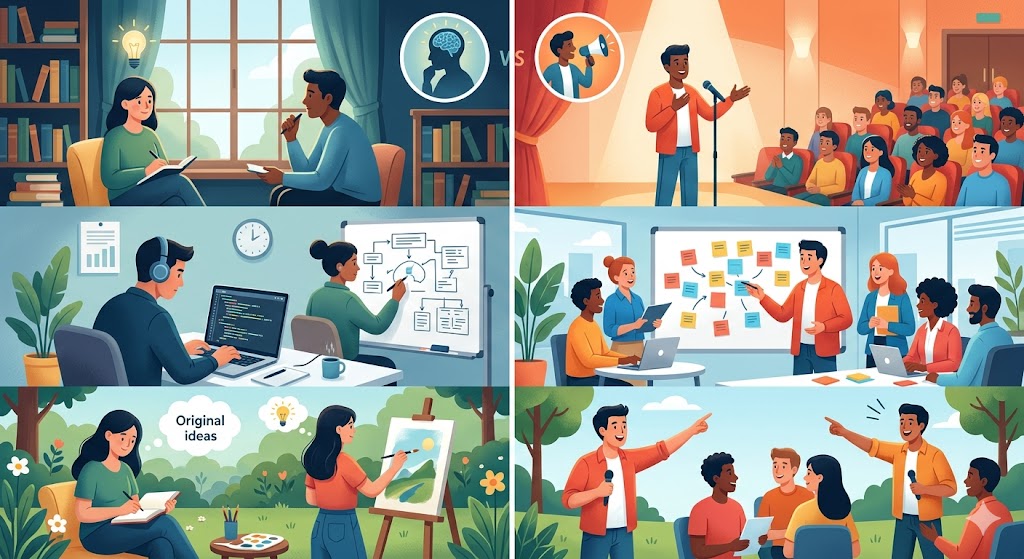
A fair look at introvert vs extrovert strengths is harder to find than it should be. Most comparisons either romanticise the extrovert — sociable, confident, built for the world as it is — or overcorrect in favour of the introvert, listing quiet virtues as though they need defending. Neither approach is honest. The reality is that each orientation comes with genuine advantages, and weighing introvert vs extrovert strengths fairly means looking at what biology and lived experience actually show, not the stereotypes.
What Science Says About Introvert vs Extrovert Strengths
The introvert-extrovert distinction is one of the most replicated findings in personality psychology. It sits at the centre of the Big Five model as extraversion, and it has a measurable biological basis. Research by psychologist Hans Eysenck suggested introverts have a higher baseline level of cortical arousal — meaning their nervous systems are more easily stimulated. Extroverts, by contrast, seek stimulation because their baseline is lower.
This difference in arousal explains a lot. Extroverts tend to respond more strongly to dopamine-driven reward signals — the buzz of a new conversation, a crowded room, a quick decision with immediate feedback. Introverts process experiences more deeply, using acetylcholine pathways associated with reflection, careful thought, and sustained focus. Neither system is superior. They are adapted to different kinds of demand.
Carl Jung, who first popularised these terms in the early 20th century, was clear that introversion and extroversion describe where a person directs their energy — inward or outward — not how capable or healthy they are. The problem is that workplaces, schools, and social norms have often treated extroversion as the default, which skewed how both types came to see themselves.
Where Each Type Tends to Excel
Extrovert advantages show up most clearly in fast-moving, socially dense environments. Extroverts tend to think out loud, which makes them effective in brainstorming sessions and real-time negotiation. They are often quicker to build rapport with strangers, which matters in sales, management, networking, and any role where relationships need to form fast. Their comfort with action over analysis means they move quickly — which is a genuine asset when speed matters more than depth.
Introvert strengths tend to emerge in contexts that reward concentration, nuance, and independent judgement. Introverts typically prepare more thoroughly, listen more carefully, and produce higher-quality work when given uninterrupted time. Studies in workplace psychology have found that introverts often outperform extroverts when managing proactive employees — they listen to ideas rather than override them. Writing, research, programming, design, and strategic planning are fields where introvert advantages show up consistently.
It also bears noting that introvert extrovert differences are not fixed across every situation. Both types can stretch. But stretching costs energy, and knowing where your natural strengths lie helps you structure your life so you are not constantly working against yourself.
Recognising These Patterns in Your Own Life
You might notice that your best thinking happens after a conversation, not during it. You leave meetings with half-formed thoughts that sharpen into clear ones an hour later, alone. That delayed processing is not a flaw — it is how introverts consolidate information. It often shows up as being labelled quiet or hesitant in group settings, even when the ideas that come later are stronger than anything said in the room.
For extroverts, the pattern tends to run the other way. Energy rises in the presence of others. Ideas sharpen through dialogue rather than solo reflection. Silence can feel like stagnation rather than clarity. If you are an extrovert reading this, you will likely recognise that your best problem-solving often happens when you can talk it through with someone — even someone who barely responds.
Both patterns are real. Neither is a performance or a preference that could simply be swapped for a better one. They reflect how the brain is wired to process and respond to the world.
What Actually Helps You Use Your Strengths
The most practical thing is to stop treating your natural orientation as a problem to fix. If you are an introvert, structure your working day so that deep-focus tasks happen in protected, uninterrupted blocks. Decline the meetings that do not genuinely require your presence. Prepare talking points before high-stakes conversations — not because you cannot think on your feet, but because preparation is one of your actual strengths.
When you leave a social event early, do not apologise. Just leave. The explanation is unnecessary and the guilt is counterproductive.
If you identify more as an extrovert, use that social facility strategically — build the relationships that create opportunities. But build in reflection time too. Extroverts who never sit with a decision often miss things that slower thinking would have caught.
For both types, the goal is not to become more like the other. It is to understand where you are strongest and put yourself in situations that use that more often than not.
When to Get Support
If you find that your introversion is tipping into persistent social anxiety, isolation, or an inability to function in necessary social situations, that is worth addressing with a therapist — not because introversion is a problem, but because anxiety is treatable and limiting. Similarly, if extroversion is masking avoidance of reflection or difficult feelings, talking to someone trained in that area can help. Personality type and mental health are related but not the same thing.
A Few Questions Worth Answering
How do introvert vs extrovert strengths compare fairly?
Introvert vs extrovert strengths compare best by condition rather than by ranking. Each outperforms in different environments.
What are the clearest introvert strengths?
The introvert strengths most consistently found are sustained focus, careful listening, and better decisions under conditions that reward deliberation.
What are the real extrovert strengths?
The extrovert strengths are genuine: rapid rapport, comfort with ambiguity in groups, and momentum when a decision needs making now.
Is a personality strengths comparison even useful?
A personality strengths comparison is useful for team design rather than for self-ranking. Introvert vs extrovert strengths are complementary far more often than competitive.
- Are introverts smarter than extroverts?
- No consistent research supports this. Intelligence is unrelated to introversion or extroversion. Introverts may perform better on tasks requiring deep focus; extroverts often outperform in tasks requiring quick verbal responses. Neither pattern reflects overall intelligence.
- Do extroverts have an advantage in the workplace?
- In many traditional workplaces, yes — especially those built around open offices and constant collaboration. But extrovert advantages in visibility do not always translate to better outcomes. Introvert strengths like preparation and deep work are measurably valuable in knowledge-based roles.
- Can introverts develop extrovert skills?
- Yes, and many do. But developing a skill is different from changing your wiring. An introvert can learn to present confidently or network effectively. They will still need recovery time afterward. Calling that skill development is accurate; calling it “becoming more extroverted” is not.
- What do introvert extrovert differences mean for relationships?
- Mixed-type relationships work well when both people understand the other’s energy needs. The friction usually comes from misreading behaviour — an introvert going quiet is not withdrawing emotionally; an extrovert wanting to talk things through immediately is not being aggressive. Understanding the difference reduces a lot of unnecessary conflict.
The introvert vs extrovert framing is most useful when it stops being a competition and starts being a map. Knowing how you are wired lets you make better decisions about your time, your work, and the people you spend energy on. That is not a small thing.