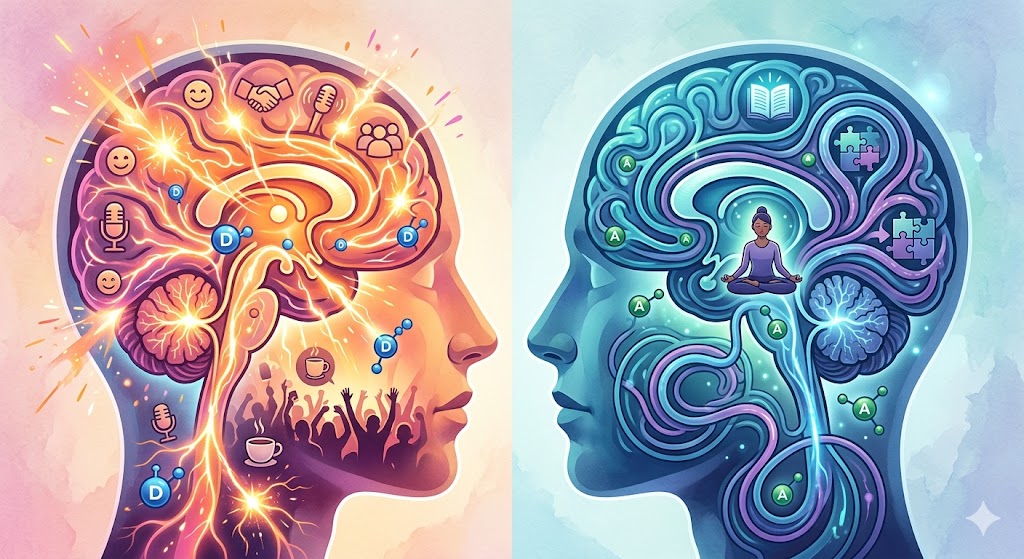
How the introvert and extrovert brain works differently isn’t a matter of one being more socially skilled than the other — it comes down to measurable differences in neurochemistry and stimulation processing that explain a huge amount of the behaviour typically attributed to personality alone. Understanding the actual biology behind it tends to be far more validating than any personality quiz, since it shows these patterns are wired in, not simply chosen.
How the Introvert and Extrovert Brain Works Differently at the Stimulation Level
Research using brain imaging has consistently found that introverts show greater baseline activity in regions associated with internal processing and higher sensitivity to external stimulation, meaning the same level of noise, social contact, or sensory input registers as more intense for an introvert’s nervous system than for an extrovert’s. This isn’t a matter of introverts being “more sensitive” in a vague, subjective sense — it reflects an actual, measurable difference in how much processing a given amount of stimulation triggers, which explains why the same party or meeting can feel mildly stimulating to one person and genuinely overwhelming to another.
This baseline difference in stimulation processing is arguably the single most important fact for understanding how the introvert and extrovert brain works differently, since nearly every behavioural difference between the two temperaments traces back to this core distinction in how much a given environment registers neurologically.
Dopamine, Acetylcholine, and the Chemistry Behind the Behaviour
Dopamine, the neurotransmitter associated with reward and the pursuit of external stimulation, appears to drive extrovert behaviour more strongly — extroverts tend to find dopamine-triggering activities like social novelty and risk-taking more consistently rewarding, which is part of why they’re drawn toward more external stimulation rather than finding it depleting. Introverts, by contrast, appear to rely more heavily on acetylcholine pathways, a neurotransmitter associated with inward-focused attention, careful thought, and the kind of deep, sustained concentration that solitude and low-stimulation environments support particularly well.
This dopamine-versus-acetylcholine distinction offers a genuinely useful explanation for the extrovert brain’s pull toward novelty and social reward compared to the introvert brain’s pull toward depth and internal reflection — neither pathway is better, but they produce meaningfully different behaviour and different sources of genuine satisfaction, which is exactly why generic advice built around one temperament’s chemistry so often fails to work for the other.
What This Neuroscience Actually Means for Daily Life
Understanding these underlying mechanisms helps explain why forcing yourself to behave like the opposite temperament tends to produce exhaustion rather than genuine adaptation — you’re not simply choosing a less effortful path when you favour solitude or stimulation depending on your wiring, you’re working with or against real neurochemical tendencies that don’t change easily through willpower alone. This is useful, validating information rather than an excuse: it means the fatigue an introvert feels after excessive stimulation isn’t weakness, and the restlessness an extrovert feels during prolonged solitude isn’t shallowness — both reflect real, different brain chemistry doing exactly what it’s built to do.
It’s also worth noting that this is a spectrum, not a strict binary, and most people show some mix of both patterns to varying degrees, which is why understanding your own actual response to stimulation tends to be more useful day to day than trying to fit neatly into either category.
This neuroscience also has practical implications for environment design, whether at home, school, or work. Spaces and schedules that account for genuine differences in stimulation processing — quiet zones alongside collaborative ones, flexible rather than uniform social expectations — tend to let both temperaments actually perform closer to their real potential, rather than forcing one group to constantly operate outside their natural neurochemical comfort zone.
Questions People Ask About Introvert and Extrovert Brain Differences
Is this brain difference something I’m born with, or does it develop over time?
Evidence suggests it’s substantially innate, tied to baseline nervous system reactivity present from early in life, though environment and experience can shape how the underlying tendency gets expressed in behaviour.
Does this mean introverts and extroverts literally can’t understand each other?
Not at all — understanding the actual mechanism tends to improve mutual understanding considerably, since it replaces “they’re just being difficult” with “we’re running on genuinely different wiring,” which is easier to work with and around.
Can lifestyle changes shift where I sit on this spectrum?
Some modest shift is possible through changed habits and experience, but the underlying baseline sensitivity tends to remain fairly stable — better to work with your actual wiring than to expect a fundamental neurochemical change.
Why do introverts get so tired after socialising if there’s nothing physically wrong with them?
The heightened processing of stimulation, driven by baseline nervous system reactivity, genuinely consumes cognitive resources even without physical exertion, producing real fatigue that has a clear neurological basis rather than being imagined or exaggerated.
Do medications or substances affecting dopamine change where someone sits on this spectrum?
Some can temporarily shift subjective experience of stimulation and reward, but this reflects a temporary chemical change rather than a genuine, lasting shift in the underlying baseline temperament itself.
How the introvert and extrovert brain works differently ultimately comes down to real, measurable neurochemistry, not a matter of one temperament simply trying harder than the other — and understanding that distinction tends to replace a lot of unnecessary self-judgment with genuine self-understanding, at any age and at any stage of learning to work with your own wiring.