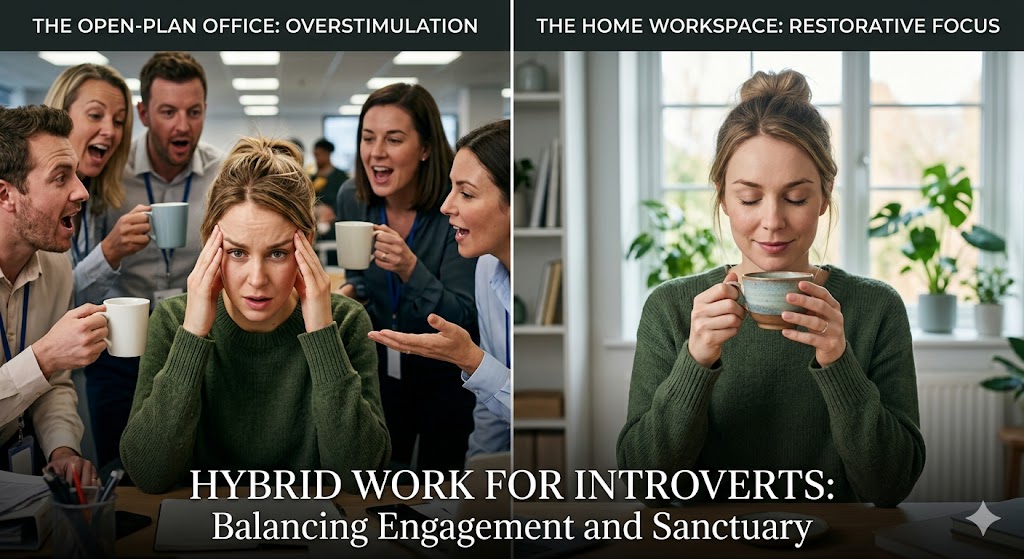
If your calendar now bounces between office badge swipes and pajama-adjacent home mornings, you already know that hybrid work for introverts is a completely different animal than either fully remote or fully in-office life ever was. The old rules do not apply cleanly anymore. You cannot just retreat into a quiet home office every day, and you cannot lean on a single predictable routine to protect your energy. Instead, you are managing two environments with two different social loads, two different noise profiles, and two different sets of expectations about how visible and “on” you need to be. That constant switching is exactly where introverts either quietly burn out or, with the right structure, actually start to thrive. This article is about the second path.
Why Hybrid Work for Introverts Feels Harder Than Either Extreme
Fully remote work let many introverts finally breathe. No hallway small talk, no forced lunchroom chatter, no open-plan office noise bleeding into your concentration. Fully in-office work, whatever its downsides, at least had a rhythm you could learn and brace for. Hybrid work removes both of those comforts. Every week is a little different. You might have back-to-back meetings on your office day and then a wide-open, silent Tuesday at home, and your nervous system has to recalibrate each time. Add commuting, wardrobe decisions, and the general cognitive tax of “which version of me shows up today,” and it is no wonder so many introverts describe hybrid schedules as more draining than either pure setup. Naming this friction honestly is the first step toward managing it, rather than assuming something is wrong with you for finding it exhausting.
Structuring Your In-Office Days on Purpose
The biggest mistake introverts make with hybrid work is treating office days as just “the same job, different location.” Office days carry a heavier social and sensory load, so they need deliberate structure. Start by front-loading your most people-facing work — meetings, check-ins, collaborative brainstorms — into the earlier part of the day, while your social battery is still relatively full. Protect a real lunch break away from your desk, ideally outside or somewhere quiet, even if it is just fifteen minutes in your car or a stairwell. Many introverts find it helpful to book one short solo task, even something small like reviewing documents, specifically as a mid-afternoon reset before diving back into conversation. If your office allows flexible seating, scout out a quieter corner or booth in advance rather than defaulting to whatever desk is open near the loudest team. None of this is antisocial — it is energy management, and energy management is what makes the social parts of your day sustainable instead of depleting.
Protecting Deep Focus Time on Remote Days
Remote days are where introverts tend to do their best, most concentrated work, but that advantage disappears fast if your calendar fills up with video calls just because you happen to be “available.” Guard at least one substantial block of uninterrupted time on your remote days and treat it as non-negotiable, the same way you would treat an important client meeting. Turn off chat notifications during that block, close unnecessary tabs, and let your team know in advance that you are heads-down. This is also the time to tackle work that requires real thinking — writing, planning, problem-solving — rather than saving it for whenever a gap appears between meetings. The goal is not to become unreachable; it is to make sure the flexibility of remote days actually gets used for what introverts do best, instead of quietly filling up with the same meeting overload as office days.
Equally important is resisting the urge to overcompensate for not being physically present. Some introverts respond to hybrid arrangements by over-messaging on Slack or over-scheduling video calls on their remote days out of guilt, which defeats the entire purpose. Trust that your output speaks for itself, and use written updates to stay visible without draining your energy on synchronous conversation you do not actually need.
Managing the Transition Between Modes
One underrated skill for hybrid work for introverts is managing the transition itself, not just the two environments separately. The switch from a quiet home Tuesday to a bustling office Wednesday, or the reverse, is where a lot of hidden fatigue accumulates. Build a small transition ritual: a specific commute playlist, a five-minute walk before logging on, or a short written note the night before listing your top priority for the next day. These rituals give your brain a clear signal that the mode is changing, which reduces the low-grade anxiety of constantly recalibrating. On the evening before an office day, try to go to bed slightly earlier than usual, since in-person interaction genuinely costs introverts more energy than most people realize, and starting the day already depleted makes everything harder. Small, boring, repeatable rituals do more for hybrid resilience than any single big productivity hack.
Advocating for a Schedule That Actually Works
Many introverts silently accept whatever hybrid schedule their company defaults to, even when it clashes with how they actually function best. It is worth having an honest conversation with your manager about which days genuinely need your in-person presence versus which are simply habit. If your best focused work happens at home and your team’s most valuable collaboration happens on specific office days, propose aligning your schedule accordingly. This kind of self-advocacy is a real introvert career skill, not a sign of being difficult. Framing the request around outcomes — better deliverables, more thoughtful contributions in meetings — rather than personal preference alone tends to land well with managers who are focused on results. You are far more likely to sustain a long, productive career in a hybrid environment if you shape the model around your working style instead of forcing yourself into someone else’s default.
Questions People Ask About Hybrid Work for Introverts
How many office days feel manageable for most introverts? There is no universal number, but many introverts find two to three office days per week strikes a sustainable balance, leaving enough remote time for deep focus while still maintaining visibility and relationships. Pay attention to how you feel by Thursday of a given week and adjust from there.
Is it okay to decline optional in-office social events? Yes, within reason. Selectively attending the events that matter most to your relationships or career, rather than everything offered, is a healthy strategy for hybrid work for introverts. Declining occasionally does not damage your reputation if your actual work and communication remain strong.
How do I stay visible to leadership when I am remote several days a week? Focus on clear, proactive written updates, showing up fully prepared and engaged during the meetings you do attend, and occasionally scheduling short one-on-one check-ins. Visibility in hybrid work is less about physical presence and more about consistent, thoughtful communication.
Hybrid schedules are not going away, and for introverts, that is not necessarily bad news. With deliberate structure around office days, protected focus time on remote days, small transition rituals, and honest conversations about what actually works for you, hybrid work for introverts can become one of the most sustainable ways to build a long career. The key is stopping the drift into whatever default schedule your company hands you and instead designing your week around how your energy actually operates.