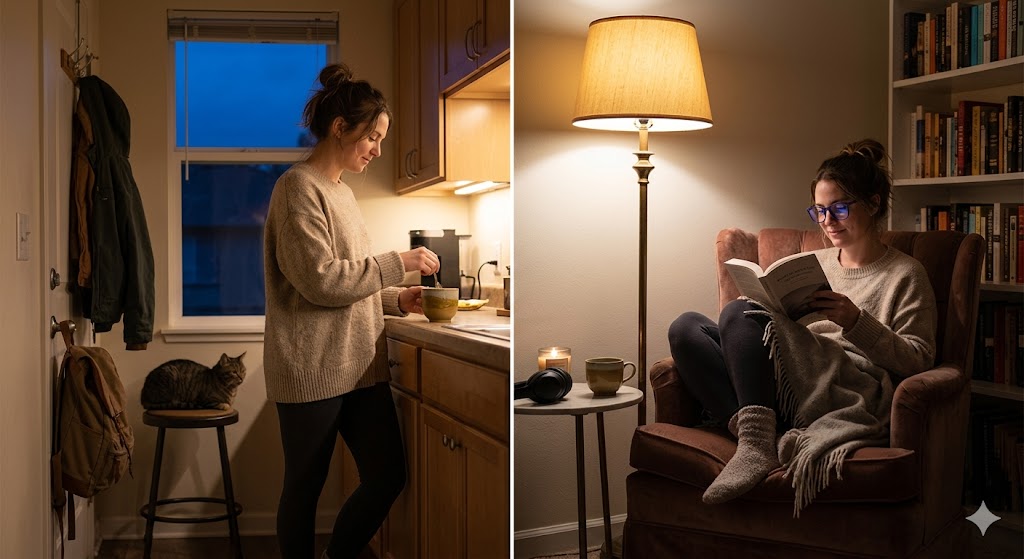
The hardest part of an introvert’s day usually isn’t the day itself — it’s the stretch between “I’m finally home” and “I’m actually ready for bed.” That gap, the whole arc from the last meeting or errand through dinner, downtime, and decompression, is exactly what a good introvert evening routine is built to protect. Most advice about evenings jumps straight to sleep hygiene: dim the lights, put the phone away, read a book. Useful, but it skips the two or three hours before that, when the real recovery work happens. If you’re an introvert who ends most days feeling scraped out rather than settled, the issue probably isn’t your bedtime. It’s everything that happens on the way there.
Why the Evening Transition Matters More Than the Wind-Down
Introverts recharge by turning inward, and that process doesn’t switch on the moment you close your laptop. It has to be built, deliberately, across the whole evening. Think of the hours after work or social obligations end as a runway, not a light switch. You need distance from stimulation before you can actually rest, and that distance takes longer to create than most people assume. An effective introvert evening routine treats the transition — not just the final ten minutes before sleep — as the part that needs the most protection. Skip it, and you end up carrying the day’s noise straight into bed with you, which is why so many introverts report lying awake replaying conversations or feeling wired despite being exhausted.
What an Introvert Evening Routine Actually Looks Like
There’s no single template, but the shape tends to repeat: a clear signal that “work mode” is over, a low-demand period for dinner and basic tasks, a deliberate stretch of solitary or quiet activity, and only then a move toward sleep-specific wind-down. The middle piece — the deliberate solitary stretch — is the part most evening routines skip entirely, and it’s the part that does the actual restoring. It might be forty minutes with a hobby that requires no talking, a walk without a podcast, cooking something slow, or simply sitting without a screen or a task. The point isn’t the activity itself; it’s that it asks nothing of you socially or cognitively. That’s the ingredient that separates a routine that recharges you from one that just fills time until bed.
Building an Introvert Evening Routine Around Your Actual Energy
Energy management, not time management, is the real skill here. A rigid schedule that says “quiet time from 7 to 8” ignores the fact that some days you’ll need that recovery window at 5:30, and other days not until 9. What matters is protecting the window, not pinning it to a specific clock time. Pay attention to your own signals: a short temper, difficulty following conversations, the urge to escape a room. Those are cues that your evening needs to shift toward recovery sooner rather than later. Over time, most introverts learn to read these signals well enough that the routine becomes less about rules and more about responding — which is exactly how it should work. A routine that fights your actual energy levels will get abandoned within a week.
Guarding Against Evening Burnout
Burnout rarely announces itself as a single bad day. It builds from a string of evenings where the transition never happened — where work bled into dinner, dinner bled into more screens, and the day just ran out the clock instead of ending on purpose. If you notice you’re consistently short-tempered, foggy, or dreading the next day by Wednesday, that’s often an evening-routine problem before it’s anything else. The fix isn’t a dramatic overhaul; it’s usually reclaiming even twenty minutes of genuinely unstructured, undemanding time between the end of obligations and the start of sleep prep. Small, consistent protection of that window does more for long-term burnout prevention than an occasional day off ever will.
Adjusting the Routine for Social Evenings
Not every evening is a quiet one, and an introvert evening routine has to flex for that. On nights with dinner plans, family obligations, or events, the recovery window doesn’t disappear — it just moves. That might mean arriving at a gathering having already had ten minutes of quiet in the car, or building in a buffer after you get home instead of before you leave. The goal isn’t to avoid social evenings; it’s to make sure they’re bracketed by enough decompression that you’re not starting the next day still depleted. Introverts who plan for this ahead of time tend to enjoy social evenings more, not less, because they’re not silently counting down the minutes until they can leave.
Questions People Ask About an Introvert Evening Routine
How long should an introvert evening routine be?
There’s no fixed length, but most people notice a real difference with somewhere between thirty minutes and two hours of low-demand time before sleep prep begins. What matters more than duration is consistency — showing up for that window most evenings, even briefly, works better than an occasional long one.
What if my evenings are unpredictable and I can’t stick to a set schedule?
Anchor the routine to a sequence rather than a clock. Instead of “quiet time at 7pm,” try “quiet time right after dinner, whenever that happens.” Sequence-based routines survive schedule chaos far better than time-based ones, and they still give your brain the same clear signal that recovery time has started.
Is it selfish to protect this time from family or roommates?
No — protecting a recovery window usually makes you a better, more present version of yourself for the rest of the evening and the following day. Most people who live with introverts would rather get twenty rested, engaged minutes than two hours of someone who’s running on empty and irritable.
An introvert evening routine isn’t about optimizing every minute after work — it’s about making sure the transition from “on” to “off” actually happens instead of getting skipped. Give that transition real space, adjust it to your actual energy instead of a rigid clock, and protect it even on social evenings, and the payoff shows up in fewer wired nights, less creeping burnout, and mornings that don’t start already behind.