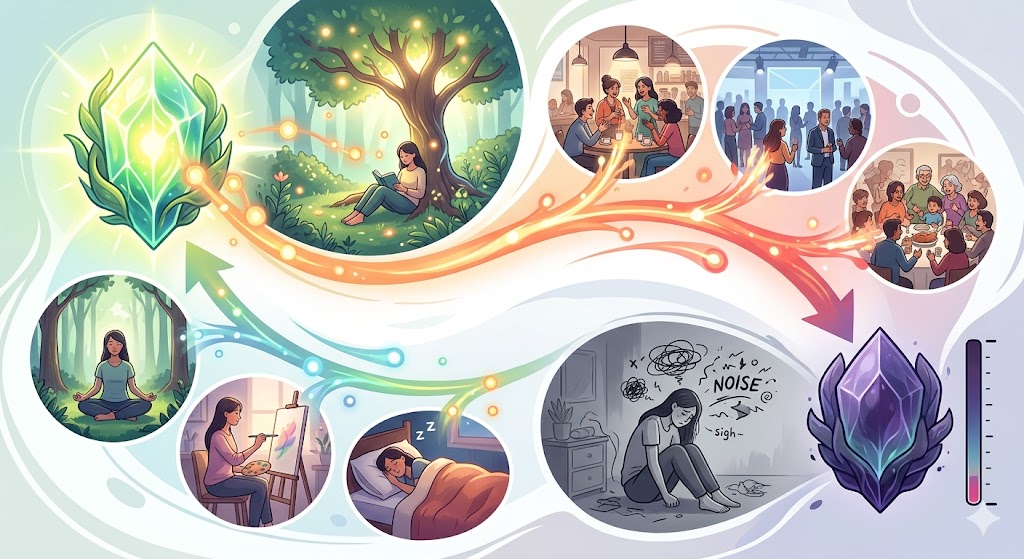
Your social battery is not a metaphor for being shy. It is a real, measurable pattern in how your nervous system responds to people — and for introverts, that response costs energy in a way it simply does not for extroverts. You probably already know this from experience: a full day of meetings leaves you more depleted than a full day of physical work. A birthday dinner with people you love can still leave you needing two hours alone before you feel like yourself again. That is not weakness. That is your biology.
How the Social Battery Works, Mechanically
The social battery concept maps onto something real in neuroscience. Research into personality and arousal suggests that introverts have a naturally higher baseline level of cortical stimulation. Social interaction adds to that stimulation. After a certain threshold, the brain starts working harder to process everything — facial expressions, tone of voice, conversational turns, unspoken dynamics — and that cognitive load is exhausting.
Carl Jung, who first described introversion, framed it as a preference for turning inward to restore energy rather than outward. Modern neuroscience adds detail: introverts appear to rely more on acetylcholine, a neurotransmitter linked to internal reflection and calm focus, while extroverts run more on dopamine, which rewards external stimulation and novelty. This means the same party that energises an extrovert is genuinely working against an introvert’s preferred neurological state.
So when your social battery drains, it is not about disliking people. It is about the difference between environments that align with your nervous system and ones that work against it.
Signs Your Social Battery Is Running Low
The signs are not always dramatic. Social exhaustion in introverts often shows up quietly. You might notice that you stop contributing to a conversation even though you still have thoughts. Your responses get shorter. You start watching the room rather than participating in it.
Physically, it often feels like a low-grade fatigue behind the eyes, a slight heaviness in the chest, or an unusual sensitivity to noise and light. Some people notice they become irritable over small things — someone’s laugh, a question they would normally answer easily. That irritability is not a character flaw. It is a signal that your buffer is full.
It often shows up after the event too. You get home and feel unable to do anything that requires decision-making or conversation. Replying to a text feels disproportionately hard. You might replay the social event on a loop, which is itself a sign your brain is still processing a high-stimulation experience rather than resting.
What Actually Helps You Recharge
Recharging after socialising is not simply about being alone. It is about reducing the specific type of stimulation that drained you. Sitting alone in a noisy café does not restore an introvert. Sitting in a quiet room does — even for 20 minutes.
Physical solitude with low sensory input is the fastest reset. This means dim lighting, reduced sound, no screens demanding social responses. Reading fiction works well because it is a single, controlled stream of input rather than the unpredictable demands of real interaction.
Avoid scheduling anything socially demanding in the first hour after a draining event. That buffer period is not laziness. It is when your nervous system actually processes and settles. Treating it as dead time and filling it with more stimulation — scrolling social media counts — interrupts the recovery and leaves you more depleted going into the next thing.
When you plan social commitments, build in genuine recovery time the following day if possible. One heavily social day followed by a quiet morning makes a measurable difference to how you function the rest of the week. This is not about avoiding life. It is about managing your energy with the same seriousness you would manage your sleep.
When to Get Support
A depleted social battery is normal for introverts. But if social exhaustion has become persistent — lasting days rather than hours, making it hard to work or maintain relationships you value — that crosses into territory worth taking seriously. Chronic social exhaustion can overlap with anxiety, depression, or burnout, all of which respond well to professional support. A therapist who understands introversion can help you distinguish between healthy energy management and something that needs more attention.
A Few Questions Worth Answering
Does how the social battery works change with age?
How the social battery works stays broadly the same, though capacity tends to shrink and recovery to lengthen. Understanding how the social battery works early makes the later adjustment far less alarming.
- What is a social battery, in plain terms?
-
A social battery is the finite capacity you have for real-time interaction before your ability to process it degrades. It is a metaphor for a real limit, not a mood.
- Where does the social battery meaning come from?
-
The social battery meaning that circulates online maps closely onto what researchers describe as differences in cortical arousal and stimulation tolerance. The language is informal; the underlying pattern is measurable.
- Is the social battery introvert idea backed by research?
-
The battery framing is popular rather than technical, but the effect it points at — that equivalent social contact costs introverts more and takes longer to recover from — shows up consistently in studies of arousal and recovery.
- Why does my social battery drain faster with some people than others?
-
High-maintenance relationships, unpredictable conversationalists, and people who require constant emotional attunement are significantly more taxing than calm, reciprocal company. Introvert energy drain is not equal across all interactions. People who talk over you, dominate without listening, or create subtle tension cost far more than those who allow silence and take turns naturally.
- Can introverts increase their social battery over time?
-
Somewhat. Familiarity with people and environments reduces the cognitive load of social interaction, which means regular contact with the same small group is less draining than meeting strangers repeatedly. But the fundamental wiring does not change. You are managing capacity, not rebuilding it from scratch.
- Is social exhaustion the same as introversion?
-
Not exactly. Social exhaustion is something introverts experience more quickly and deeply, but it is a symptom of how the introvert nervous system processes stimulation — not the definition of introversion itself. Introverts can enjoy socialising; they simply pay an energy cost that extroverts do not.
- How do I explain my social battery to people who don’t get it?
-
Keep it practical rather than theoretical. “I need a quiet evening after a busy day” lands better than explaining neurotransmitters. Most people respond well to specifics: what you need, when you need it, and that it is not about them. You do not owe anyone a full explanation.
Your social battery is not something to apologise for or overcome. It is information about how your particular mind works. The more honestly you read it — and act on what it tells you — the less likely you are to end up running on empty and wondering why everything feels harder than it should.