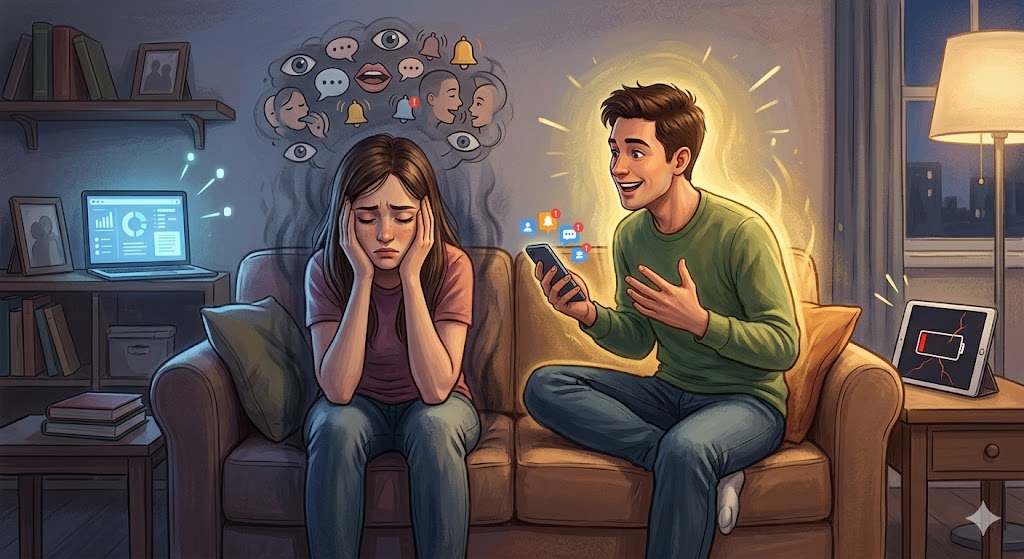
Introvert burnout in relationships is not about loving someone less. It is about running on empty in a dynamic that keeps drawing from the same limited reserve — and not refilling it fast enough.
This kind of burnout is easy to misread. You might mistake it for falling out of love, or feel guilty for needing space from someone you genuinely care about. Neither response helps. What helps is understanding what is actually happening and why your nervous system is signalling distress.
Why Introvert Burnout in Relationships Happens
Introverts process social and emotional stimulation differently. The neurological research points to how introverts tend to be more sensitive to dopamine — the stimulation and reward chemical — and rely more heavily on acetylcholine pathways, which are associated with internal reflection and calm focus. This means social interaction, including intimate conversation and emotional labour, costs more energy for introverts than it does for extroverts.
In a relationship, this cost compounds daily. Even with a partner you love, being consistently present — answering questions, managing conflict, being emotionally available, sharing space — draws on finite reserves. When those reserves are not being replenished through genuine solitude, the deficit builds.
Introvert relationship exhaustion rarely arrives suddenly. It accumulates across weeks or months of not enough alone time, too many unresolved emotional conversations, or a partner whose energy needs are simply higher than yours. The relationship itself may be healthy. But the energy equation is unsustainable.
Signs It Is Burnout, Not a Relationship Problem
You might notice a flatness that is hard to explain. Things that used to feel connective — a long phone call, a weekend away together, sharing a meal — start to feel like tasks. You go through the motions without feeling much.
It often shows up as irritability that seems disproportionate. Small things your partner does start to feel grating in a way that surprises even you. This is not personality incompatibility. It is what happens when your threshold for stimulation has been exceeded and your nervous system is signalling overload.
Social energy depletion in relationships can also look like withdrawal that goes beyond your usual need for space. You stop initiating. You give shorter answers. You find reasons to be in a different room. There is also a specific kind of dread that can settle in — not of the person, but of any interaction that requires you to be fully present and responsive.
If you feel relief when your partner leaves the house, that is worth paying attention to. Relief is information, not a verdict on the relationship.
What Actually Helps
The first thing that helps is naming it accurately. Introvert burnout in relationships is a specific condition with a specific cause. Treating it like a relationship crisis will send you in the wrong direction. Treating it like an energy problem puts you on more solid ground.
Schedule solitude the way you would schedule anything essential. Not as leftover time. Not when your partner happens to be out. A predictable, protected block — even ninety minutes of uninterrupted quiet — begins to restore what prolonged togetherness depletes. You do not need to justify this to anyone.
When you need to exit a social interaction — even one with your partner — do it without excessive explanation. “I need some quiet time” is a complete sentence. Long apologies or justifications cost more energy than the boundary saves.
Renegotiate the texture of shared time. Not all togetherness has to be interactive. Reading in the same room, watching something without discussing every scene, existing in comfortable parallel — these forms of proximity allow connection without the constant draw on your reserves.
Also, look honestly at where the depletion is coming from. If most of your social energy is going to your partner, assess whether external demands — work, family, obligations — are leaving you with nothing left for the relationship itself. Sometimes the burnout is not caused by the relationship, but the relationship is absorbing the cost of everything else.
When to Get Support
If the exhaustion has lasted several months without relief, or if you find yourself fantasising about leaving not because you want to but because it feels like the only way to rest, that is worth talking through with a therapist. Couples counselling is one option, but individual therapy — specifically with someone who understands introversion — can help you separate burnout from deeper dissatisfaction. The two are not the same thing, and conflating them leads to decisions made from depletion rather than clarity.
A Few Questions Worth Answering
- Is introvert burnout in relationships a sign the relationship is wrong for me?
-
Not necessarily. Introvert relationship exhaustion can happen in otherwise healthy relationships, especially when alone time has been chronically insufficient. Burnout distorts perception. Before drawing conclusions about the relationship, address the energy deficit first and see what remains.
- How do I explain introvert exhaustion to an extroverted partner?
-
Be specific rather than abstract. Instead of “I need space,” try “I need two hours alone each evening to feel like myself again.” Concrete numbers and timeframes help extroverted partners understand it as a need, not a rejection.
- Can social energy depletion cause physical symptoms?
-
Yes. Chronic introvert burnout can manifest as disrupted sleep, persistent fatigue, headaches, or reduced immune function. These are stress responses. The body does not separate emotional overload from physical load — they run on the same system.
- What if my partner thinks I am using introversion as an excuse?
-
That is a conversation worth having calmly, once. Share what you know about introvert neurology if it helps. But you do not owe anyone an exhaustive defence of your wiring. Consistent, respectful communication about your needs matters more than winning an argument about whether those needs are valid.
Burnout does not mean the relationship is broken. It means something in the current arrangement is not accounting for how you actually work. That is fixable — but only if you stop treating your energy needs as a problem to apologise for.